Where Three Worlds Meet
When Restoration, Food, and Formation Finally Converge
By Josh Singleton | Founder, serving as Lead Cultivator, The Neighborhood Garden Project
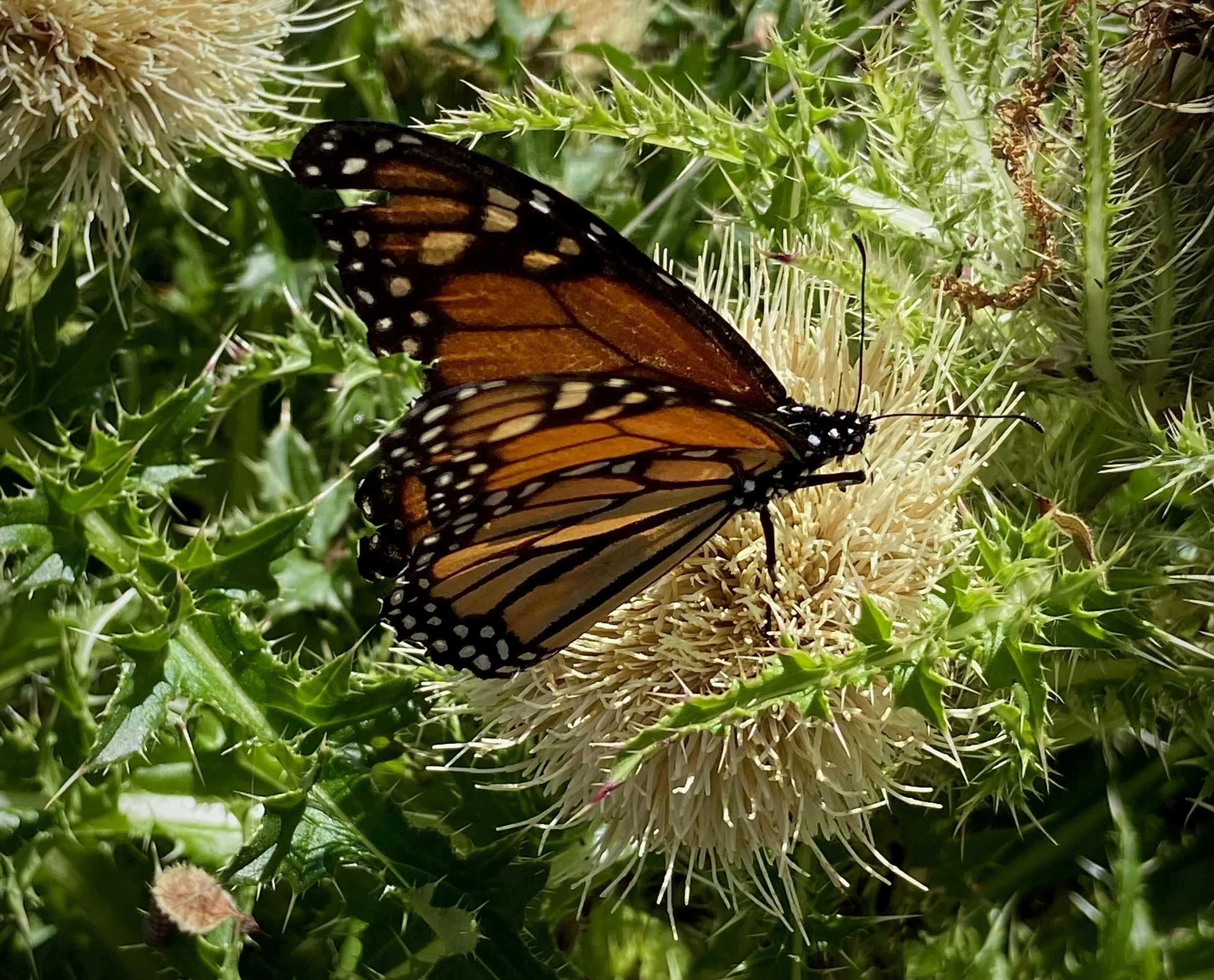
A monarch butterfly landed on a thistle bloom growing along the prairie edge beside the garden.
The thistle was not planted.
The butterfly was not invited.
No one staged the moment.
The plant emerged from the soil after mowing stopped. The butterfly found it while moving across the landscape.
Yet in that small interaction something unusual was happening.
Three worlds that rarely touch were meeting in the same place.
The world of ecological restoration.
The world of food production.
The world of human formation.
Most of the time these worlds operate independently.
Ecologists restore native landscapes in preserves far removed from agriculture.
Farmers focus on crop production, often clearing wild habitat in order to grow food efficiently.
Human formation usually happens in classrooms, institutions, or programs that are disconnected from the land itself.
Three different conversations.
Three different cultures.
Three different worlds.
Rarely intersecting.
But in the garden something unexpected is happening.
Those worlds are beginning to converge.
The Mindset I Started With
For most of my life I lived squarely inside the world of food production.
Land existed to grow crops.
Beds were planted with vegetables. Space was organized carefully. Anything that did not contribute directly to food production often felt unnecessary.
Years ago I was working on a farm in Richmond when a co-worker said something that stopped me in my tracks.
She said,
"We should plant a hedgerow of flowers along the edge of the crops."
Flowers.
The idea genuinely shook me.
Not because flowers are bad.
But because the thought had never crossed my mind.
Even knowing that pollinators were important, it had simply never occurred to me to grow life alongside life.
Why plant flowers where we could grow food?
Looking back now, I realize I was seeing the land through only one lens.
Production.
That single sentence began opening a door I did not know existed.
Layer One - Ecological Restoration
Two years ago the mower stopped along the prairie edge beside the garden.
For years that ground had been cut into uniform grass. When mowing stopped, plants began appearing that no one intentionally planted.
The first year looked uncertain.
Small pioneer plants rose quickly. Opportunistic species filled the space where the mower had once passed every week.
But this is how restoration begins.
Seeds that have been resting in the soil begin responding to light and open space. Some of those seeds may have been waiting underground for many years.
Now in the second year patterns are beginning to appear.
Lyreleaf sage blooms in early spring.
Wood sorrel spreads across the soil.
Dewberries stretch their runners through the grasses.
And then the thistle rises.
Many people see thistle and assume something is wrong.
But thistle is often one of the first signals that a prairie system is waking up.
Its deep roots loosen compacted soil.
Its blooms feed butterflies and native bees.
Its seeds later feed birds.
What appears chaotic is actually succession.
The land is remembering itself.
Normally this kind of restoration work happens far away from agriculture.
Prairies are restored in protected preserves.
Food is grown on farms.
The two worlds rarely meet.
Layer Two - Food Growing from Living Soil
Just beyond the prairie edge sit the raised beds of the vegetable garden.
Here the planting is intentional.
Tomatoes, greens, herbs, and root crops grow in soil enriched with compost and organic matter.
But over time the purpose of the garden began shifting.
The focus moved away from simple production and toward cultivating living soil.
Healthy soil is not inert material.
It is alive.
Fungi connect plant roots beneath the surface.
Bacteria cycle nutrients through the soil.
Earthworms open channels for air and water.
Roots release sugars that feed microbial life.
Microbial life returns nutrients back to the plants.
The soil becomes darker, softer, and more biologically active over time.
And something unexpected begins happening.
The prairie begins supporting the garden.
Pollinators drawn to prairie flowers begin visiting vegetable blossoms.
Two beehives now sit tucked into the back of the property.
The bees move constantly between prairie flowers and cultivated crops, gathering nectar from thistle, vervain, and other wild blooms before returning to the garden.
The prairie feeds the bees.
The bees pollinate the garden.
The garden produces food from living soil.
Wild and cultivated systems begin supporting each other.
That hedgerow of flowers I once questioned now makes perfect sense.
Layer Three - The Formation of People
There is a third world that usually operates somewhere else entirely.
The formation of people.
Human development typically takes place in classrooms, conferences, programs, or institutions.
But something different happens when people spend time working inside a living landscape.
The garden begins shaping the people who participate in it.
Seeds require patience.
Soil requires attention.
Seasons refuse to accelerate.
At first people try to control the system.
But slowly the garden teaches a different posture.
Observation replaces urgency.
Control begins loosening.
A new posture begins to emerge.
Attentive restraint.
Attentive restraint means paying attention without rushing to dominate what is unfolding.
The gardener watches the soil.
The gardener notices patterns.
The gardener allows the system time to respond.
In a culture driven by speed and control, restraint becomes an act of trust.
Trust that life was already written into the soil.
A Pattern Older Than the Garden
Over time another realization begins to surface.
This convergence of land, food, and human formation is not new.
It echoes the pattern found in the opening pages of Genesis.
In that story, God forms humanity from the dust of the ground and breathes life into it.
He then places humanity in a garden.
The garden contains wild creation, cultivated plants, and human stewardship.
Land.
Food.
People.
Ecology.
Cultivation.
Formation.
The original garden was never just about plants.
It was an environment where these layers of life were meant to function together.
For much of modern history those layers have been separated.
But occasionally a place emerges where they begin reconnecting again.
When the Three Worlds Converge
That monarch butterfly landing on the thistle is more than a beautiful moment.
It is a glimpse of what happens when these worlds finally meet.
Prairie restoration.
Food cultivation.
Human formation.
Butterflies feed on flowers rising from restored soil.
Bees move between prairie blooms and vegetable crops.
Food grows in living beds beside returning native plants.
People working in the garden begin rediscovering patience, humility, and attention.
Three worlds that normally live apart begin functioning together.
Life supporting life.
The Fourth Layer
When these three layers begin operating together, something else quietly appears.
Belonging.
People who spend time in the garden begin realizing they are not separate from the system.
They are part of it.
They see butterflies landing on plants that no one planted.
They see bees moving between prairie flowers and vegetables.
They see food growing from living soil.
And slowly they begin recognizing something deeper.
They belong inside the living world.
Heaven Touching Earth
The biblical story begins with soil.
God forms humanity from the dust of the ground and breathes life into it.
Spirit from heaven enters earth.
Life begins where those two meet.
The garden quietly reflects that same pattern.
Two years after mowing stopped, the prairie is waking up.
Butterflies land on flowers that no one planted.
Bees move between wildflowers and vegetables.
Food grows from living soil.
People working the land begin rediscovering rhythms older than the culture surrounding them.
The garden becomes more than a place to grow vegetables.
It becomes a place where heaven touches earth.
Not through force.
Not through control.
But through the quiet practice of attentive restraint.
And sometimes it begins with something as simple as a sentence spoken years ago on a farm in Richmond.
"We should plant a hedgerow of flowers along the edge of the crops."
At the time it seemed unnecessary.
Now it feels like the beginning of everything.