The Middle Ground
Why the garden thrives between neglect and control
By Josh Singleton | Founder, serving as Lead Cultivator, The Neighborhood Garden Project
One of the quiet things a garden reveals is that life does not flourish at the extremes.
On one side is wilderness.
On the other side is control.
Wilderness leaves everything alone. Nature moves forward without restraint. Some species dominate, others disappear, and the strongest forces shape the landscape.
Control moves in the opposite direction. Every imbalance must be corrected immediately. Every insect is treated as a threat. Every irregularity becomes a problem to solve. Chemicals, sprays, and constant intervention attempt to force the system into a state of permanent perfection.
Both approaches miss something essential.
Both remove the human being from their rightful role.
Wilderness removes responsibility.
Control replaces stewardship with domination.
A garden lives somewhere else.
A garden lives in the middle ground.
And that middle ground is where cultivation begins.
A Place to Participate Again
At The Neighborhood Garden Project, we hold that middle ground intentionally.
The purpose of the garden is often misunderstood. From the outside it may appear to be about growing food. Food certainly grows here. Vegetables are planted, roots develop beneath the soil, and harvests happen throughout the season.
But food is not the primary work of the garden.
The deeper work is cultivation.
The garden exists as a place where anyone who feels drawn to participate can step back into something humanity has always known but largely forgotten.
Responsibility.
Responsibility is not a burden in the garden. It is a gift.
It restores something inside a person that modern environments often take away. When someone tends a small piece of living ground, even a single raised bed, they begin to rediscover their place inside creation.
They are no longer a spectator.
They become a participant.
And participation restores identity.
But that restoration only happens when the environment is held in the middle ground.
If every imbalance is immediately corrected by a central authority, people never actually learn how life works. They become consumers of a managed space rather than cultivators within it.
If everything is left to wilderness, the system eventually becomes inaccessible to most people.
The garden must remain somewhere in between.
That is where stewardship lives.
At The Neighborhood Garden Project, we intentionally carry margin so the garden can remain in that middle ground.
We are not driven by production quotas.
We are not operating under harvest targets.
We are not trying to maximize yield at every moment.
In fact, we have no intention of trying to feed the world or measuring how much we can extract from the soil.
That way of thinking quietly turns the garden into a machine. The soil becomes a resource to mine, the plants become units of production, and success becomes a matter of how much can be taken from the ground in a season.
But extraction has never been the purpose of this place.
Food certainly grows here, but the deeper work of the garden is the cultivation of people. And that work requires margin.
Because we carry margin, we are not forced to react to every imbalance the moment it appears.
Instead, we practice something that has become rare in modern culture.
Attentive restraint.
Attentive restraint means we are paying attention without rushing to control.
We observe.
We notice patterns.
We give the living system time to respond.
That posture allows the garden to begin correcting itself in ways that would be impossible in an environment driven by constant intervention.
In a culture that constantly asks how much can be taken, the garden quietly teaches another way.
Sometimes, the most faithful work of cultivation is not extracting more from the soil.
It is creating enough margin to allow life to respond as it was designed to.
And when that margin exists, both the garden and the people within it begin to change.
Watching the Garden Correct Itself
A simple example shows up almost every year.
Aphids appear.
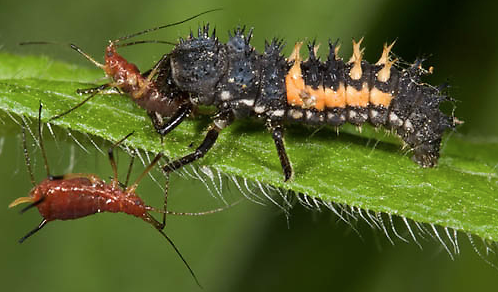
They gather on tender stems and new growth, small clusters of soft-bodied insects feeding on the plant. The instinct in most cultivated environments is immediate elimination. Spray them. Wash them away. Remove the problem before it spreads.
But in the garden, we often wait.
If the aphids are contained within a single plot, we observe first.
Because something else is usually already on the way.
Ladybug larvae.
Most people recognize the adult ladybug, the small red beetle with black spots that has become a symbol of a “good bug.” But the larval stage looks completely different. It resembles a tiny armored creature moving slowly along the stems.
And it is a predator.
Ladybug larvae feed aggressively on aphids. One larva can consume dozens in a single day.
If we intervene too quickly, we interrupt a system that is already responding.
So sometimes we allow the tension to remain.
Aphids feed.
Ladybug larvae arrive.
Balance slowly returns.
This does not mean we never intervene. Stewardship still requires discernment. If a plant is being overwhelmed or the imbalance spreads beyond a manageable point, action becomes necessary.
But often the garden is already correcting itself.
The margin allows us to see it.
What Attentive Restraint Teaches Us
Practicing this kind of restraint does something deeper than teach people how ecosystems function.
It begins loosening something inside the human heart.
We live in a culture formed by control, anxiety, fear, and competition. The moment something feels uncertain, our instinct is to tighten our grip and force a solution.
The garden introduces another way of living.
As people practice attentive restraint in the soil, they begin to recognize that not every tension requires immediate correction.
Sometimes balance is already forming beneath the surface.
Sometimes life is responding in ways we cannot yet see.
This realization begins to shift how people approach their own lives.
The same Creator who designed the soil, the insects, the plants, and the seasons also designed the human being.
The systems of life that existed long before we arrived were not built without intelligence or intention.
And when we step into the real work of cultivation, something remarkable happens.
We begin to discover that we are not carrying the responsibility alone.
The Work of the Cultivator
Cultivation is not about control.
It is about participation with a living system that already exists.
The cultivator pays attention.
The cultivator protects what is vulnerable.
The cultivator intervenes when necessary.
But the cultivator also trusts the deeper intelligence woven into creation itself.
At The Neighborhood Garden Project, this posture allows the garden to become something more than a place where plants grow.
It becomes a place where people remember who they are.
They remember that life is not meant to be lived in constant control.
They remember that responsibility is not something to avoid, but something that restores dignity.
They remember that participation with living systems brings a kind of peace that cannot be manufactured.
The garden quietly teaches all of this without lectures or programs.
It simply invites people to step into the middle ground.
And once someone begins living there, something changes.
They begin to cultivate the soil.
And at the same time, the soil begins cultivating them.