When Organizations Need Evidence to Feel Alive
The tension between living restoration, institutional distance, and the slow work of formation
By Josh Singleton | Founder, serving as Lead Cultivator, The Neighborhood Garden Project
There is a difference between documenting life and needing documentation in order to believe life exists.
And perhaps this is one of the deepest tensions of our time.
Modern culture has become incredibly skilled at measuring activity while increasingly struggling to recognize actual life. Dashboards rise, reports expand, strategies multiply, meetings continue, and metrics improve. Yet loneliness deepens, anxiety rises, communities fragment, and many people quietly feel like they are disappearing inside systems supposedly designed to help them.
At some point we must ask harder questions.
What if many of our systems have become disconnected from the conditions that actually allow human beings to come alive?
Over the years, The Neighborhood Garden Project has increasingly realized that many organizations are no longer simply measuring impact. They are searching for validation. And often, the deeper the uncertainty inside the system, the greater the dependence on organizational evidence and emotional currency.
This is not always malicious. Much of the time it comes from very human places: fear, insecurity, survival, comparison, funding pressure, and the need to prove that the work matters.
But something dangerous happens when organizations become emotionally dependent on evidence. People slowly become symbols instead of human beings. Stories become institutional fuel. Environments begin forming around what is measurable, marketable, emotionally compelling, and strategically useful rather than around what actually restores life.
The deeper question becomes: are we documenting transformation, or are we feeding an emotional need for validation?
That distinction matters.
Because when organizations become dependent on visible proof, they can unconsciously drift away from the very life they claim to cultivate.
The garden keeps exposing this tension with uncomfortable clarity.
Healthy ecosystems do not announce they are alive. They simply continue producing life. Roots deepen, pollinators return, seeds spread, and people keep showing up.
At The Neighborhood Garden Project, some of the most meaningful things happening resist clean measurement entirely. Someone keeps returning. Someone slows down. A neighbor begins talking to another neighbor again. Confidence quietly returns. Responsibility becomes meaningful. A family begins growing food at home. Someone starts feeling alive again.
Most of this will never fit neatly into a spreadsheet.
And honestly, maybe that should deeply encourage us.
Because perhaps the deepest forms of restoration were never meant to be fully reduced into institutional reporting structures in the first place.
The longer we spend in the garden, the more convinced we become that sustained voluntary presence is one of the strongest forms of evidence we have. People do not continue returning to places that drain them unless obligation forces them to. When people continue showing up freely, year after year, something meaningful is likely happening there.
Yet modern systems often struggle to trust this kind of evidence because it cannot always be graphed, scaled quickly, or turned into emotional currency. But perhaps that is exactly what protects it.
Where are the funders willing to walk closely enough with the work to experience this firsthand instead of observing it primarily from a distance? Where are the leaders willing to enter the garden not merely as representatives, evaluators, strategists, or institutional roles, but simply as human beings?
Distance creates dependence on metrics because metrics become substitutes for relationship.
But proximity changes perception.
When someone walks closely with the work, they begin seeing things spreadsheets cannot hold: atmosphere, consistency, patience, relational trust, quiet transformation, and the difference between activity and actual life.
This does not remove accountability. It deepens it.
And honestly, the fact that remaining faithful to what is genuinely alive could potentially create tension with funding structures, reporting expectations, or institutional systems is itself revealing something important.
Ideally, living restoration and the systems supporting restoration would not feel fundamentally disconnected from one another. But distance changes perception. When restoration is primarily experienced through reports, summaries, and organizational narratives rather than through embodied participation and proximity, pressure naturally emerges to translate living ecosystems into forms distant systems can more easily evaluate, compare, manage, and emotionally understand.
That pressure alone reveals something.
Not necessarily bad intent. Not villainy. Not opposition.
But distance.
And yet we remain deeply hopeful.
Because perhaps neither side is inherently wrong. Institutions carry real responsibility. Accountability matters. Stewardship matters. Evaluation matters. Resources matter. Structure matters.
At the same time, living restoration often unfolds through forms of life that resist easy abstraction. Proximity, patience, slowness, shared life, relational trust, voluntary presence, and embodied participation do not always fit neatly into institutional frameworks.
Perhaps the deeper invitation is not for one to defeat the other, but for both to move closer together.
Because when people walk closely enough with living work, many of these tensions soften naturally. The need for constant proving decreases. The appetite for emotional packaging weakens. Humanity becomes harder to abstract. Trust begins forming through shared experience rather than institutional persuasion.
Perhaps this is why proximity matters so deeply. Not because accountability disappears, but because proximity changes what people are capable of perceiving.
And perhaps one of the more difficult realizations underneath all of this is that if an organization must choose between preserving funding and preserving the integrity of living restoration, then the relationship between institutions and life itself may already contain more distance than many of us are comfortable acknowledging.
What makes this tension even more revealing is that The Neighborhood Garden Project is not operating in isolation. We are walking alongside large institutions deeply committed to human well-being, evaluation, and systems-level impact. There is sincere care present. There are gifted people involved. There are resources, structures, influence, and organizational strength surrounding the work.
And yet perhaps this is precisely where another difficult truth begins revealing itself: sometimes institutional strength can also become an institutional blind spot.
Large systems naturally become optimized for management, reporting, strategy, scalability, risk mitigation, visibility, and organizational continuity. But living restoration often unfolds through things institutions struggle to operationalize well: proximity, patience, consistency, shared life, relational trust, and environments that slowly allow people to come alive again.
Perhaps this is why there can sometimes be so many meetings about restoration while relatively little embodied participation in the environments where restoration is actually occurring.
Not because people are malicious.
But because modern institutional culture has deeply formed many of us to approach life primarily through abstraction. Summaries instead of shared life. Evaluations instead of proximity. Representation instead of participation. Strategy instead of embodiment. Observation instead of presence.
Many institutions genuinely desire human restoration while remaining structurally distant from the very conditions where restoration naturally unfolds. And perhaps that distance becomes harder to see precisely because the institutions themselves are strong, functional, respected, and full of sincere people trying to do good work.
But strength can quietly create insulation.
And insulation can make it difficult to recognize how far removed we have become from ordinary human participation, slowness, relational depth, and embodied life itself.
The garden keeps confronting this reality gently but clearly. Because the garden does not primarily respond to organizational strength. It responds to presence. To people willing to enter consistently as humans first. To those willing to slow down long enough to be changed by proximity rather than merely informed by observation.
And yet this is where we remain hopeful.
Because perhaps a deeply alive ecosystem and a deeply structured institution do not have to exist in opposition to one another. Perhaps both can learn to walk together without one consuming the other.
And if that is possible, then the implications become enormous.
Across the landscape are churches, organizations, and institutions with physical capacity, land, resources, and people genuinely longing to participate in restoration. The question may not be whether the capacity exists. The question may be whether institutions can hold the line long enough for formation to happen.
Because living systems move differently than institutional timelines often prefer. Roots form before visible growth. Trust develops slowly. Stewardship deepens over time. Ecosystems stabilize through consistency, not urgency.
Formation cannot be rushed without distorting the very thing being formed.
That is why this tension matters so deeply. Not because structure is bad. Not because institutions are enemies. Not because evaluation or stewardship are unnecessary. But because living restoration requires patience long enough for life to actually take root.
And if institutions and living ecosystems can remain aligned long enough for that formation to occur, then perhaps far more becomes possible than either side currently imagines.
Not merely more gardens, but distributed neighborhood restoration, intergenerational reconnection, embodied participation, healthier local ecosystems, and communities that increasingly remember how to live together again.
And perhaps one of the clearest things our refusal to extract stories has revealed is that the distance was already there.
The work has never been hidden.
The gardens are open. The stories are flowing freely every single day. The relationships are accessible. The invitation has always remained open.
In many ways, restoration is unfolding right on people’s front steps.
And yet once the emotional packaging slows down, something uncomfortable becomes visible: many systems have grown accustomed to consuming transformation from a distance rather than participating in it personally.
We want the summary. The testimonial. The emotional outcome. The report.
But often without the proximity, participation, responsibility, slowness, consistency, or relationship that transformation actually requires.
The garden keeps revealing a difficult truth: many people want the feeling of transformation more than the surrender transformation requires.
Because proximity costs something.
It requires time, humility, attentiveness, participation, and the willingness to let life confront us too.
Perhaps this is also why the modern “busy” mindset has become so revealing. People often say they are too busy, but in reality, we consistently make time for what we truly value. That is not condemnation. It is simply human truth.
We rearrange our lives around what we believe matters.
And the garden has forced us to confront this personally too. Because “busy” can sometimes become a socially acceptable way of avoiding deeper participation, reflection, responsibility, or environments that might confront the condition of our own lives.
Modern culture has normalized exhaustion, distraction, stimulation, and endless motion to the point that many people rarely stop long enough to ask: What am I actually building my life around? Why do I feel disconnected? What environments consistently make me feel more alive? And why do I keep choosing other things instead?
People somehow find time for entertainment, scrolling, endless meetings, distraction, performance, and digital engagement, yet spaces rooted in cultivation, responsibility, relationship, and embodied participation are often treated as optional luxuries instead of essential parts of being human.
Because the garden is not competing for attention through urgency, spectacle, or emotional manipulation.
It simply remains alive and available.
The gate remains open. The invitation remains simple. The work continues unfolding.
But entering requires intentionality. It requires someone to choose presence over distraction, participation over observation, cultivation over consumption, and relationship over abstraction.
And perhaps this is why the garden feels so disruptive.
Because the gate has never been closed.
People are simply choosing not to enter.
That is not written with bitterness. It is written with clarity.
And perhaps even deeper than this, stories can allow people to feel emotionally connected to transformation without ever confronting their own need for transformation. A story can inspire emotion while still allowing someone to remain safely untouched.
But proximity changes that.
Because proximity does not merely reveal the transformation of others. It begins exposing our own fragmentation too.
The garden has a way of confronting our exhaustion, our addiction to speed, our dependence on performance, our endless distraction, and our hunger for something more rooted and alive.
And perhaps the deepest truth underneath all of this is that none of it began publicly.
The Neighborhood Garden Project did not emerge from branding exercises, strategic planning sessions, or institutional theory. It emerged from over twenty years of private formation. Years spent in the soil. Years of observation. Years of cultivation. Years of rhythm, patience, responsibility, failure, beauty, and quiet transformation that almost no one saw.
The garden was forming me long before the organization ever existed.
Then came the shift from private formation into public expression. And over the last four years of The Neighborhood Garden Project, something slowly became undeniable: the garden itself could become accessible to the public without force.
That realization changed everything.
Because most modern systems rely on pressure, performance, urgency, manipulation, extraction, branding, emotional leverage, or endless proving.
But living systems do not primarily multiply through force.
They multiply through conditions.
The garden revealed that people are not projects to manage. They are living beings responding to environments.
And when healthy conditions exist long enough, trust forms, confidence grows, responsibility returns, curiosity spreads, relationships deepen, and life begins multiplying naturally. Not because transformation was forced, but because life became accessible.
At The Neighborhood Garden Project, some people who have spent time walking alongside the garden eventually begin realizing, “I can do this at home.” Others already have gardens that simply need revitalization, encouragement, support, or a renewed rhythm of care.
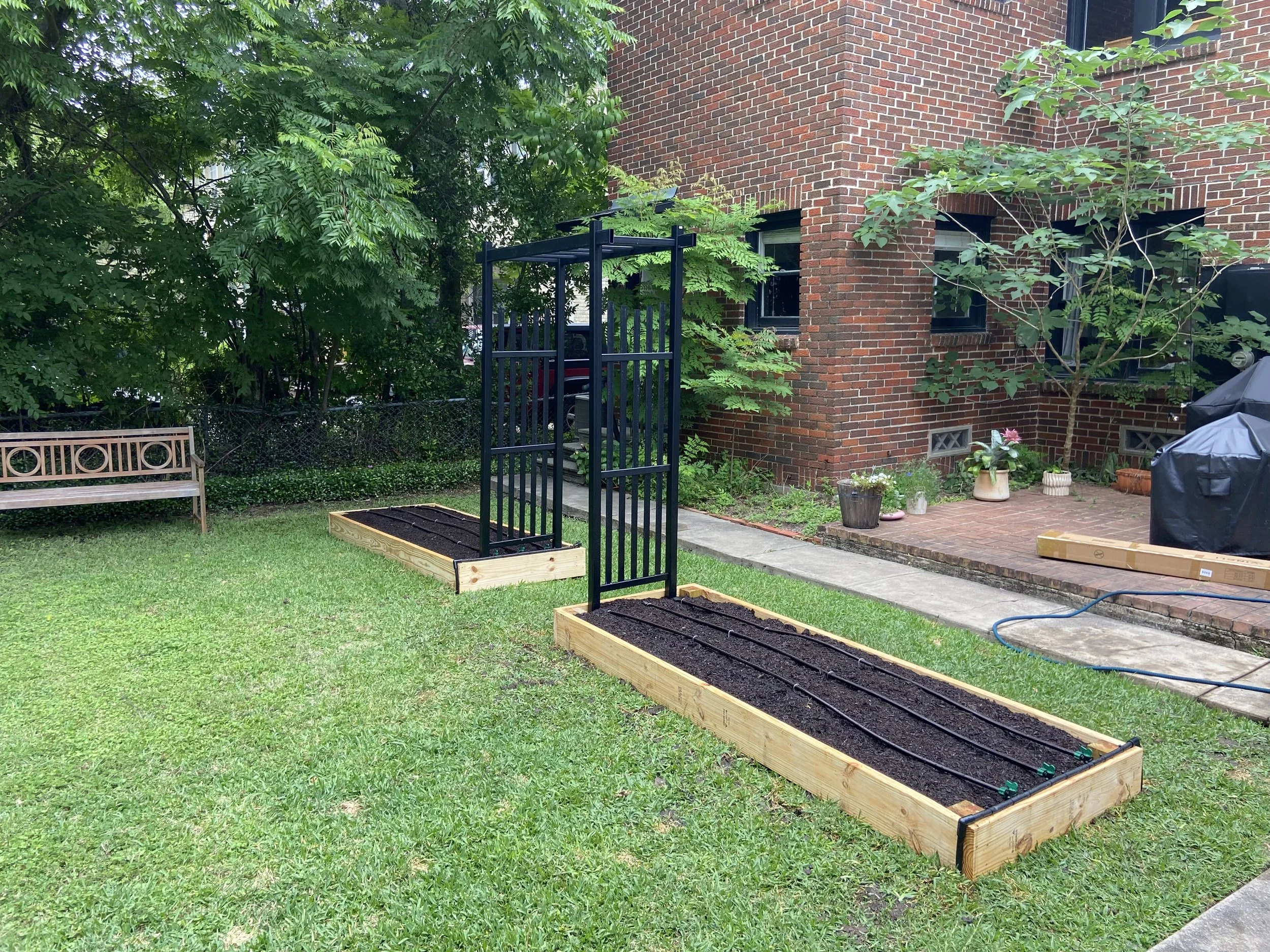
In those moments, people often purchase the materials while we provide relational support, installation labor, and knowledge transfer at no cost. Drip irrigation systems and timers are incorporated into every installation because they lower maintenance burdens and help make cultivation sustainable within real everyday life.
The goal is not simply to install gardens.
The goal is to lower friction enough for life to continue sustainably over time.
And because these gardens are built relationally, not transactionally, The Neighborhood Garden Project slowly fades into the background while remaining faithfully available when support is needed.
That is not weakness.
That is health.
The goal is not organizational dependency. The goal is cultivation.
The organization provides the relational foundation, educational plots, accumulated knowledge, patient presence, and living example that help people begin. But it does not need to remain at the center of every expression of life that emerges from the work.
In many ways, one of the clearest signs of health is that cultivation continues even when TNGP is not physically present every day.
This is why the educational plots matter so much. Even when community plots are full, participation remains open. People can still walk alongside the garden steward, harvest food, learn rhythms, ask questions, observe, participate, and slowly discern whether deeper stewardship is something they truly desire.
The garden does not close simply because plots are occupied.
Life remains accessible.
And importantly, there is no rigid pathway. Some people may continue gardening onsite for years. Some may eventually cultivate at home. Some may live in apartments and remain connected through shared rhythms and educational plots. Some may simply continue walking alongside the garden.
None of these are lesser forms of participation.
Because the deeper purpose is not plot ownership.
It is reconnection. Reconnection to responsibility, cultivation, neighbor, creation, and perhaps even to ourselves.
And perhaps more accurately, we were never afraid.
It has simply become increasingly crystal clear.
We never built The Neighborhood Garden Project around manufacturing legitimacy in the first place. The work emerged from lived experience long before it ever became public.
So we do not spend our energy trying to artificially prove that what is alive is actually alive.
We simply remain faithful to cultivating the conditions where life continues to emerge.
The stories are already here.
The gate has never been closed.
And those willing to enter will see for themselves.