The Wealth of the Garden
The unseen wealth released when a community tends soil together
By Josh Singleton | Founder, serving as Lead Cultivator, The Neighborhood Garden Project
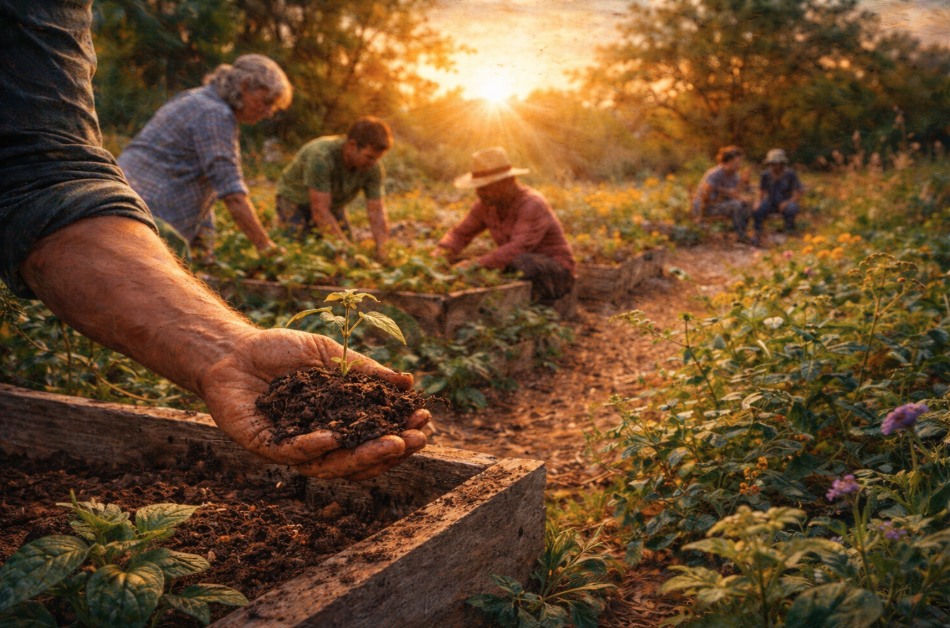
If the human body is a physical well of wealth, the garden is where that wealth is activated, multiplied, and made visible. Not through programming. Not through pressure. But through proximity to life that grows according to a wiser rhythm than our systems usually allow.
A garden is not simply land producing food. It is a living center that reorganizes how people relate to themselves, to one another, and to the place they inhabit. When a community gathers around a garden, something fundamental begins to change. Not all at once. But deeply. And permanently.
This is the wealth of the garden.
Spiritual Wealth: Reorientation Toward Trust
Spiritually, the garden does not teach ideas. It trains attention.
This distinction matters. Ideas can be debated, defended, and ignored. Attention cannot. Attention reshapes posture before it ever reshapes belief. The garden works at this deeper level, not by convincing the mind, but by reorienting the whole person toward how life actually unfolds.
Soil insists on patience. Seeds refuse to hurry. Weather cannot be negotiated. These realities quietly confront the illusion of control that governs much of modern life. In the garden, outcomes are not forced. They are awaited. This waiting is not passive. It is active attentiveness. Watching moisture. Reading leaves. Noticing timing. Learning when to act and when to refrain.
When people return to the garden week after week, their internal posture begins to change. At first, many arrive with the habits they have been trained into, urgency, efficiency, anxiety about results. Over time, those habits loosen. People stop trying to manage outcomes and begin learning how to tend conditions. This shift is subtle, but profound. Responsibility remains, but control dissolves.
The garden restores spiritual alignment by returning people to dependence without shame. In a culture that equates dependence with weakness, the garden reveals dependence as reality. Plants depend on soil. Soil depends on cover. Life depends on timing. No one in the garden grows anything alone, and no one is diminished by that fact. Dependence here is honest, shared, and dignified.
It teaches trust through observable growth. Faith is no longer an abstract idea or an internal sentiment. It becomes something you can see, touch, and return to. A seed planted in trust becomes a sprout. A bed rested in faith becomes fertile again. Growth does not happen because someone believed hard enough. It happens because life was given what it needed and allowed to respond in its own time.
The garden allows faith to become participatory rather than abstract. People are not asked to agree with doctrines before they belong. They are invited to take part in life that is already unfolding. Participation precedes understanding. Trust is formed through shared tending, not through explanation.
Prayer becomes embodied here. Not always spoken, often unannounced. It shows up in the act of watering slowly. In covering soil before rest. In choosing to wait one more week before harvesting. Prayer takes the shape of cooperation. Discernment sharpens not because answers are handed down, but because the noise of urgency fades. When urgency quiets, clarity emerges.
People begin to sense timing again. They learn that not everything ripe is ready, and not everything unseen is inactive. They recognize that unseen work is still work. That roots grow before fruit appears. That rest is not abandonment, but preparation. That growth continues even when no one is watching or measuring.
Spiritually, the garden gives people permission to stop forcing life and start cooperating with it. This permission is deeply relieving. It releases people from the pressure to prove their faith through productivity or certainty. It restores trust that life, when tended faithfully, will respond.
The garden does not demand belief.
It invites alignment.
And in that alignment, people rediscover a faith that feels less like effort and more like agreement with the way life was always meant to grow.
Emotional Wealth: Regulation Through Belonging
Emotionally, the garden functions as a regulating environment.
This is not accidental. Human nervous systems are designed to settle in the presence of living things that are not demanding anything in return. Plants do not evaluate us. Soil does not require explanation. Growth does not rush us. When people enter the garden, their bodies receive cues of safety before their minds ever catch up.
The repetitive tasks of watering, planting, mulching, and harvesting gently return the body to rhythm. These movements are predictable, purposeful, and grounded. They invite steadiness rather than stimulation. In a culture that keeps people perpetually activated, the garden offers a rare opportunity to downshift without being told to calm down.
There is no urgency here to perform vulnerability. No expectation to narrate one’s pain. No pressure to be emotionally articulate in order to belong. People are not required to share their story in order to be welcomed. Belonging emerges through shared presence rather than shared disclosure.
This is a critical distinction.
The garden produces emotional wealth by offering safety without scrutiny. People are seen, but not watched. Noticed, but not examined. This kind of safety allows the nervous system to release its guard naturally. Trust forms not because someone promised confidentiality, but because nothing was demanded in the first place.
It allows people to arrive as they are and return as often as needed. There is no threshold of readiness. No expectation of progress. People can come fragmented and leave quiet. They can return the next week unchanged and still be welcomed. Over time, this freedom to return without pressure becomes deeply healing.
The garden also creates connection through side by side work rather than face to face pressure. Working alongside someone removes the intensity that often accompanies direct conversation. Silence is permitted. Words come when they are ready. Relationship forms through shared effort, not forced intimacy.
As people regulate, subtle changes begin to appear. They listen more carefully. They interrupt less. They react with more curiosity and less defense. They stay longer because their bodies are no longer scanning for threat or evaluation. Conflict softens because trust is no longer theoretical. It has been built slowly, through repeated, ordinary moments with hands in the same soil.
This kind of emotional wealth compounds quietly.
People who once felt overwhelmed begin to feel capable again, not because their circumstances changed, but because their nervous systems regained capacity. People who felt invisible begin to be seen, not through spotlight or affirmation, but through steady inclusion. They are noticed because they are present, not because they asked to be.
The garden does not try to fix emotions.
It creates conditions where regulation becomes possible.
In doing so, it restores people to themselves and to one another, without force, without diagnosis, and without demand.
Physical Wealth: Capability, Strength, and Nourishment
Physically, the garden restores right relationship with the body.
Most people arrive carrying a quiet mistrust of their own physical capacity. Their bodies have been framed either as something to discipline, optimize, or push through, or as something fragile to be protected from effort. The garden offers a different relationship altogether. Here, the body is not a problem to solve. It is a partner in meaningful work.
Movement in the garden is purposeful, not performative. There is no audience and no scorecard. Lifting, bending, digging, carrying, and kneeling all have clear reason and immediate feedback. Strength develops because it is needed, not because it is measured. The body responds differently to this kind of work. It recognizes usefulness.
Over time, people begin to trust their physical capacity again because effort is met with real outcomes. A bed gets planted. A trellis stands upright. A harvest comes in. The feedback loop is honest and grounding. You can see what your body contributed, and that visibility rebuilds confidence without comparison.
The garden produces physical wealth by building functional strength slowly and sustainably. Muscles adapt through varied, moderate movement rather than repetitive strain. Endurance grows without depletion because work is shared and paced by seasons rather than deadlines. This kind of strength does not peak and crash. It settles in.
It also produces food that carries story, dignity, and origin. People know where it came from. They know the weather it endured. They remember the hands that planted it. Food stops being abstract fuel and becomes the result of relationship. Nourishment becomes layered with meaning.
Confidence grows here, not from appearance, but from contribution. Bodies are valued for what they can participate in, not how they look while doing it. This shift is deeply stabilizing. People stop relating to their bodies as objects to control and start relating to them as instruments of care.
When people harvest food they helped grow, eating changes meaning. Meals slow down. Gratitude deepens because effort is remembered. Waste decreases because value is felt. The body is no longer something to manage or optimize. It becomes something to listen to and partner with.
This physical wealth does not burn people out because it does not ask the body to perform beyond its design. It stabilizes people by reconnecting them to honest effort, shared labor, and tangible provision.
In the garden, the body is not pushed to prove its worth.
It is invited to remember it.
Environmental Wealth: Regeneration That Extends Beyond the Fence
Environmentally, the garden models a fundamentally different relationship with land.
Most land in our culture is treated as a surface to be managed, optimized, or subdued. Productivity is extracted upward and outward, often at the expense of what is happening below. The garden rejects this posture. Instead of extraction, it practices regeneration. Instead of domination, it practices cooperation. Instead of forcing yield, it tends conditions.
Soil improves when it is covered and fed rather than left bare and compacted. Organic matter builds slowly. Microbial life returns. Structure forms that allows roots, air, and water to move freely again. This living soil becomes resilient, capable of holding moisture in drought and draining excess water during heavy rains.
Pollinators return when habitat is restored rather than simplified. When flowering plants are allowed to mature, when diversity replaces uniformity, life responds quickly. Bees, butterflies, beetles, birds, and beneficial insects find food and shelter again. The land begins to hum quietly with activity that had been missing.
Water infiltrates when compaction is relieved. Instead of running off hardened surfaces, rain is absorbed and stored underground. This slows erosion, replenishes groundwater, and cools the surrounding environment. The land becomes sponge-like rather than brittle.
Diversity increases when monoculture is resisted. Gardens that welcome many plant species create stability. No single failure collapses the whole system. Pests are balanced by predators. Disease pressure decreases. Resilience emerges naturally.
This same logic extends powerfully through prairies.
Where gardens cultivate food, prairies cultivate ecosystem memory.
Native prairie plants send roots deep, sometimes many feet below the surface. These roots break up compacted soil, draw nutrients upward, and create long-term carbon storage underground. Prairies rebuild soil structure at a scale gardens alone cannot reach. They restore what decades of mowing, grazing, and development have stripped away.
Prairies are not decorative. They are functional.
They provide:
Continuous habitat for pollinators across seasons
Deep-rooted stability that resists erosion
Natural water management through infiltration and storage
Genetic diversity adapted to local climate and stress
When gardens and prairies exist together, the land begins to heal as a whole system. Gardens offer human-scale interaction and nourishment. Prairies provide ecological backbone and long-term resilience. Together, they create a landscape that serves both people and the more-than-human world.
The garden generates environmental wealth by rebuilding living soil rather than depleting it. Soil becomes something we protect, not something we mine. It creates habitat instead of ornament. Beauty emerges from function, not decoration. And it increases resilience rather than fragility. Systems grow stronger the more they are allowed to mature.
This wealth extends outward beyond what is immediately visible.
Microclimates cool as vegetation increases. Air quality improves as plants filter particulates. Insect populations stabilize, supporting birds and other wildlife. Stronger ecosystems emerge that can withstand heat, drought, flood, and disturbance without collapsing.
The garden and prairie together become quiet teachers. They show that sustainability is not something we impose through control and compliance. It is something we allow when we stop interrupting life’s natural processes.
The land does not need us to save it.
It needs us to stop breaking relationship with it.
When we gather around gardens and restore prairies, we participate in an environmental wealth that grows stronger the longer we stay attentive. The ground beneath our feet begins to respond, not because it is managed harder, but because it is finally being listened to.
Communal Wealth: A Shared Center That Reorders Everything
What happens when a community gathers around a garden is that wealth stops being individual and becomes shared.
This shift is subtle at first. People arrive for different reasons. Some come for food. Some for quiet. Some because they were invited. Some because they wandered in. But over time, the garden begins to function as a shared center rather than a service being provided. And when that happens, relationships reorganize.
People who would never meet elsewhere begin to recognize one another. Not through introductions or icebreakers, but through repeated proximity. Generations overlap naturally. Children work near elders. Newcomers learn from those who have been tending longer. Skills are exchanged without hierarchy because usefulness, not status, becomes the currency.
Stories are shared without agenda. No one is asked to explain themselves in order to belong. Conversation arises organically while hands are busy. Silence is allowed. Laughter appears without planning. The garden becomes neutral ground where no one has to prove anything to be worthy of space.
This is where communal wealth begins to take shape.
Shared responsibility emerges without coercion. People notice what needs tending and respond because they care, not because they were assigned. Tasks are taken up according to capacity and season. No one is shamed for doing less. No one is elevated for doing more. Responsibility feels shared because the space itself is shared.
Leadership is revealed through faithfulness, not titles. Those who return consistently begin to be trusted. Those who notice details become guides. Those who listen well become anchors. Authority grows from presence rather than position. Leadership here is recognized, not appointed.
Trust is built through return, not recruitment. The garden does not grow by convincing people to stay. It grows by being a place worth returning to. Over time, familiarity replaces suspicion. Reliability replaces performance. People trust one another because they have shown up again and again, not because they signed on to a vision statement.
This is where the wealth of the human body and the wealth of the garden converge.
Bodies arrive carrying presence, rhythm, empathy, creativity, and endurance. The garden receives that embodied wealth and gives something back. Nourishment that feeds more than hunger. Trust that steadies relationships. Stability that allows people to exhale.
The exchange is mutual and reinforcing. The more people bring themselves honestly, the more the garden stabilizes. The more the garden stabilizes, the more people feel safe bringing themselves honestly.
Money does not disappear in this ecosystem. It simply returns to its proper place. It becomes support rather than source. It strengthens what is already alive instead of attempting to manufacture life from the outside. Like a trellis, it holds space for growth, but it is not the thing that grows.
Communal wealth formed this way cannot be rushed and cannot be replicated through policy alone. It grows through shared time, shared work, and shared ground. It is resilient because it is relational. It holds because it is rooted.
When a garden becomes a community’s shared center, everything begins to reorder. Not through force, but through alignment. People remember how to belong, not as consumers or volunteers, but as neighbors tending life together.
Why Everything Begins to Change
When a community gathers around a garden, time begins to behave differently.
Minutes are no longer packed for efficiency. Hours are no longer measured by output. The pace of growth sets the tempo, not the clock. People linger longer than they planned. Conversations unfold without being scheduled. Silence feels permissible again. Attention deepens because there is something alive worth attending to.
In this slowing, people stop asking what they can extract and start asking what they can tend. This is not a moral shift imposed from above. It is a natural response to living systems. Plants invite care, not consumption. Soil responds to patience, not pressure. As people witness this, scarcity narratives loosen their grip. Abundance becomes observable, not theoretical.
The garden does not fix people.
It reorders them.
It does not solve every problem.
It reveals which problems were created by disconnection in the first place.
Many of the pressures people carry are not rooted in personal failure, but in environments that demand constant output without return. The garden quietly exposes this by offering a different environment altogether. One where growth is expected to take time. Where rest is part of the process. Where unseen work is acknowledged as necessary.
What begins to change is not just behavior, but perception.
People begin to see growth as collaborative rather than competitive. No single person is responsible for the harvest. Success is shared, and failure is absorbed by the system rather than blamed on individuals. This reshapes how people approach work, relationships, and responsibility beyond the garden.
They begin to see rest as productive. Beds are covered. Tools are set down. Fields are allowed to pause. Instead of anxiety, rest signals preparation. This reframes how people relate to their own limits. Stopping no longer feels like falling behind. It feels like wisdom.
They begin to see wealth as something already present. Not hidden in future funding or external approval, but visible in healthy soil, shared meals, reliable relationships, and the ability to return. Wealth becomes tangible and local. Something you can touch, smell, and participate in.
As these shifts take root, people become less reactive. Decisions slow. Conversations soften. The urgency to prove or perform loses its power. People begin to trust that life is responsive when tended with care.
The garden becomes a living reminder that life flourishes when it is honored, not hurried.
It teaches this not through instruction, but through repetition. Week after week. Season after season. The change is quiet, but it is durable. And once people have experienced life ordered this way, it becomes difficult to accept environments that require constant strain to survive.
This is why everything begins to change when a community gathers around a garden. Not because the garden is magical, but because it restores people to the rhythms that life itself depends on.
And once that restoration begins, the desire to extract fades.
The desire to tend takes its place.
Why We Refuse to Flatten What Is Alive
This is also why we do not advertise, promote, extract, or package the garden into updates, presentations, or annual reports.
Not because communication is wrong.
Not because transparency is unimportant.
But because the moment we translate living participation into consumable representation, something essential is lost.
Advertising turns presence into product.
Promotion turns relationship into reach.
Extraction turns willingness into resource.
Reports turn lived experience into flattened proof.
Each of these practices, however well intentioned, asks the garden to perform its worth rather than simply live it. They shift the center of gravity away from participation and toward perception. Away from relationship and toward explanation.
And in doing so, they quietly extract from those who have already given freely.
The people who show up in the garden do so willingly. They bring their bodies, their time, their attention, their care. They are not participating to be counted, measured, or displayed. They are participating because something in the environment allows them to be whole.
When we ask to summarize that participation for external consumption, we flatten it. We reduce lived alignment into digestible outcomes. We turn presence into data. We turn trust into narrative. We turn return into metrics.
This is not neutral.
It shifts the garden from a shared center into a content source.
It repositions people from co-stewards into contributors.
It subtly converts gift into commodity.
The garden refuses this economy.
Not loudly. Not polemically. Quietly.
It refuses urgency, so it refuses promotional cycles.
It refuses extraction, so it refuses reporting that mines experience for legitimacy.
It refuses the lie that life must be translated into proof to matter.
This does not mean nothing is seen.
It means what matters most is not made portable.
The wealth of the garden cannot be exported without distortion. It must be encountered. It must be walked. It must be returned to. The only way to understand it is to participate in it.
This is why trust is built through presence, not updates.
Why leadership is revealed through return, not recognition.
Why impact is felt through stability, not storytelling.
The garden’s economy is relational, not representational.
Once we accept that, many familiar nonprofit practices simply fall away. Not as a rejection, but as a mismatch. They belong to systems that require constant justification. The garden belongs to a system that grows through faithfulness.
We do not document the garden to make it matter.
It matters because it is alive.
And protecting that aliveness means refusing to flatten it into something that can be consumed without cost.
This refusal is not resistance.
It is stewardship.
It is how we honor those who participate willingly.
It is how we keep the well from being drawn dry.
It is how the garden remains a place of life rather than a source of extraction.
This, too, is part of the quiet revolution of gathering around living ground.
The Quiet Revolution of Gathering Around Living Ground
The most radical thing about a garden is not what it produces.
It is what it refuses to produce.
It refuses urgency.
It refuses extraction.
It refuses the lie that life must be forced to matter.
In a world trained to equate speed with significance and output with worth, this refusal is quietly subversive. The garden does not respond to pressure. It does not reward anxiety. It does not bend itself to deadlines that ignore season, soil, or capacity. And because it will not comply, it exposes how much of our exhaustion has been normalized.
When a community gathers around a garden, everything begins to change, not because people adopt new values, but because their bodies encounter a different truth repeatedly. They begin to remember how life actually works. Slowly. Relationally. Faithfully.
Growth happens through attention, not force.
Fruit comes through patience, not control.
Stability is built through return, not acceleration.
This remembering is powerful because it is experiential. No one has to be convinced. People feel the difference in their bodies. They notice how their breath slows. How conversations soften. How decisions become less reactive. The garden trains a different kind of wisdom, one rooted in timing rather than urgency.
The revolution is quiet because it does not announce itself. It does not recruit followers or demand allegiance. It simply continues to be what it is. A place where life is tended instead of driven. A place where limits are honored rather than overridden. A place where value is revealed through care rather than performance.
Over time, this posture begins to spill outward. People carry it into their homes, their work, their relationships. They become less willing to participate in systems that demand depletion as the price of belonging. They begin to ask different questions. Not “How fast can this grow?” but “What does this need?” Not “Who is responsible?” but “Who is present?”
The garden becomes more than a place.
It becomes a shared orientation toward life.
It shapes how people measure success.
It reshapes how communities understand wealth.
It restores a sense that life is trustworthy when tended with care.
This is not a loud revolution. It will not trend or scale quickly. But it is durable. It grows through consistency rather than spectacle. And once a community has oriented itself around living ground, it becomes difficult to return to systems built on extraction alone.
The garden stands quietly, season after season, reminding us that abundance does not come from taking more. It comes from tending what is already here.
This is the wealth of the garden.