The Life of This Land
From homestead field to community garden
By Josh Singleton | Founder, serving as Lead Cultivator, The Neighborhood Garden Project
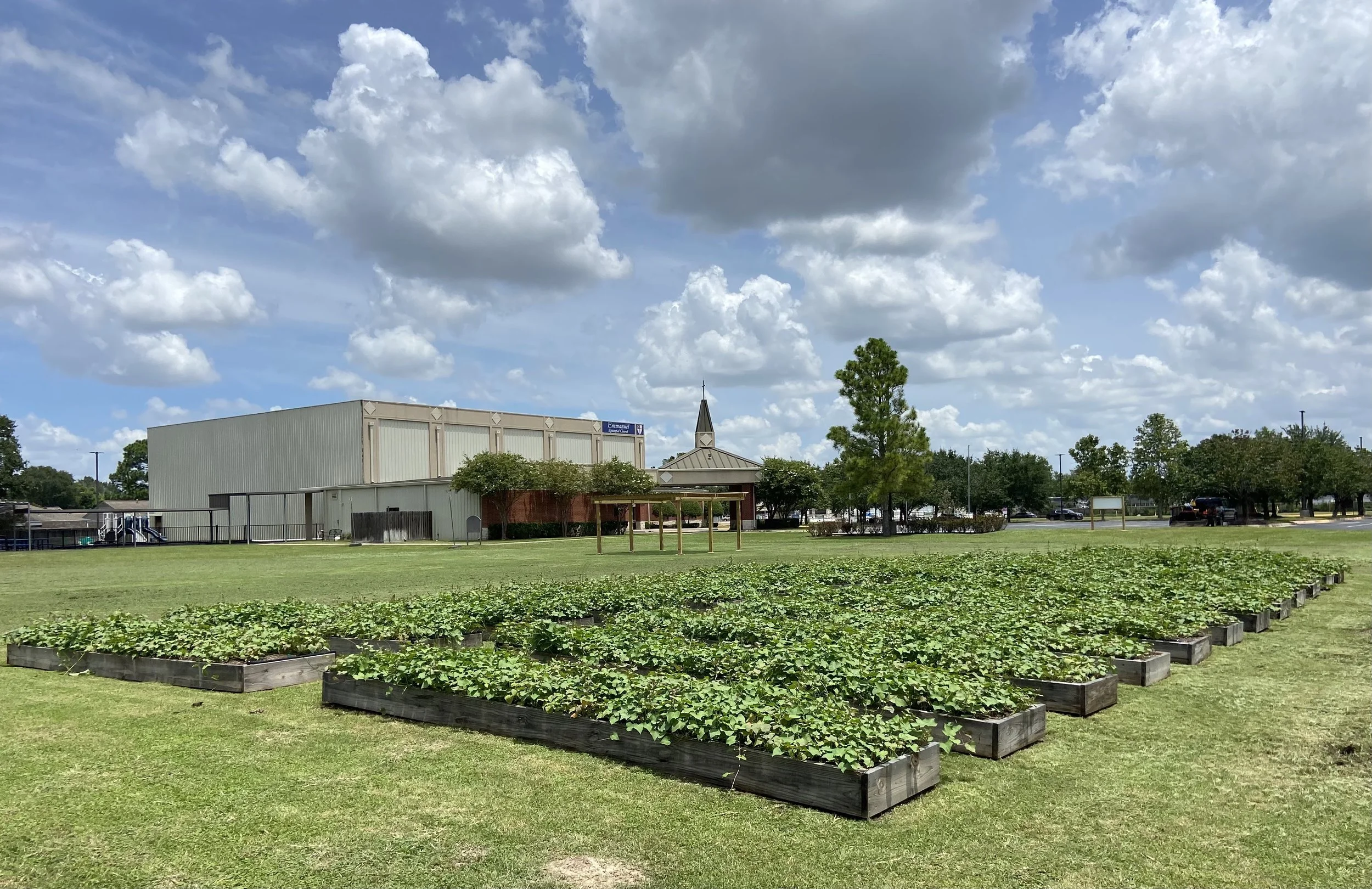
When people walk onto the garden today, most of them see a fairly simple scene.
A church building.
A field.
A few raised beds.
Some trees along the edge of the property.
To most people, it looks like the space has always been this way.
Very few people ask what the land looked like before.
And honestly, most people do not seem particularly curious.
The landscape feels permanent to them, as if it has always existed in its current form.
But when you begin looking back through old aerial photographs, a very different story starts to appear.
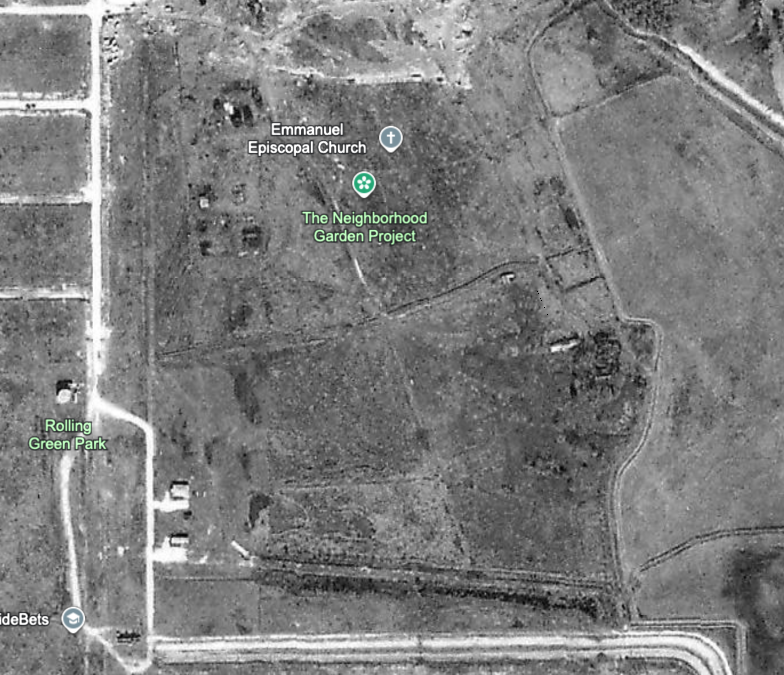
1978 aerial image of the property when the land was still part of a larger agricultural parcel. A homestead sat on the southern portion of the land and the soil shows signs of cultivation.
In 1978, the land where the garden now sits was part of a much larger agricultural parcel. When you study the aerial photograph closely, small details begin to reveal how the land was once lived in.
In the southern portion of the property there was a house. Nearby, the ground shows clear signs of disturbance where soil had been repeatedly worked. Faint tracks cut across the field, creating subtle pathways that likely carried trucks, tractors, or daily foot traffic between the house and the surrounding land.
This was not empty land waiting for something to happen.
This was a place where someone woke up each morning and stepped outside to look over the field. Where tools were carried out and work was done in rhythm with weather and seasons. The soil was not scenery. It was part of daily life.
Someone once lived on this land.
Someone once depended on it.
The soil that now holds raised beds and walking paths was once part of a working landscape where human life and land were closely connected.
One of the most striking things in the photograph is how completely open the land is. There are almost no trees across the property. The entire parcel appears exposed to the sun, stretching uninterrupted from one edge to the other.
That openness is not accidental.
When land is actively farmed or grazed, trees are often cleared so that sunlight can reach crops and so equipment can move freely across the ground. Open land allows a person to see across the entire field, manage livestock, and work the soil without obstruction.
The absence of trees suggests the land had been intentionally cleared and maintained as working ground.
In other words, the soil beneath the garden beds today was not untouched land waiting for its first relationship with human hands. It had already lived through a season where people shaped the landscape in order to survive from it.
Long before a church building stood here, and long before neighbors gathered to plant seeds together, this land had already been part of a deeply human story tied directly to the soil.
The buildings may have changed.
The boundaries may have changed.
But the soil has quietly carried the memory of that relationship the entire time.
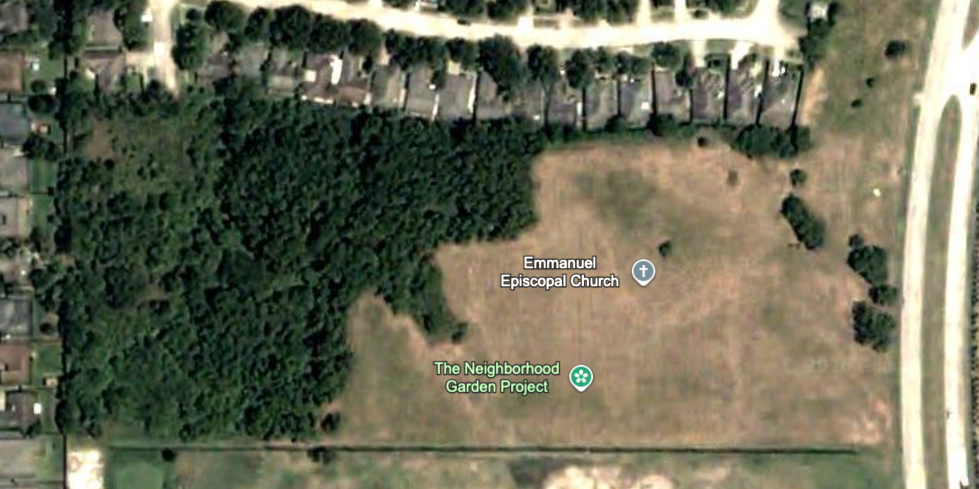
2002 aerial image showing the land after the agricultural era had faded but before the church was built. The homestead was gone and the land sat as an open field surrounded by growing suburban development.
Sometime between the mid-1990s and early 2000s, the land was divided. What had once been part of a larger agricultural parcel was split into smaller pieces as suburban development began expanding across the area. The homestead that once stood on the southern portion of the property disappeared, and the land slowly shifted away from its earlier life.
The aerial photograph from 2002 shows the property in a kind of quiet in-between stage. The house was gone, but nothing new had yet been built in its place. The land sat as an open field surrounded by growing neighborhoods.
Looking closely at the earlier photographs, the land does not appear to have been heavily cultivated in row crops. Instead, the wide open ground and subtle mowing patterns suggest the fields were likely maintained as hay or pasture land. The soil was not being turned each season. Rather, the grass was probably cut periodically and allowed to grow again between harvests.
That type of use creates a very different relationship with the land.
Unlike intensive agriculture, hay land often remains mostly open but is not aggressively cleared of every tree or seedling. As long as the field is cut regularly, young trees struggle to establish themselves, and the landscape remains mostly grass.
Another detail becomes visible when studying the aerial image closely. Broad, faint curves run across the field, forming shallow swales that gently guide water across the property. The land appears relatively flat from the ground, but from above these subtle contours reveal how rainfall naturally organizes itself as it moves through the landscape.
Rather than a single ditch or channel, water likely spread slowly across the field during storms, gathering in these shallow depressions before continuing toward the lower southern portion of the parcel. Over time, these quiet paths of water shaped the structure of the land, creating patterns that farmers and landowners learned to work around rather than erase.
Water, more than anything else, tends to define how land lives.
Even when a field appears smooth and uniform, water is always finding the easiest way through. Slight rises remain drier and firmer underfoot. Shallow depressions hold moisture longer. Mowing patterns and equipment paths often follow the firmest ground while avoiding the softest spots.
The land may look simple from a distance, but water quietly reveals its deeper structure.
But when mowing eventually stops, something interesting begins to happen.
The landscape slowly starts changing.
Seeds carried by birds and wind begin taking root. Small trees that once struggled to survive in a regularly cut field suddenly have the opportunity to grow. Over time, areas that were once open grassland begin filling in with shrubs and young trees, especially along the edges of the property and in places where moisture lingers slightly longer.
This appears to be what happened on this property.
Between the early 2000s and the years that followed, trees began appearing along the northern edge of the land and in scattered pockets across the field. The landscape slowly shifted from open hay ground into a more mixed pattern of grass and trees.
In 2004, a church building was constructed on the northern portion of the property. Parking lots and walkways followed, and the land entered a new phase of life as institutional space.
Years later, after Hurricane Harvey reshaped many things across the region, the campus became home to Emmanuel Episcopal Church.
For many years the property simply held buildings, parking, and open grass while the trees along the edges continued growing quietly.
Then in March of 2024, through The Neighborhood Garden Project, people began working the soil again.
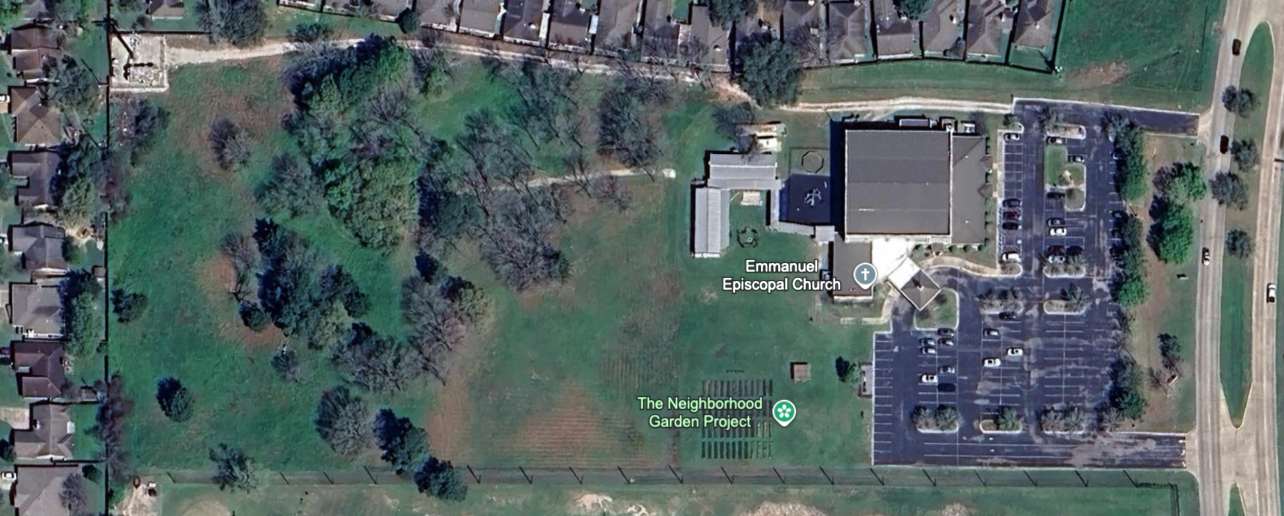
The property today. The church campus occupies the northern portion of what was once a larger agricultural parcel. In March of 2024, a garden began taking shape beside the church building.
Then in March of 2024, through The Neighborhood Garden Project, people began working the soil again.
Raised beds were built. Paths were formed. Seeds were planted.
At first glance, it might appear that the garden introduced something entirely new to the property.
But the aerial photographs suggest something different.
The soil had known human hands long before the garden arrived.
What changed over time was not the land itself.
What changed was our relationship with it.
At some point in our history, many of us moved away from homesteading, gardening, and working with the land as a normal part of daily life. Work moved indoors. Learning moved into classrooms. Community moved into buildings. Much of our formation began happening inside walls instead of under open sky.
The land remained.
But the ordinary human relationship with soil quietly faded from everyday experience.
That is part of what makes the garden so interesting.
It is not simply about growing vegetables.
It is about reopening a relationship that once existed here.
And something else has begun revealing itself as we spend more time paying attention to the land.
In areas where mowing has slowed and prairie restoration has begun, native plants are starting to appear that no one planted. Goldenrod, asters, grasses, and other prairie species are slowly emerging from the soil. Their seeds had been waiting quietly underground, sometimes for decades, for the right conditions to return.
The land remembers.
Where one household once worked this soil for their livelihood, the garden now invites an entire community to step back into that same relationship with the land.
Children dig in the soil. Neighbors plant seeds. People gather around beds and watch things grow again.
And sometimes it raises a quiet question.
When the people who once lived here eventually moved on, when the land changed hands and the fields were divided, did they ever imagine that one day a community might return to the soil?
We cannot know their hopes.
But after spending time with this land, it is hard not to wonder.
Because the soil they once cared for is now becoming a place where people gather again.
Not to survive from the land the way a homestead once did, but to rediscover something that had quietly faded from our lives.
The simple act of working with the earth.
And in doing so, remembering that cultivation has always shaped more than land.
It shapes people.