Creation Care Begins in the Garden
Why caring for the earth starts by tending a place
By Josh Singleton | Founder, serving as Lead Cultivator, The Neighborhood Garden Project
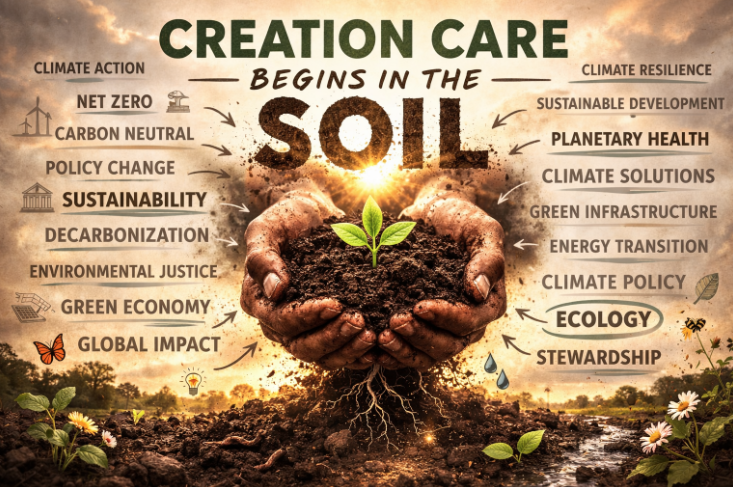
Most people do not walk into a garden thinking about creation care.
They are thinking about tomatoes.
Or weeds.
Or simply learning how to grow something for the first time.
But the moment someone begins tending the ground, something begins to change.
They start noticing things.
The soil is alive.
Bees move between flowers.
Certain insects help plants grow while others damage them.
Rain does not behave the same way on healthy soil as it does on compacted ground.
Without trying to become environmental stewards, people begin paying attention to creation.
And attention slowly grows into care.
The Garden Teaches What Creation Care Means
One of the quiet truths about gardening is that the garden refuses to cooperate with human control.
You can prepare the soil.
You can plant seeds.
You can water and tend the space.
But the life that emerges is never fully in your hands.
Seeds germinate because life was placed within them long before we arrived.
Roots move through soil systems we cannot see.
Insects arrive and participate in ways we often do not understand until we slow down and watch.
Over time the garden teaches a simple lesson.
We are not managers of creation.
We are participants in it.
That shift matters.
When people see themselves as managers, they often try to dominate or extract.
When people see themselves as participants, they begin learning how to cooperate with the living systems around them.
That posture naturally leads to care.
The Church Is Already Holding the Land
Across the country, churches sit on land.
Sometimes it is a few acres.
Sometimes it is several city blocks.
Sometimes it is simply open green space surrounding a building.
Most of this land is not used very intentionally.
It may be mowed regularly.
It may sit quietly around a sanctuary.
But rarely is it seen as part of a living system.
Yet when you step back and look at the larger picture, something remarkable becomes clear.
Churches collectively hold an enormous amount of land.
And unlike many other landowners, churches are not primarily driven by profit or development pressure.
The same property that existed fifty years ago will often still be there fifty years from now.
That kind of stability is rare.
It means churches are uniquely positioned to care for the land patiently.
Soil can be rebuilt.
Trees can be planted that will shade people decades from now.
Pollinator habitat can quietly grow over time.
The infrastructure for caring for creation already exists.
It simply requires seeing the land differently.
When Creation Care Becomes Too Big to Touch
Another challenge appears when creation care is discussed mainly at the institutional level.
The conversation often centers on large global concerns.
Climate systems.
Environmental policy.
Planet-wide ecological change.
These issues matter.
But when they are framed primarily at that scale, something unintended can happen.
The responsibility to address these concerns quietly shifts onto the shoulders of ordinary church members.
Parishioners begin feeling that they are expected to somehow respond to problems that operate at a planetary scale.
The gap between the size of the problem and the scale of everyday life becomes overwhelming.
And when people feel overwhelmed, they often do nothing at all.
Not because they do not care.
But because the problem feels too large to touch.
The Garden Changes the Scale
The garden quietly changes the scale of the conversation.
Instead of asking people to solve global environmental problems, the garden invites them to care for a place.
A small patch of soil.
A raised bed.
A row of flowers.
Suddenly the work becomes tangible.
People can plant something.
They can observe what happens.
They can participate in the life of the land directly in front of them.
And something remarkable begins to occur.
When people care for small places faithfully, the larger systems begin responding.
Pollinators return.
Soil improves.
Water moves differently through the ground.
The garden reminds us that meaningful change rarely begins at the scale of the planet.
It usually begins with a small place that someone is willing to tend.
Creation Begins to Respond
Something else begins to happen when people begin tending the ground.
Creation responds.
Pollinators appear where flowers are planted.
Soil becomes softer when organic matter is returned to the ground.
Birds arrive where insects are present.
Life gathers where life is welcomed.
At our gardens we have watched this happen again and again.
Flowers bring bees.
Native plants bring butterflies.
Leaving roots in the soil improves the ground for the following season.
The garden slowly becomes more alive.
None of this requires a complicated environmental strategy.
It simply requires people willing to pay attention.
The Garden Is Connected to Everything Around It
At first the work of a garden feels small.
A few beds.
Some vegetables.
A patch of flowers.
But over time something becomes clear.
The garden is not isolated.
It is connected to the land around it.
Healthy soil holds water differently.
Instead of rain immediately running off the surface, more water slowly moves into the ground.
This simple shift begins influencing how water moves across the land.
Every piece of land sits inside a watershed.
Rain that falls in one place eventually moves somewhere else.
When soil is healthy, it acts like a sponge.
Water infiltrates instead of rushing away.
Pollinators travel much farther than most people realize.
Bees and butterflies move between flowering plants across entire neighborhoods.
A small patch of flowers planted on church land may feed pollinators that visit yards, parks, and green spaces throughout the surrounding area.
What begins as a garden slowly becomes part of a much larger living network.
Soil connects to water.
Flowers connect to pollinators.
Small places influence the health of the wider landscape.
What This Looks Like Along the Gulf Coast
Here along the Gulf Coast, these connections become visible very quickly once you begin paying attention.
Much of the Houston area once held vast coastal prairie.
Those landscapes managed water through deep root systems that reached many feet into the soil.
Rain did not simply run across the surface.
It moved slowly into the ground through those living root channels.
Much of that prairie has now been developed.
But the living systems have not disappeared.
They simply need places where they can begin functioning again.
When flowers appear, pollinators return.
When soil is covered with organic matter instead of left bare, earthworms begin showing up again.
When native plants are allowed to grow, butterflies that once struggled to find habitat begin visiting again.
These changes do not require large environmental programs.
They simply require places where the living systems of the land are welcomed again.
A garden becomes one of those places.
The Garden Reorders the Human Heart
The most surprising part of this process is that the garden does not just restore soil.
It restores people.
Modern life often places humans above creation, as if the natural world exists primarily for our use.
The garden quietly challenges that idea.
When someone spends time kneeling in soil, watching seeds emerge, and realizing how little control they actually have, something begins to shift.
Humility returns.
Patience returns.
Gratitude returns.
People begin rediscovering that they are part of creation, not separate from it.
And once that realization takes root, caring for the land no longer feels like a responsibility placed upon them.
It becomes a natural response to the relationship they have rediscovered.
When the System Is Ready but the Roots Are Still Growing
The garden also teaches something about timing.
Healthy systems can expand quickly once the conditions are right.
Seeds multiply.
Soil improves.
Pollinators return.
Life spreads outward.
But something must always come first.
Roots.
A plant cannot grow taller than the strength of the roots beneath it.
The same pattern often appears in the work of people.
Sometimes the systems are ready.
The patterns are clear.
The work can grow.
But the people carrying the work are still being formed.
Roots are still strengthening.
From the outside it can look quiet.
It can even feel like the world is not noticing yet.
But the garden reminds us that the most important growth often happens underground.
There are seasons where the work remains hidden while the foundations deepen.
Others may still be asleep to what is forming.
But when the roots are strong enough, the growth above the surface often appears quickly and naturally.
Strong roots must come before wide branches.
It Began in a Garden
Long before the phrase creation care existed, the story of humanity began in a garden.
In the opening pages of Scripture, humans are placed in the middle of a living world already full of life.
Plants, animals, water, soil, and seasons were already in motion before humans arrived.
The first role given to humanity was not to dominate the earth.
It was to tend and keep the garden.
To tend means to cultivate and participate in the life of the place we inhabit.
To keep means to watch over and protect what has been entrusted to us.
Neither role places humans above creation.
Instead, it places us inside it.
Participants in the living systems God has already spoken into existence.
Creation Care Begins with Presence
For many churches, the idea of creation care can feel overwhelming.
Global environmental concerns can seem distant and complex.
But the invitation is actually very simple.
Touch the ground.
Plant something.
Pay attention to the life around you.
When people begin interacting with soil, plants, insects, and seasons, something deeper begins to grow.
Care emerges from relationship.
And relationship begins with presence.
The garden simply provides a place where that presence can begin.
Because when people rediscover their place within creation, caring for it is no longer a program or a responsibility.
It becomes the natural way we live.