The Cost of Being Useful
How living work gets reduced to outcomes and explanations
By Josh Singleton | Founder, serving as Lead Cultivator, The Neighborhood Garden Project
There is a subtle trend that shows up whenever something life-giving begins to take root.
It does not arrive loudly. It rarely comes with bad intentions. More often, it comes wrapped in affirmation, urgency, and the language of partnership. Over time, though, its pattern becomes clear.
People begin to approach the work not with curiosity, but with need.
They do not ask why the work exists or what it is forming. They ask what it can provide. Language. Visibility. Outcomes. Legitimacy. Relief for their own pressure. Something they can point to and say, “See, we are doing something.”
This is extraction.
Extraction rarely looks aggressive. Most often, it looks responsible. It sounds like requests for explanation, documentation, alignment, and clarity. On the surface, these requests appear reasonable. But underneath, they are driven by a single assumption: that the work exists to stabilize something else.
What is missing is proximity.
Curiosity draws near. Extraction reaches outward.
When curiosity is present, people ask why something exists before asking how to describe it. They spend time. They observe. They participate. They allow themselves to be formed by the pace and posture of the work itself.
When extraction is present, those steps are skipped. The move is straight to language, outcomes, and usefulness. People want the fruit without committing to the conditions that produce it.
This is where tension begins.
Living work does not respond well to being abstracted. When language runs ahead of formation, the work is misnamed. When outcomes are demanded before trust is built, the work is pressured to perform. When visibility is prioritized over integrity, the work begins to hollow out.
One of the most common ways this shows up is through mislabeling.
Because food is visible, tangible, and easy to explain, there is a strong tendency to loop this work into “food ministry” language. That framing may feel supportive or even affirming, but it fundamentally misnames what is happening.
Internally, this work has never been a food ministry.
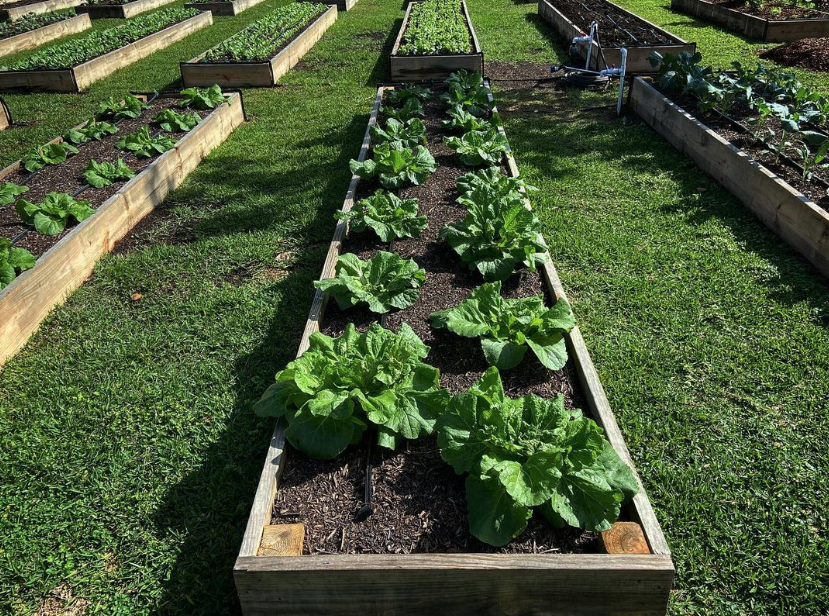
Food is present, but it is not the point. The garden is not organized around distribution, recipients, or supply. It is organized around presence, participation, and formation. Food emerges as a byproduct of shared cultivation, not as a service delivered from one group to another.
When something is mislabeled, expectations follow. Metrics shift. Questions change. Pressure increases. Suddenly the work is evaluated for how much food is produced, who receives it, and how it can be justified within existing ministry categories.
That shift is not neutral.
It pulls the work away from mutuality and toward transaction. It creates donors and recipients where there were co-stewards. It introduces urgency where patience was doing its quiet work. And it asks the garden to perform into a role it was never designed to carry.
This dynamic intensifies when real urgency enters the room.
Hunger in Texas is real. Food insecurity is rising. Programs like SNAP carry the overwhelming weight of feeding millions of people. Churches and food ministries play a vital, life-saving role, and advocacy around these systems matters.
None of that is in question.
But urgency has a way of narrowing vision.
When pressure increases, systems begin scanning the landscape for anything that can be named, counted, hosted, or mobilized. Commitment gets measured through signatures. Alignment gets demonstrated through attendance. Faithfulness gets translated into visibility and scale.
This is mobilization.
Mobilization has its place. It is necessary for policy, funding, and large-scale response. But it operates on a different logic than formation.
Mobilization asks people to act quickly around a shared goal. Formation asks people to slow down long enough to be changed.
The problem comes when these two are confused.
When formation-based work is pulled into a mobilization frame, it gets flattened. Language replaces life. Participation is substituted with proof. Urgency compresses nuance. The work is no longer allowed to be what it is. It is asked to help stabilize something else.
This is how extraction becomes normalized.
Over time, we have learned a simple discernment.
If someone wants what the work produces but not the way the work forms, they are not asking to join. They are asking to extract.
That does not make them bad. It does make the answer clearer.
Good work requires boundaries, not because it is fragile, but because it is alive. Living things need time, space, and conditions that support growth. They cannot be rushed into serving someone else’s urgency without cost.
As leaders, the challenge is not avoiding power or urgency altogether. The challenge is stewarding power relationally without allowing fear, pressure, or scale to dictate our language or pace.
That means learning how to say no without over-explaining. Learning how to end conversations that are no longer producing clarity. Learning how to keep language close to lived reality rather than allowing it to be repurposed by those who are not present.
This kind of stewardship will always disappoint systems looking for quick stabilization. But it preserves the integrity of the work and the people within it.
Over time, that integrity becomes its own invitation.
Those who are curious will draw near.
Those who are urgent will move on.
Both outcomes are appropriate.