The Better Question
Why We Designed a World That Excludes What Humans Need to Be Whole
By Josh Singleton | Founder, serving as Lead Cultivator, The Neighborhood Garden Project
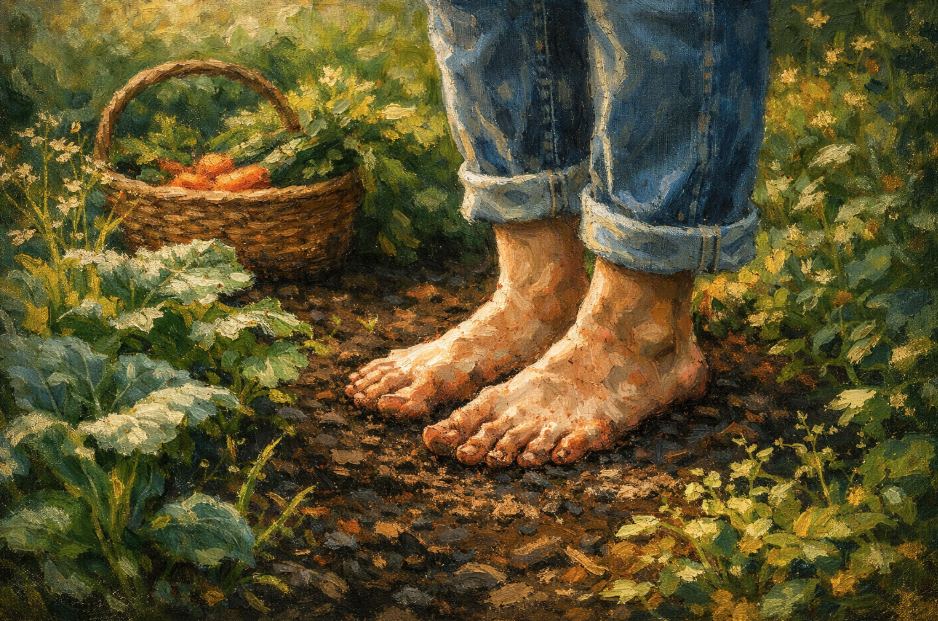
For a long time, I asked what was wrong with my body.
Why I needed movement so badly.
Why stillness made me restless.
Why my mind only settled after hours outside, moving soil, lifting weight, adapting to weather and uneven ground.
I assumed this meant something about me.
But the body answered a different question long before my thinking caught up.
It is not just me.
Gardening, cultivation, and hands in soil stewardship are human native, not personality specific. My body is not discovering a workaround. It is remembering its original operating system.
Before humans were thinkers, planners, managers, or strategists, we were tenders.
Our bodies were shaped to dig, carry, lift, walk uneven ground, use tools with intention, read subtle environmental cues, work in cycles, and respond to seasons rather than clocks. This is not symbolic language. It is anatomical reality.
My spine, hips, shoulders, hands, breath, and nervous system all assume regular interaction with the living world. They assume friction, resistance, weight, variability, and recovery. Modern life violates those assumptions.
Human bodies were designed for the earth itself, not for flat floors, padded chairs, and climate-controlled boxes. Our feet, joints, balance systems, and nervous systems evolved to move across uneven ground, to constantly adapt, to sense texture and slope, and to respond to gravity in real time. When those inputs disappear, the body does not relax. It dysregulates.
That is not a flaw.
That is feedback.
Cultivation regulates the human body so deeply because it combines what modern life has separated. Full-body movement instead of isolated exercise. Purposeful effort instead of arbitrary repetition. Sensory feedback through soil, resistance, and weather instead of screens. Time-bound loops with a beginning, tending, and completion instead of endless tasks. Delayed reward that trains patience instead of instant results. Visible impact where the hands can see what they actually did.
The nervous system recognizes this immediately and responds with calm. Not because responsibility was escaped, but because the body returned to an environment it understands.
Everyone benefits from cultivation, but not everyone feels its absence at the same intensity. Some bodies are more buffered by abstraction. Mine is not.
I regulate through movement and purpose. I discharge stress through doing. I am sensitive to misalignment. When I am cut off from cultivation, the contrast is loud. That does not make me abnormal. It makes me less insulated from disconnection.
Culture made a quiet but costly shift.
Cultivation was reframed as a hobby, a lifestyle choice, a leisure activity, a niche interest. Something optional. Something aesthetic. Something you do if you have extra time or a certain disposition.
That framing is backwards.
Cultivation was the baseline. Modern abstraction is the experiment.
We built systems that remove people from land, food, seasons, and each other, then asked the human body to function as if nothing fundamental had changed. We replaced movement with sitting, touch with screens, rhythm with schedules, and meaning with output. Then we labeled the body’s response as weakness, lack of discipline, or dysfunction.
When the body resists stillness, screens, and endless explanation, it is not failing. It is objecting.
It is saying that something essential is missing.
This realization freed me from a subtle trap, the question of why I need this so much.
I no longer ask that.
The better question is this.
Why did we design a world that excludes what humans need to be whole?
My body answered that already.
I am not returning to something primitive.
I am returning to something foundational.
Cultivation grounds the mind. It regulates emotion. It trains patience. It teaches limits. It restores humility. It reconnects body and purpose. That is why it heals quietly, without performance or explanation.
Human bodies were made for cultivation.
Mine simply refuses to forget.
Instead of apologizing for that, I am learning to let my design lead.
That is not regression.
That is alignment.