Standing by the Brook
Learning to Move and Remain by One Voice
By Josh Singleton | Founder, serving as Lead Cultivator, The Neighborhood Garden Project
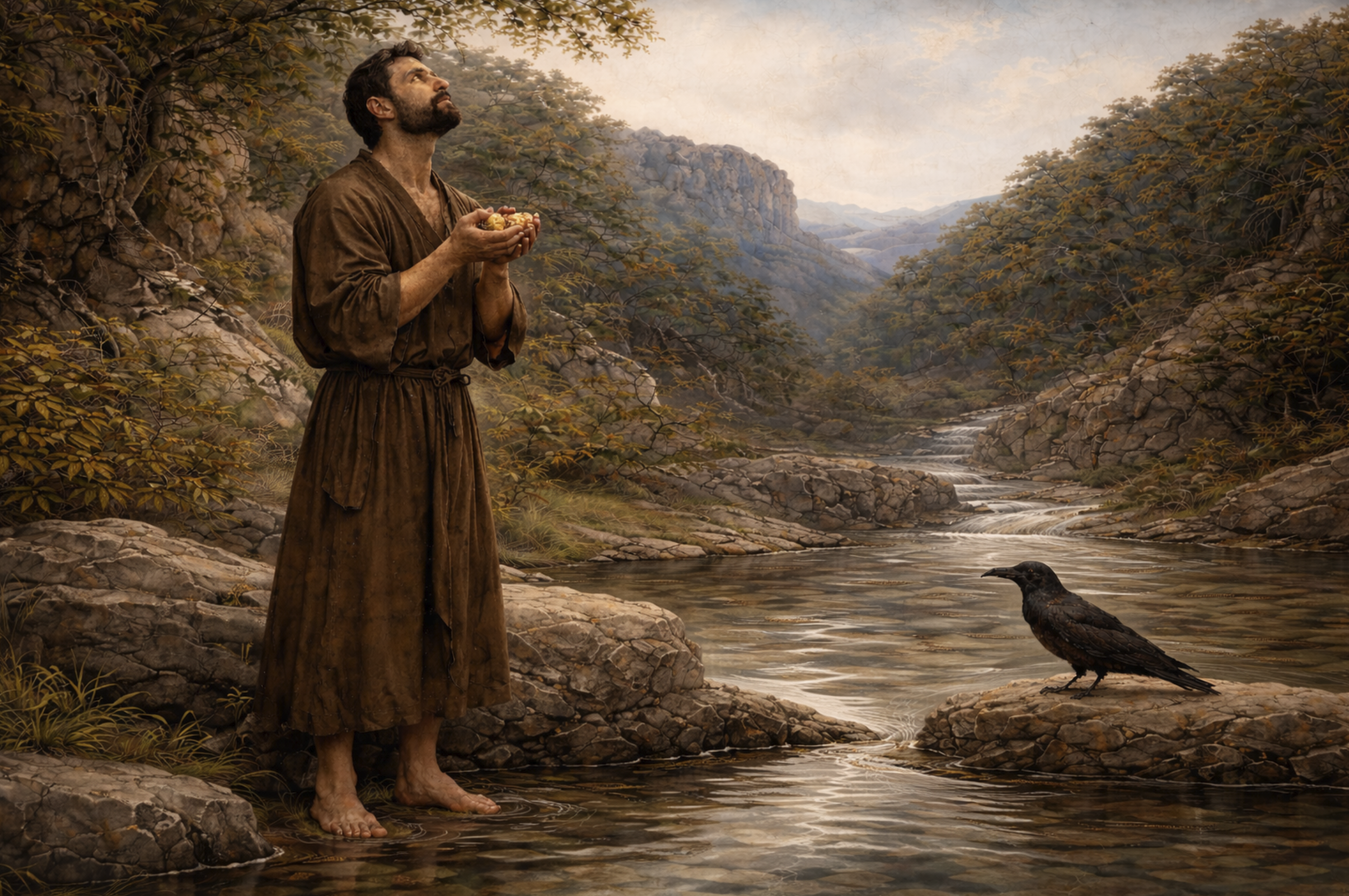
There is a story in Scripture that I return to often when I am working in the garden.
It is the story of Elijah standing beside a small stream called the Brook Cherith, recorded in the First Book of Kings.
Most people remember Elijah for the dramatic moment on Mount Carmel when fire fell from heaven. But long before that public moment, Elijah lived through a quiet season that shaped everything that followed.
The Bible introduces Elijah almost suddenly.
There is no childhood story. No account of how he learned to hear the voice of God. The text simply says that Elijah the Tishbite appears before the king of Israel, Ahab, and declares something that would shake the entire nation.
There will be no rain.
Not for months. Not even for years.
In a land dependent on agriculture, that declaration was more than a prophecy. It was a confrontation. Ahab and his wife Jezebel had led the nation into the worship of Baal, a god people believed controlled storms, rain, and agricultural fertility.
Elijah’s words exposed the illusion.
The living God, not Baal, governed the rain.
But moments like that do not appear out of nowhere. Scripture introduces Elijah at the moment his obedience becomes visible, but his formation almost certainly began long before that day.
Somewhere in the rugged hills of Gilead, away from royal courts and public attention, God had already been shaping a man who could hear His voice and obey it.
That pattern shows up often in Scripture.
Roots grow before fruit.
God forms identity before influence.
The Instruction to Leave
After Elijah makes his declaration, the political environment immediately becomes dangerous.
A prophet who shuts off the rain in an agricultural society does not remain popular for long.
So God gives Elijah a surprising instruction.
Leave.
Go east.
Hide yourself by the Brook Cherith.
Elijah does not negotiate the assignment. He does not ask how long he will be there or what the future will look like.
He goes.
And there, beside that small stream, the rhythm of his life becomes very simple.
Each morning ravens bring him bread and meat.
Each evening they return again.
The brook provides water.
Day after day the same quiet pattern repeats itself.
No crowds.
No recognition.
No visible success.
Just daily provision and the quiet presence of God.
Why Ravens?
One of the most curious details in the story is the choice of birds.
God could have chosen doves.
He could have chosen songbirds.
Instead He chose ravens.
In the world of ancient Israel, ravens were not considered clean or noble birds. They were scavengers. Opportunists. Creatures that fed on what others left behind.
Ravens were not the kind of animals people associated with divine provision.
And yet those are the birds God appoints to feed His prophet.
Each morning and evening they arrive carrying food.
Bread and meat.
The very birds known for taking and scavenging are now bringing and delivering.
The detail carries a quiet lesson.
God’s provision does not always arrive through the channels we expect.
Sometimes He uses the overlooked.
Sometimes He uses the unlikely.
Sometimes He chooses methods that dismantle our assumptions about where provision should come from.
But the most important part of the story is not the birds.
It is the place.
God tells Elijah exactly where to stand.
The ravens are assigned to that location.
Elijah does not chase them.
He simply remains where God told him to remain.
When the Brook Begins to Dry
Eventually the story takes another turn.
The brook begins to shrink.
The drought Elijah announced is now affecting his own water supply.
Day by day the stream gets smaller.
Many of us would see that as a sign that something has gone wrong.
But the story shows a different posture.
Elijah does not panic.
He does not run ahead searching for another water source.
He remains where God placed him.
Only when the brook has fully dried does the next instruction come.
Then the word of the Lord comes again.
Go to Zarephath.
The brook was never the destination.
It was simply the place of formation for that season.
The Garden and the Brook
The longer I spend working in the soil, the more I recognize that gardens operate with a similar rhythm.
Gardens do not chase attention.
They do not advertise themselves or campaign for visitors.
A garden simply remains where it has been planted.
Season after season it grows quietly in the soil.
Roots move slowly downward.
Microbes build structure in the ground.
Life develops underground long before anyone sees leaves above the surface.
Over time the people who need the garden find it.
The same thing happens in the gardens we steward.
We do not recruit volunteers.
We do not summon the public.
The gates remain open. The soil is tended. The space remains steady and present.
And slowly, quietly, people arrive.
Some stay for a while. Some disappear for months and return later as if no time has passed at all.
The garden does not keep score.
It simply remains faithful to the ground.
One Voice
Working in the soil has clarified something for me over the years.
Faithful work is not about chasing opportunities or responding to every voice that demands something from us.
Faithful work means learning to move and remain according to one voice.
The voice of the One who authored the world into being.
The voice of the One who knew me in my mother's womb.
There are many voices in the world that attempt to shape our direction.
Voices that measure success.
Voices that demand performance.
Voices that insist we prove our value.
But Elijah’s life moved according to a different rhythm.
Speak when God says speak.
Leave when God says leave.
Stand by the brook when God says stand.
Move again when the next word comes.
That rhythm is the only one I trust.
I refuse to bow my knee to any voice but the One who created the life I am living and who continues to participate fully in the work He has invited me into.
Provision Already in Flight
When I picture Elijah beside that quiet stream, one detail continues to stay with me.
The ravens were already on their way before Elijah ever saw them.
Somewhere in the sky those birds had been set in motion.
Their flight began before Elijah’s hunger arrived.
In the same way, provision often begins moving toward us long before we recognize our need.
Faithfulness does not mean manufacturing provision.
It means standing where God has told us to stand and trusting that what is needed is already in flight toward that place.
Just as the ravens were assigned to the brook, the provisions we need are often already moving toward the ground where we are standing.
Our task is not to chase them.
Our task is to remain faithful to the place God has given us.
Tend the soil.
Welcome the people who arrive.
Listen for the next word.
And trust that the provisions we need are already in flight toward the place where we are standing.
Standing by the brook.
Waiting for the voice that tells us when it is time to move again.