Resilient Soil Builds Resilient Communities
How God Is Drawing Us Back to the Soil Where He Breathed Soil into Life
By Josh Singleton | Founder, serving as Lead Cultivator, The Neighborhood Garden Project
We keep looking for resilience in the wrong places. We look for it in policies, programs, metrics, and speed, trying to manufacture strength through efficiency and scale. But resilience has always come from something slower and far more ancient. It comes from soil. Before there were systems, there was ground. Before there were institutions, there was breath meeting dust. God did not speak humanity into strategies or structures. He formed us with His hands and breathed Heaven into soil, and that origin still matters.
Soil was the first classroom. It teaches patience, limits, and dependence in ways nothing else can. Healthy soil is never rushed. It is built through layering, rest, decay, and time. Organic matter breaks down. Microbes multiply. Roots cooperate. Life becomes possible because something else was willing to return to the ground. This process is not accidental. It is instructional. When communities lose touch with soil, they lose touch with formation and begin to believe growth can happen without cost, without time, and without relationship. That belief always produces fragility.
We often confuse resilience with hardness, but soil tells a different story. The most resilient soil is not compacted or rigid. It is crumbly, open, and alive. It absorbs water instead of shedding it. It flexes under pressure instead of cracking. It recovers because it has depth. Communities work the same way. When people are given room to breathe, to belong, and to contribute without being consumed, resilience emerges naturally. When everything is extracted, optimized, and measured, life shuts down beneath the surface long before collapse becomes visible.
This return to soil is not nostalgia. It is restoration. God is drawing us back to the place where Heaven first touched earth, not to escape the world, but to remember how life actually grows. He is not asking us to abandon progress. He is asking us to root it. The garden is not an illustration added later. It is a pattern woven into creation itself. When people share soil, they begin to share time. When they share time, they share stories. When they share stories, walls soften, and provision stops being transactional and becomes communal.
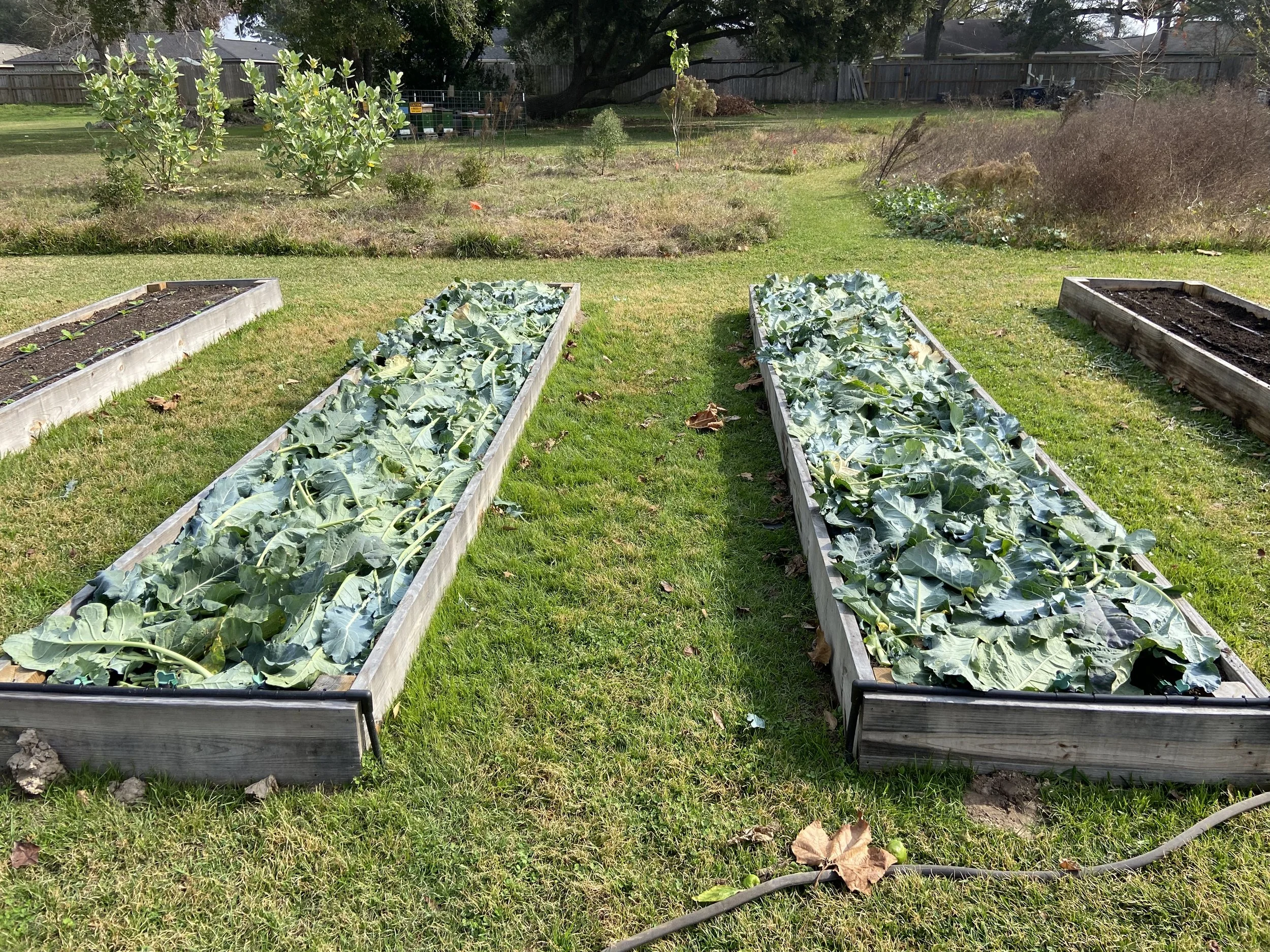
That pattern shows up in the most practical work of the garden. We surface-pull weeds instead of tearing the soil open. We cut crops at soil level when their season is complete, leaving the roots in the ground to decay naturally and feed what comes next. What grew above ground is laid back down as cover, protecting moisture, feeding microbes, and strengthening the soil for the future. Nothing is exported unnecessarily. Nothing is wasted. The garden provides what the garden needs. Each cycle reduces dependence on outside inputs while increasing life below the surface.
This kind of restraint releases resources most systems never see. When roots are left in place and plant matter is returned to the beds, hidden work begins. Channels remain. Microbial life expands. Fertility increases quietly. What looks like limitation becomes provision. What looks like restraint becomes abundance. The soil reveals that life multiplies when we stop demanding more than it can naturally sustain.
As the system becomes simpler, margin appears. Not margin for expansion, but margin for presence. Using what the garden provides allows us to invest more fully in the people who arrive here, not as projects or problems to solve, but as neighbors seeking rest, clarity, and belonging. The soil underwrites this work by asking less and giving back differently.
It is often called irresponsible to invest in a few when there are so many visible needs. But I will not walk away from the few. I am willing to lay my own life down to see them gather in the garden, trusting that the Father is pleased with faithfulness that refuses extraction. I will no longer ask the soil to give beyond what it can naturally sustain. I will no longer ask it to be driven by inputs to cover my own tendency to outpace formation. The soil has not forced this reckoning. It has invited me into it through its quiet resistance to being extracted. In listening to that resistance, I am learning to slow down and to look honestly at myself. And in that honesty, I am discovering that faithfulness is not proven by how much I can produce, but by how carefully I am willing to tend what has been entrusted to me.
In this faithfulness to the soil, the community will inevitably learn to be faithful to one another.