A Place to Be Received and Reoriented
Refuge, Embassy, and the Recovery of Shared Life
By Josh Singleton | Founder, serving as Lead Cultivator, The Neighborhood Garden Project
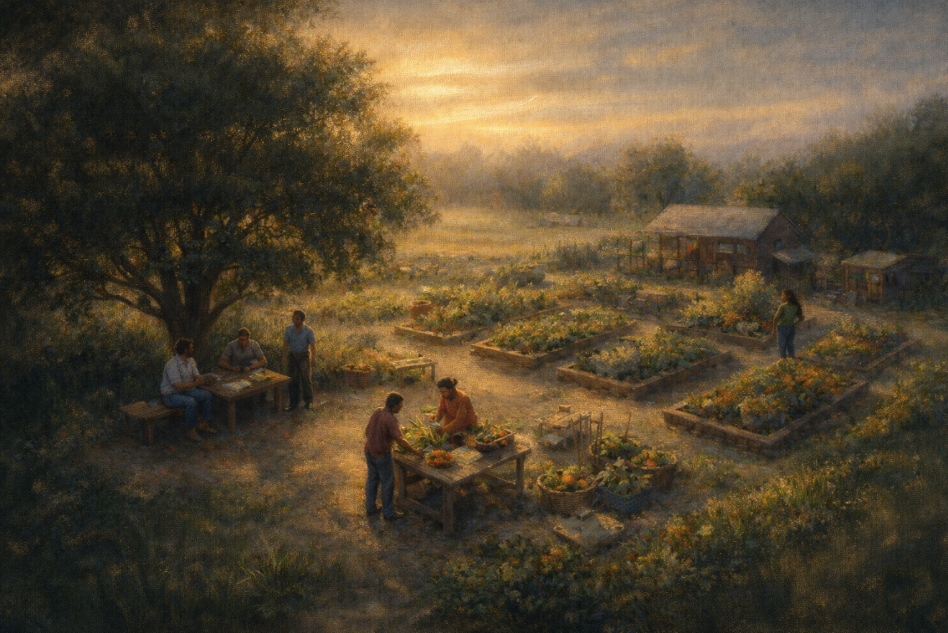
What if ordinary life still held places where nothing was demanded of you? Places carved out not for productivity or improvement, but for rest, for presence, for life to be shared at a human pace. Places where time slowed enough for your body to exhale, where provision stayed close, where stories were not rushed toward conclusions. What if such places were not retreats set apart from the world, but quietly embedded within it, woven into neighborhoods, soil, and daily rhythms.
A refuge and an embassy are not the same thing, but they are meant to belong together. A refuge offers safety. It allows people to arrive without defense, without explanation, without performance. An embassy represents a different way of life. It carries the culture, values, and authority of another place into the midst of foreign ground. Refuge receives people as they are. Embassy reorients people toward what they belong to. When separated, refuge becomes comfort without direction, and embassy becomes authority without mercy. When held together, people are both received and reshaped.
The garden does not operate as a program. It operates as a place where refuge comes first and embassy is revealed over time. Programs move people through steps. Places receive people as they are and invite them to remain. From the beginning, the garden has followed a rhythm that was not designed in advance but revealed through staying present long enough to notice what life required. Safety opens the door. Allegiance emerges later.
People arrive at the garden in many conditions. Some are tired. Some are curious. Some are unsure why they came at all. The refuge of the garden meets them before anything is asked of them. Soil under their hands. Shared work without pressure. Unhurried time. Nothing is demanded. No belief is required. No outcome is measured. Silence is permitted. Presence is valued more than participation. This is how refuge restores the body before the embassy ever speaks to the will.
As people remain, the embassy begins to take shape quietly. They notice that the garden lives by a different rhythm. Food is not treated as product but as shared provision. Time is not optimized or filled but honored. Scripture is not delivered as content but read together as shared text. Care is not outsourced to distant systems but kept close and relational. These differences are not announced. They are encountered. Refuge holds people long enough for embassy culture to become visible.
Over time, the overlap becomes clear. The same practices that create refuge also carry embassy authority. Keeping food close restores shared responsibility. Slowing time reveals a different economy. Refusing transaction preserves dignity. The garden does not declare itself a Heavenly Embassy. It becomes recognizable as one because its life is coherent. People sense that they are standing in a space shaped by a different allegiance, even if they would not yet name it that way.
This is why the garden resists transaction. Transactional systems undermine both refuge and embassy. They are efficient, but efficiency creates distance. They relieve people of the responsibility to remain. They address need while bypassing formation. Transaction breaks safety by rushing past presence, and it breaks embassy culture by severing generosity from relationship. The garden refuses these shortcuts not out of ideology, but because refuge and embassy cannot survive them.
Daily life in the garden follows this same flow. It remains open rather than promotional. It deepens rather than scales quickly. Roles emerge slowly as trust is established. Leadership is exercised through steadiness rather than control. Growth is allowed to be uneven and seasonal. These are not management decisions. They are protections of refuge and expressions of embassy culture. The garden stays small enough to remain safe and close enough to remain honest.
What forms here is neither dependency nor extraction. Refuge prevents exploitation. Embassy prevents stagnation. People who remain long enough begin to carry both with them. They learn to recognize safety. They learn to live with shared responsibility. They learn to resist transactional patterns elsewhere. Some stay rooted. Some are sent. All are changed by proximity.
This is why retreats now feel necessary in our culture. Ordinary life has lost its refuge and forgotten its allegiance. Rest was removed. Presence was replaced with productivity. Provision was abstracted. Community was fragmented. What once belonged to daily rhythms was extracted and sold back as something you earn, schedule, or deserve. When ordinary life could no longer hold refuge or reflect a coherent way of life, people began searching for it elsewhere.
The Father does not break into ordinary life by interrupting it. He reenters it when refuge is restored and embassy culture is embodied again. He moves where time is no longer optimized, where people are not being managed, where provision stays close, where no one is rushing toward outcome. He inhabits places that are safe enough to receive Him and coherent enough to reflect Him.
This is why the garden matters. It is not exceptional. It is faithful. The soil refuses hurry. Seeds refuse efficiency. Growth refuses control. Refuge is built into the ground. Embassy culture emerges through waiting. In those conditions, heaven does not need to announce itself. It becomes recognizable.
The garden does not offer retreat from life. It restores refuge to ordinary life and carries heaven’s culture into it. It becomes a refuge not by design, but by faithfulness. It becomes a Heavenly Embassy not by declaration, but by coherence. Heaven was never meant to live only in special places. It was meant to dwell among us.
When ordinary ground is given back its dignity, the Father does not have to break in.
He simply walks in again.