Cover Crops and the Work We Don’t Know How to Value
How Night Length Governs Readiness in Plants and People
By Josh Singleton | Founder, serving as Lead Cultivator, The Neighborhood Garden Project
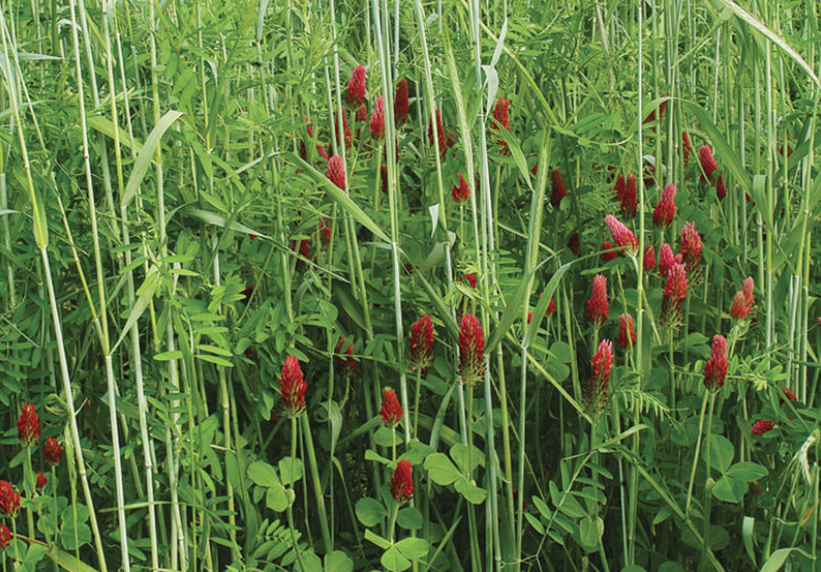
A cover crop is a plant grown not for harvest, but to protect and restore soil between periods of production.
In agriculture, cover crops are planted to keep soil covered when cash crops are not present. Their purpose is not yield, but function. They reduce erosion, regulate moisture, feed soil biology, improve structure, cycle nutrients, and buffer stress within the system.
Unlike cash crops, their value is not measured by what is removed from the field. It is measured by what is left behind.
Cover crops work primarily below the surface. Through roots, microbial relationships, carbon exchange, aggregation, and time, they rebuild the conditions that make future growth possible. They do not accelerate production. They stabilize it.
Because they are not harvested, their contribution is indirect. Because their work is largely invisible, their impact is often delayed. And because they do not produce an immediate, marketable return, they are frequently misunderstood.
Yet without them, soil systems become exposed. Moisture is lost more quickly. Structure degrades. Nutrients move erratically. Stress accumulates unnoticed until failure becomes obvious.
In this way, cover crops are not supplemental.
They are foundational.
They exist to do work that production crops cannot do while production is happening. They occupy the in-between spaces, holding the system together while nothing else appears to be changing.
This definition is widely accepted in agriculture.
What is less commonly acknowledged is how uncomfortable this kind of work is for systems that prioritize speed, visibility, and immediate results.
In most agricultural systems, cover crops are tolerated, not trusted.
They are permitted, but only conditionally. Allowed to exist as long as they do not interfere with production timelines, cash flow, or planting schedules. Their presence must be justified repeatedly, season by season, even when their benefits are already well documented.
They are planted in the margins of the calendar, after the “real work” is finished and before the next cycle begins. They are framed as optional, temporary, and expendable. When pressure rises, whether from weather, labor, or markets, they are among the first practices to be cut short or removed entirely.
Their value is rarely questioned in theory.
It is constantly questioned in practice.
Not because they fail.
But because their contribution does not announce itself.
Cover crops do not exist to produce something immediately visible. They exist to change the conditions underneath everything else. Their primary labor happens underground, through root exudation, microbial exchange, carbon transfer, aggregation, and time. They restore structure where structure has been lost. They rebuild memory where soil has been pushed into constant reaction. They stabilize systems long before stability becomes obvious.
They reduce volatility before yields increase.
They absorb stress before stress shows up.
They repair damage that cannot be corrected quickly or cleanly.
This makes them difficult to value in systems trained to reward immediacy.
Cover crops rarely create dramatic results early. They do not spike yields on command. They do not perform on a schedule that aligns neatly with economic reporting cycles. Their impact shows up gradually, unevenly, and often long after the decision to plant them has faded from memory.
And because of this, they live in constant tension with systems that prioritize speed, visibility, and measurable output.
These systems are not designed to notice preparation. They are designed to reward production. They recognize value when something can be counted, compared, and extracted. Work that prevents failure rather than producing spectacle is easily overlooked.
This is not because preparation lacks value.
It is because preparation resists commodification.
Cover crops ask for patience in a system built on urgency.
They require trust in a culture trained to demand proof.
They operate on timelines that do not conform to quarterly expectations.
So they are tolerated, not trusted.
And this is not just an agricultural problem.
It is a cultural one.
Cover crops are not a method to be applied. They are a response to soil conditions.
They germinate when the soil is ready.
They stall when it is not.
They express imbalance through uneven growth.
They slow systems down before they stabilize them.
Healthy soil does not react quickly. It absorbs. It buffers. It integrates change slowly so that systems do not collapse under stress. Degraded soil responds fast because it has lost that buffering capacity.
This is why early cover crop success is often misunderstood. Fast germination and explosive growth can feel like progress, when in reality it often signals exposure, not health. Over time, as soil gains structure and memory, responses slow. Growth becomes steadier. Feedback becomes quieter.
The work becomes harder to see.
And in systems trained to equate speed with success, quiet work is assumed to be unproductive.
Clover is rarely noticed. It spreads low and uneven, fixing modest amounts of nitrogen, protecting moisture, and feeding biology steadily. It prevents erosion long before erosion becomes visible. Clover does not dominate space. It stabilizes it. In systems obsessed with performance, clover looks insignificant. In reality, it is holding the surface together.
Alfalfa works where shortcuts fail. Its taproot moves downward slowly, sometimes over years, opening compacted layers that no quick intervention can resolve. Alfalfa resists being rushed. It will not perform on command. If the soil is not ready, it simply waits. This makes it frustrating in production systems, but transformative in living ones. Alfalfa repairs what cannot be fixed quickly.
Buckwheat appears fast and disappears just as quickly. It germinates rapidly, covers ground, mobilizes nutrients, and exposes surface conditions almost immediately. Then it steps aside. Buckwheat is not meant to last. It is meant to reveal. It shows what just happened to the soil, not what we hope will happen next.
None of these crops exist to impress. None of them scale cleanly. None of them produce a marketable yield. Yet without them, soil systems become fragile and exposed.
For-profit agricultural systems are built around throughput. Time is monetized. Predictability is rewarded. Variability is treated as inefficiency.
Cover crops resist this logic.
They require time without immediate return.
They produce benefits that cannot be isolated to a single season.
They introduce complexity where systems prefer uniformity.
They demand observation instead of control.
So to survive in these systems, cover crops are reframed as tools. Nitrogen tools. Weed tools. Risk-management tools. Yield tools.
That translation makes them acceptable. But it strips them of their deeper function. They stop being allowed to lead. They are forced to serve.
And when pressure rises, tools are removed.
The same logic governs how culture treats human formation.
Work that focuses on presence, healing, rooting, and internal regulation is tolerated only as long as it can justify itself through visible outcomes. Attendance numbers. Program outputs. Scale. Growth metrics.
Work that happens slowly, relationally, and internally is discounted. Not because it lacks value, but because its value cannot be quickly seen or measured.
This is where The Neighborhood Garden Project lives.
Not as a response to crisis, not as a corrective program, and not as a solution competing for attention. It exists to restore the conditions that make healthy community possible in the first place. It invests in people before productivity. It prioritizes internal stability before external performance. It values rootedness over reach and depth over speed. It allows time to do what time alone can do.
This posture often looks inefficient to systems trained on acceleration. It looks quiet to systems that equate noise with impact. It looks unnecessary to systems sustained by momentum and denial. But like cover crops, its value is not found in immediate output. It is found in what is stabilized, what is buffered, and what does not collapse when pressure arrives.
The most important work happening within TNGP is not easily visible. It unfolds in unpublicized conversations, in trust built slowly, in people learning to regulate themselves again, in capacity being restored quietly, and in margin being protected rather than filled. This work does not announce itself. It does not scale cleanly. It does not conform to reporting cycles. And because of that, it is often overlooked.
Cover crops are underestimated by systems that measure success at the surface, but soil remembers. Over time, soil reveals what was present when pressure came and what was missing. Communities do the same. When systems are stressed, it becomes clear which work was performative and which work was foundational.
TNGP operates with that long view. Not seeking validation. Not demanding recognition. Not rushing outcomes. Like cover crops, it remains faithful to its role, holding ground quietly until the conditions require what has already been prepared.
What holds the system together is rarely what gets celebrated.
And when those quiet systems are removed, everything else becomes much harder to sustain