Faith, But…
What happens when belief is affirmed and obedience is resisted
By Josh Singleton | Founder, serving as Lead Cultivator, The Neighborhood Garden Project
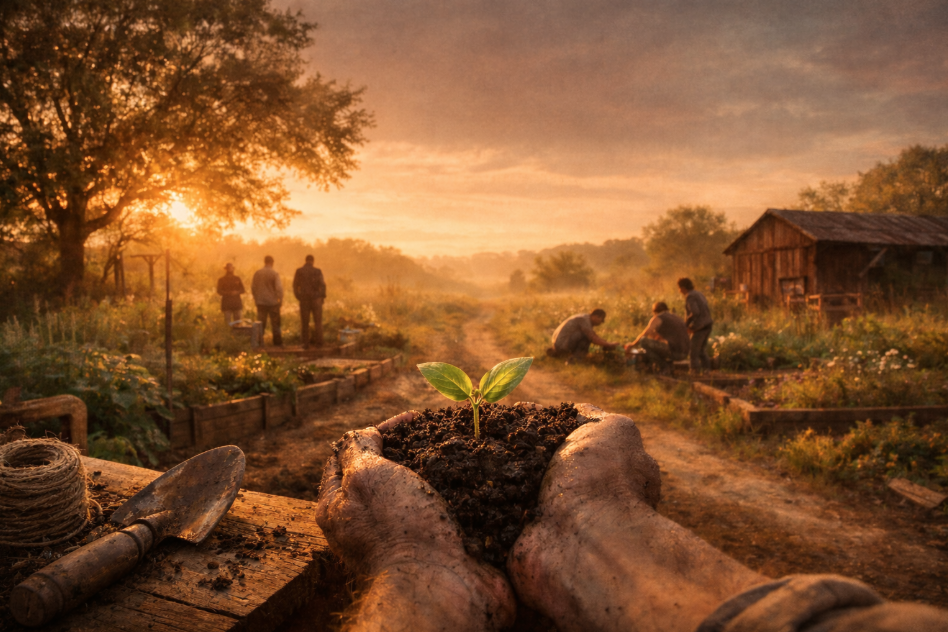
What I hear most often is not rejection, and it is not disbelief. It is affirmation with a boundary attached.
“I know you have faith, but…”
That sentence reveals more than it intends to. Faith is acknowledged just long enough to remain respectable, then quietly restrained before it is allowed to govern anything real. It is welcomed as belief, language, or personal conviction. It becomes a problem the moment it begins to shape timing, funding, pace, or structure.
This is where faithfulness starts to look irresponsible.
Most of the systems we live inside reward what can be proven in advance. Movement is justified when outcomes are forecasted. Decisions are validated when risk is minimized. Wisdom is defined by predictability. Faithfulness refuses those terms. It moves when clarity is present, not when certainty is secured. It walks without borrowing reassurance from the future.
That posture unsettles people, not because it is careless, but because it exposes where trust actually lives.
The Garden Project is not theorizing this. It is living it. Not as a philosophy or a spiritual brand, but as a daily posture. Provision here is relational. Timing is organic. Obedience is practiced rather than explained. There is no rush to reassure observers, no performance of competence to calm anxiety. The work simply continues in alignment with what has been entrusted.
When people encounter that up close, without urgency, without metrics, and without constant justification, tension rises. Not because something is wrong, but because something familiar is missing. The usual scaffolding of control is absent. That absence reveals how much of modern wisdom is built on fear management rather than trust.
That discomfort often turns into projection. What cannot be measured gets labeled vague. What does not rush gets interpreted as drifting. What refuses to hedge gets called irresponsible. But the tension does not originate in the work itself. It originates in the contrast between embodied trust and managed safety.
Creation makes this contrast unavoidable.
Seeds placed underground look wasted for a time. Beds at rest look unproductive. Soil left undisturbed looks neglected to anyone trained to equate value with visible output. But rest is not neglect. Burial is not loss. Waiting is not irresponsibility. These are conditions life requires.
Nature does not explain itself. It does not defend its timing. It does not adjust its rhythms to match opinion cycles. It grows according to design, not consensus.
Jesus taught this way intentionally. He was anchoring the unseen in the seen. Every parable He told was tethered to something observable. Seeds. Soil. Birds. Fields. Weather. Labor. He was not asking people to imagine the Kingdom. He was pointing to it already operating in front of them.
His teaching only works if observation is still intact.
When I say people do not observe anymore, I mean it literally. We analyze. We theorize. We spiritualize. We outsource knowing to institutions and explanations instead of paying attention to what is faithfully revealing itself every day. We often speak as if this wisdom vanished with the Indigenous people who stewarded this land before us, as though attentiveness itself disappeared with them.
But the land never stopped teaching.
What was lost was not knowledge, but posture. Presence was replaced with productivity. Speed replaced attentiveness. Control replaced listening. Creation did not go silent. We did.
The Garden Project exists to reintroduce listening to the land, not as a novelty or a wellness exercise, but as an ancient necessity. We are not running a program. We are hosting a space.
For most of human history, survival required attentiveness. You had to notice when soil changed, when water lingered or disappeared, when plants signaled stress, when seasons shifted. You could not dominate land you depended on. You had to cooperate with it. That posture formed restraint, humility, and patience.
For many who enter the garden today, this is the first time they have ever been asked to listen rather than manage. To observe without extracting. To stay present without rushing toward outcome. To touch soil without needing to explain it or turn it into something productive.
Nothing mystical is being added here. Something ancient is being remembered.
Faithfulness grows naturally in this space because faith was never meant to float above reality. It was meant to be practiced within it. Listening to the land does not replace listening to God. It restores it.
This is why the phrase “I know you have faith, but…” keeps surfacing. It reveals how faith has been domesticated. It is allowed to comfort and inspire, as long as it does not organize life. As soon as faith begins to lead decisions, people reach for familiar safeguards. Hedge a little more. Secure something tangible. Translate obedience into something easier to defend.
Questions about funding expose this quickly.
“Have you secured new funders?”
It sounds practical, even caring. But beneath it sits a deeper assumption that legitimacy comes from accumulation and safety comes from diversification. The question is not really about money. It is about authorship.
I have one funder. The one who authored my life for His glory.
That answer unsettles people because it cannot be mapped, guaranteed, or insured. But it is not abstract. It is embodied. Provision has arrived not by stockpiling reassurance, but by obedience in motion. Not early. Not late. In season.
Creation has all the answers I actually need.
Soil teaches timing.
Seasons teach restraint.
Roots teach patience.
Ecosystems teach provision without hoarding and growth without panic.
I place no hope in American culture to define truth or sustain life. It changes its convictions every few years. It is governed by beliefs I do not share. I give to Caesar what is Caesar’s. I comply where required. I participate where appropriate. But I do not confuse civic systems with spiritual authority.
The Kingdom I live in is not reactionary. It does not swing with public opinion or election cycles. It is ever increasing. Quietly. Steadily. Like seed beneath the soil.
And almost every time faith is explained this way, rooted in creation and practiced simply, another phrase appears.
“Well, that’s just too simple. Humans are more complex than that.”
That statement sounds thoughtful, but it reveals something deeper. It assumes complexity is evidence of depth and simplicity is reduction. Creation tells a different story. Complexity is not something humans invented. It is something we disrupted.
Soil systems are unimaginably complex. Root networks communicate. Fungi exchange nutrients. Insects coordinate roles. Seasons regulate themselves with a precision no human system has ever matched. Yet none of it is complicated. It works because it is aligned. Complexity held within order becomes simple to live inside.
Human life became complicated when we stopped listening.
We layered management on top of wisdom. We replaced observation with explanation. We confused control with intelligence. The result was not depth, but fragmentation. Complexity did not make us wiser. It made us louder, busier, and less present.
Jesus never treated simplicity as ignorance. He treated it as clarity. He spoke plainly because reality was already doing the heavy lifting. His words only sound simplistic to people who have been trained to live abstracted from consequence.
When someone says, “humans are more complex than that,” what they often mean is, “I no longer trust that reality itself can teach me.” Complexity becomes a defense against obedience. If life is too intricate to understand, then no one has to live faithfully within it.
But creation contradicts that excuse every day.
The land does not ask us to solve it. It asks us to listen.
Faith does not ask us to master it. It asks us to walk within it.
Simplicity is not the absence of complexity.
It is complexity rightly ordered.
This is why faithfulness here does not panic when systems tremble. It does not chase relevance or scramble for protection. It keeps tending what has been entrusted. It keeps honoring timing. It keeps walking within a reality that was true long before this cultural moment and will still be true long after it passes.
Faith does not function well as an accessory. It either orders life or it gets reduced to language. The “faith, but…” posture reveals where many are still negotiating control.
The Garden Project does not argue with that tension. It does not try to resolve it. It simply continues. Seeds go into the ground. Soil rests when it needs to. Life emerges in season.
Those who have spent time observing how ecosystems actually function recognize what is happening almost immediately. Those who have not often struggle, not because the work is unclear, but because it refuses to operate by borrowed certainty.
Faithfulness looks irresponsible until it works.
Then it is quietly reframed as wisdom.
But faithfulness does not wait for that recognition. It stays present within uncertainty. It trusts alignment over applause.
Nothing was lost.
We just stopped paying attention.
And faithfulness begins the moment we start listening again.