Obedience That Nourishes
Alignment, Not Compliance
By Josh Singleton | Founder, serving as Lead Cultivator, The Neighborhood Garden Project
The garden never whooped me into submission. It never coerced, shamed, or demanded compliance. It never sent me outside to pick the switch from the tree that would be used for my own punishment. What drew me in was curiosity. Paying attention. Wanting to understand what was happening beneath the surface and being willing to respond to what I was seeing.
That distinction matters more than we often admit, because many of us were formed in cultures where obedience was taught as conformity. Uniformity. Compliance. Fall in line. Do not question. Do not linger too long. Whether in homes, schools, churches, or institutions, obedience was often enforced through fear, threat, or the anticipation of correction. Even when punishment was not physical, the posture was the same. Authority stood above. The goal was control. The fruit was silence.
Over time, that kind of formation trains the soul to associate obedience with danger rather than life. It leaves a residue. A bad taste in the mouth around authority itself.
That residue does not stop with human relationships. It quietly reshapes how we imagine God.
When obedience is framed as compliance, God begins to look like a supervisor rather than a shepherd. Distant. Evaluating. Easily disappointed. Authority becomes synonymous with control, and control becomes something to fear, resist, or endure. Many people do not reject God. They reject the version of God formed in them through fear-based obedience.
But this is not the biblical picture.
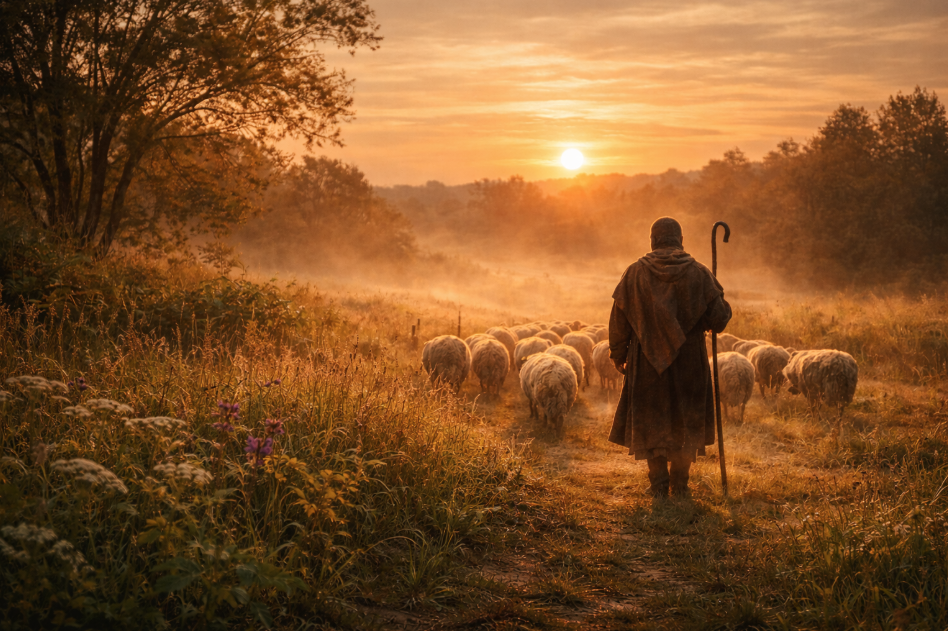
When Scripture speaks of the “rod,” it is not introducing violence. It is invoking shepherding. In Psalm 23, David writes, “Your rod and your staff, they comfort me.” A tool that comforts is not primarily an instrument of pain. The rod was used to guide, to block danger, to rescue, to keep sheep close to what was safe. It symbolized authority exercised through proximity, not domination.
The phrase “do not spare the rod” appears in Proverbs, which belongs to wisdom literature, not legal code. Proverbs is concerned with formation over time, not punishment in moments of failure. The Hebrew word often translated as discipline means instruction, training, and correction toward maturity. It assumes relationship. It assumes presence. It assumes care.
To “spare the rod” was never a call to inflict pain. It was a warning against disengagement. Against withholding guidance. Against abandoning the slow, relational work of formation. The opposite of the rod is not kindness. It is absence.
Historically, force entered the interpretation when authority became separated from relationship. Fear-based systems needed fast compliance. Physical punishment produced immediate results, and those results were mistaken for obedience. But compliance is not alignment. Silence is not trust. Fear can shape behavior, but it cannot shape the heart.
Scripture consistently points in the opposite direction. God seeks relational alignment, not coerced behavior. God walks with Adam and Eve before law exists. God reasons with Cain before violence erupts. God sends prophets to call people back, not enforcers to beat them into submission. Again and again, the invitation is relational. Return. Listen. Walk with me.
Jesus makes this unmistakable. He invites rather than compels. “Follow me.” He describes himself as gentle and lowly in heart in Matthew 11:29. He refuses to call down fire on those who reject him. Even correction is aimed at restoration, not control.
Paul echoes this when he writes in Romans 2:4 that it is God’s kindness that leads us to repentance. Not fear. Not threat. Kindness. Because fear produces survival strategies, not alignment. People learn to perform, hide, or disconnect their inner world from their outer behavior.
The garden formed me differently.
The garden offered margin instead of threat. Nothing bad happened if I slowed down. Nothing was taken away when I noticed more than I acted. Failure did not result in punishment. It resulted in information. The soil responded honestly, not emotionally. Consequences existed, but they were instructive rather than shaming. That margin made curiosity safe, and curiosity opened the door to alignment.
That curiosity led me into alignment long before it ever felt like obedience. I followed what gave life. I stayed close to what was true. Over time, attentiveness became faithfulness, and faithfulness became nourishment. Not because I was forced, but because I was drawn.
This is why obedience here has never felt like conformity. It was not imposed from the outside. It emerged from relationship. From listening. From responding to what the land, the work, and God Himself were revealing. Nourishment did not come from submitting to control. It came from choosing alignment again and again.
And obedience is nothing more or less than alignment. Not compliance. Not performance. Simply the continual choice to live in step with what is true, what gives life, and what is being revealed.
This is what the garden has been teaching me.