When Timelines Are Quietly Woven
How God Forms People in Secret Before Bringing Them Together
By Josh Singleton | Founder, serving as Lead Cultivator, The Neighborhood Garden Project
There is a way God forms people that does not announce itself as formation.
It does not arrive as a calling statement, a role description, or a decisive moment. It arrives quietly, through repetition. Through return. Through ordinary faithfulness to things we keep being drawn back to, often without knowing why.
This is not new. It is a pattern God has used over and over again.
He forms people long before He sends them. He weaves readiness long before He reveals purpose. He allows years of unseen formation to accumulate before anything ever looks meaningful from the outside.
For the three of us, Lizzie, Kayla, and me, that place of quiet formation has been the garden.
For fifteen years and more, gardening has been a part of each of our lives. Not always central. Not always intentional in the same way. Sometimes it showed up as work, sometimes as rest, sometimes as survival, sometimes as joy. At different points, for different reasons, each of us kept returning to soil.
None of us were preparing for an organization. None of us were mapping a future assignment. We were simply being faithful to something ordinary that kept calling us back.
This, too, is part of the pattern.
God rarely forms people through abstraction. He forms them through repetition. Through environments that shape the body, the attention, and the instincts at the same time. Through work that feels simple enough to enter and deep enough to keep shaping long after we stop noticing it.
Looking back, what stands out is not that we all gardened. Many people garden. What stands out is how consistently the garden shaped us without ever demanding that we name what it was doing.
This is informal formation.
Formation without a syllabus. Formation without credentials. Formation without performance metrics. Formation that happens while you are doing something practical and embodied, while God works on something deeper beneath the surface.
The garden trained our attention long before it clarified our direction.
It taught patience without naming it. Timing without explanation. Restraint, loss, care, return, and hope through lived experience rather than instruction. It shaped how we respond to seasons, how we notice people, how we carry responsibility, and how we hold leadership.
At the time, those lessons felt personal. Separate. Individual.
But this is where the pattern deepens.
God does not only form individuals in secret. He forms them in ways that will later recognize one another.
There are moments from those early years that now hold more weight than they ever did when they were happening.
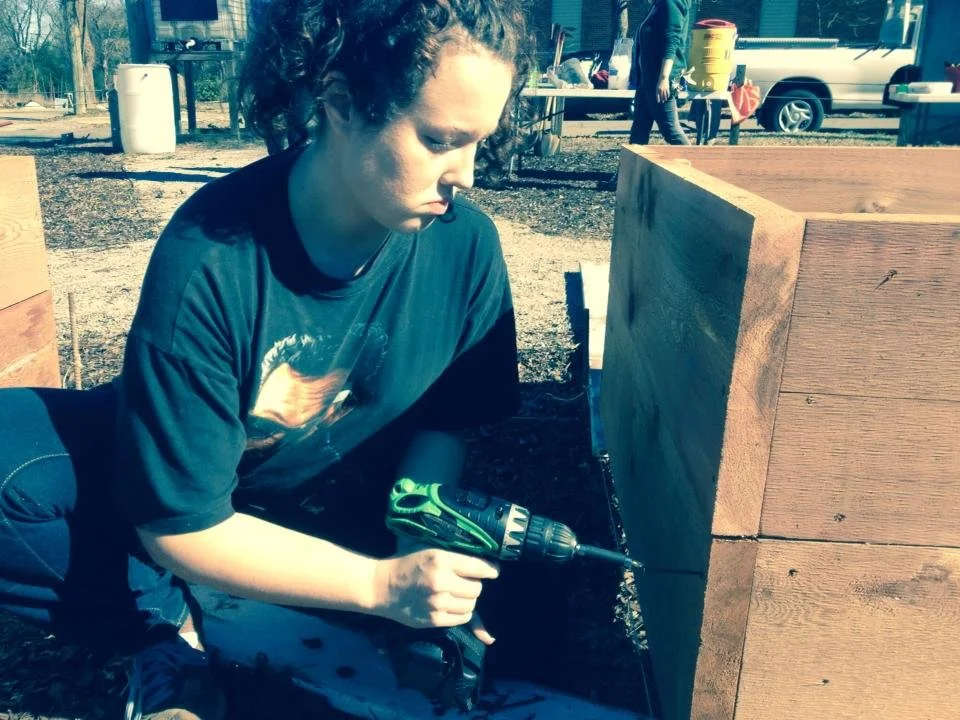
One of them is Lizzie, twelve years ago, building raised garden beds for an organization in Alabama.
She had no experience. No formal training. No credential that would have justified her being there. She was invited by close friends into something that mattered relationally. She drove ninety minutes simply to participate. Not because she was needed, but because the work mattered. Because people mattered. Because contributing to something life-giving mattered.
She showed up with her hands, a drill, and willingness.
What was happening that day was not helping someone in need. It was nourishment moving in both directions. Shared labor. Shared dignity. Shared purpose. Lizzie was being formed as much as she was contributing, even if no one named it that way at the time.
The garden was already teaching her how to show up without control. How to give herself to work that did not center her. How to invest time and energy simply because it was good and right to do so. Long before she carried responsibility within this organization, she was being trained in posture.
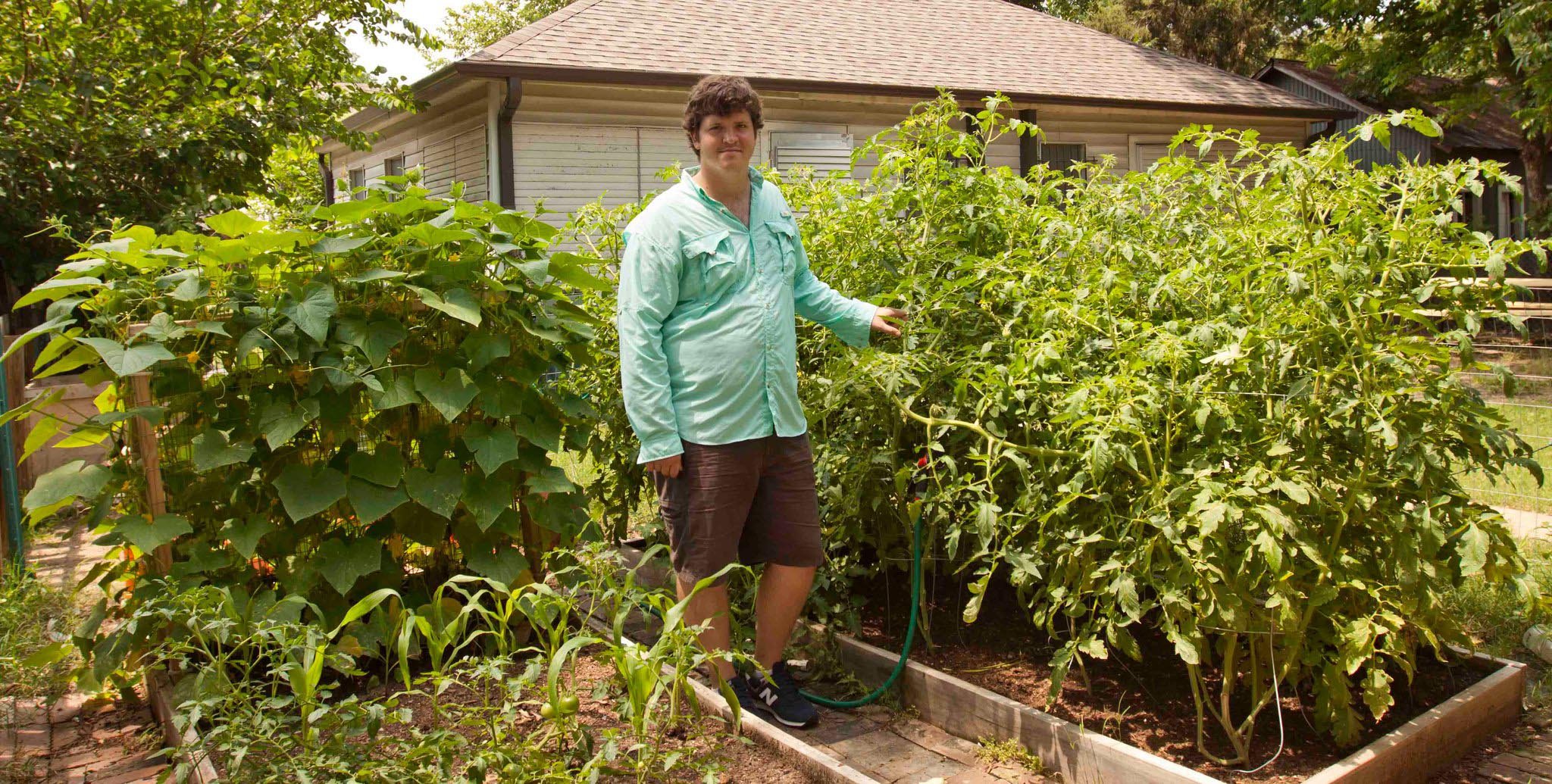
Another moment comes from my own story, sixteen years ago, in my backyard in Dallas.
No audience. No organization. No recognition.
Just soil, plants, and the slow discipline of showing up.
That garden taught me in obscurity. It taught me what stewardship looked like when no one was watching. It taught me what happened when I showed up faithfully, and what happened when I did not. The feedback was immediate and honest. Things either thrived or declined based on attention, patience, and care.
During that season, I would drive around downtown Dallas and notice empty lots scattered through neighborhoods. Vacant spaces where nothing was growing. I would wonder what it would be like if those places held gardens instead. If food, presence, and relationship took root where absence currently lived.
There was no plan. No timeline. No sense that this wondering would become anything.
But something was being formed.
The garden was training my eyes to see possibility where others saw emptiness. It was shaping endurance, faithfulness, and the willingness to keep tending even when nothing obvious came from it.
There is no image from that season of Kayla.
And that feels fitting.
Her formation did not happen in a single visible moment. Fifteen years ago, the garden began quietly drawing her in as well. Through return. Through care. Through responsibility that did not ask to be documented. Through soil that teaches attentiveness and restraint. Through rhythms that shape how a person holds people, work, and life with steadiness.
Her preparation unfolded faithfully, consistently, without witnesses.
By the time our paths converged, what Kayla carried did not need to be explained. It was evident. The garden had already trained her in the kind of care, presence, and constancy this work requires.
None of these moments felt important when they were happening.
They were not framed as preparation. They were simply faithful participation in something relational and alive.
This is also why God did not show us the plan.
Had we been given the full conception of The Neighborhood Garden Project years ago, it would not have helped us. It would have narrowed us. It would have introduced pressure before posture, outcome before obedience, destination before formation. Knowing where something was going would have quietly reoriented us toward management rather than attentiveness, toward protection rather than receptivity, toward control rather than trust.
We would have begun shaping ourselves around an idea instead of allowing ourselves to be shaped by life.
And we would have missed what life was trying to teach us.
A revealed plan would have demanded efficiency. It would have tempted us to optimize our time, our choices, our relationships, and even our faithfulness toward an imagined future. It would have taught us to measure progress instead of receive formation. A hidden plan did the opposite. It kept us available. It kept us teachable. It kept us open to lessons we never would have chosen if we thought we knew where things were headed.
Without a defined outcome, the garden was free to do its deepest work.
It taught patience without urgency. Care without strategy. Faithfulness without reward. Presence without performance. We were not forming toward a goal. We were being formed toward readiness.
This is not incidental. It is essential.
This is another pattern God uses.
He withholds clarity not as punishment, but as protection. He keeps the future obscured so the present can do its full work. When people are entrusted with vision too early, they often begin managing toward it. They prune prematurely. They bypass lessons that feel inefficient. They protect outcomes at the expense of transformation. When vision is delayed, formation is allowed to run its full course.
God does not reveal assignments until the people who will carry them can do so without being crushed by them.
What looks like delay is often mercy.
What feels like wandering is often preparation.
When clarity finally arrived for us, it did not feel like a new idea being introduced. It felt like something being unveiled that had already been formed in us. The convergence of our readiness was not something we orchestrated. It was revealed to us at the moment it could finally be borne.
It was an act of God.
Our timelines did not simply align. They were gathered. At the precise moment when posture, instincts, and capacity had been shaped deeply enough to hold the work without distorting it, God made visible what had been hidden.
By the time clarity arrived, it did not narrow us. It fit us.
The work did not demand that we become someone new. It asked us to bring forward what had already been quietly cultivated. The readiness was there before the revelation. The formation preceded the unveiling.
This is how God protects the work by protecting the people.
And this is why the convergence matters.
Not because it was impressive.
Not because it was strategic.
But because it happened at the only moment it could have happened without breaking what God was building in us.
This is how God works.
He uses ordinary faithfulness to shape people for responsibilities they do not yet know they will carry. He forms posture before position. He cultivates instinct before authority. He allows people to be nourished by the work long before the work ever flows through them toward others.
Only later does the pattern reveal itself.
Each of us was not only being formed in soil, but being formed for different kinds of responsibility.
Lizzie, Kayla, and I all carry uniquely different parts of this organization, and we were prepared for that long before we ever worked together. The time each of us spent gardening separately did not make us interchangeable. It made us distinct.
The garden formed different instincts in each of us.
It shaped how we listen, how we lead, how we hold boundaries, how we respond to tension, how we care for what is fragile. We did not learn the same lessons in the same way, even though the soil was a shared teacher.
This is another pattern God repeats.
He does not mass-produce servants. He forms people in specific environments that prepare them for specific kinds of stewardship. Later, when their paths intersect, those differences do not compete. They fit.
Only later did it become clear that God was not just forming us separately.
He was weaving timelines.
Each of us was being shaped long before our paths crossed in this work. Long before there was language for mission, replication, or stewardship. God was laying strands quietly, faithfully, without urgency.
Not in parallel lines, but in complementary ones.
The calling did not create the alignment.
The alignment revealed the calling.
When our timelines converged, it did not feel forced or strategic. It felt familiar. As if something that had been growing separately finally recognized itself in the presence of the others.
He does not rush people toward purpose. He prepares them through long obedience to small, faithful things. He allows years of unseen formation to accumulate until a moment arrives when what has been shaped quietly can finally be shared faithfully.
When our paths merged, it did not feel like starting something new. It felt like continuing something old, together.
The garden had become a common language before we ever named it as such.
It shaped how we value presence over productivity, discernment over speed, depth over scale. It gave us shared instincts for readiness and restraint, for knowing when to act and when to step back.
This is why the work unfolding here cannot be reduced to a model.
It follows a pattern older than strategy.
It was not designed on paper. It was cultivated in people.
And this is why we do not use job postings.
Why we do not review resumes.
Why we do not scan LinkedIn for credentials.
Those tools exist for a reason.
They are used because pressure demands them. Because expansion without depth demands them. Because businesses and institutions looking to increase margin need people who can be assessed quickly, categorized efficiently, and deployed predictably.
Hiring tools are responses to urgency.
They help systems grow faster than formation allows.
But speed has a cost.
When growth outpaces formation, assessment replaces discernment. Credentials substitute for character. Readiness is assumed rather than revealed. The system must protect itself from risk, so it relies on visible markers instead of lived evidence.
That is not how this work grows.
Informal formation revealed at the right time is bulletproof.
It does not collapse under pressure. It does not need to perform competence because competence has already been tested in obscurity. What has been shaped through years of faithful return to real work does not disappear when conditions change.
This is the pattern God uses.
He forms people in places where no one is watching, then reveals them only when their formation can bear weight. By the time they arrive, they are not auditioning. They are ready.
When formation comes first, discernment replaces recruitment.
We do not go looking for people to fill roles. We pay attention to who keeps showing up. Who has been shaped by life in ways that match what the work actually requires. Who carries the posture long before they carry responsibility.
By the time someone’s timeline intersects with this place, their preparation is already evident. Not because they told us who they are, but because their formation shows it.
This is slower.
And it is stronger.
And it has led us to another clarity.
Our story is not the story.
It is part of a much larger one.
There are others whose timelines are already being woven into this same work, even if they have not yet arrived. People still being formed in quiet places. In jobs that feel unrelated. In seasons that feel hidden or unresolved. Their formation is underway, even if they cannot yet see where it is leading.
God does not wait for visibility to begin shaping people. He works in secret long before He works in public.
What matters now is not holding the center, but stewarding the space.
My role in this season is not to become more central, more indispensable, or more impressive. It is to move out of the way with intention. To guard the soil. To hold the container open. To make room for those who are coming.
Some of them will be more equipped than me. More articulate. More skilled. More naturally suited to walk closely with those who will encounter this work at a deeper level. That is not a threat. It is evidence that formation is working.
If the work depends on one person remaining at the center, then it was never truly alive.
If it can receive new hands, new voices, and new leadership without losing its posture, then it is growing the way living things are meant to grow.
The garden taught this long ago. You do not grow plants by standing over them. You grow them by tending the soil and then stepping back far enough for life to do what only life can do.
This is true of people too.
This is not a solitary posture. It is a shared one.
The three of us are committed to this work together. Not to holding influence, but to holding space. Not to being the most visible, but to stewarding faithfully what has been entrusted to us for this season.
We trust that the ones who are coming are already being prepared. Their timelines are already in motion. Our role is not to manufacture their arrival, but to remain faithful so that when they do arrive, the ground is ready to receive them.
This is the work we are committed to.
To walk attentively.
To steward space with humility.
To welcome what God is still weaving.
Because this is how God has always worked.
Quietly. Faithfully. Patiently.
And always ahead of us.