When Professionalism Becomes a Substitute for Proximity
How Nonprofits Create Distance Without Meaning To
By Josh Singleton | Founder, serving as Lead Cultivator, The Neighborhood Garden Project
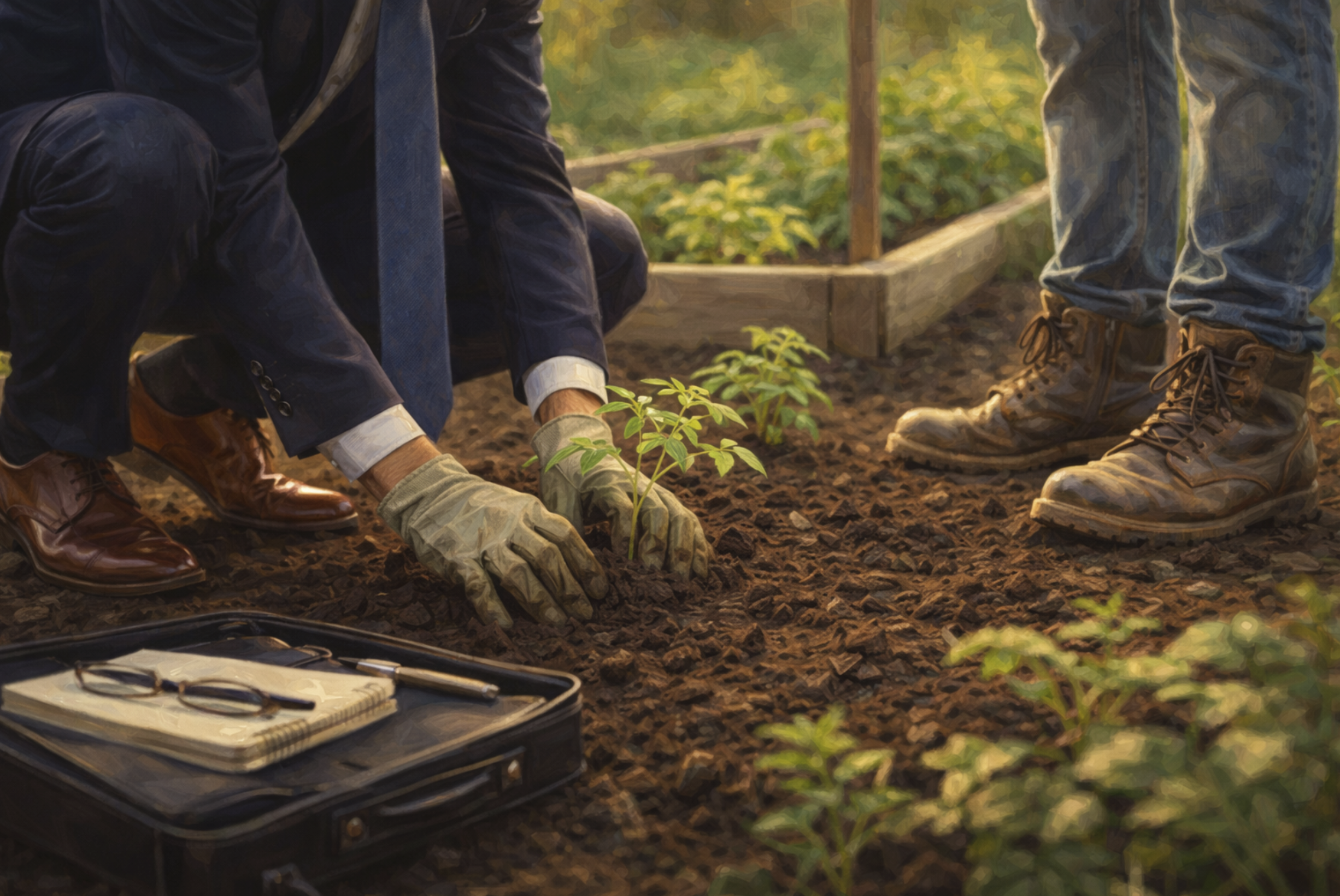
There is a pattern nonprofits rarely name out loud, yet it shows up everywhere. The more “professional” an organization becomes, the more distance grows between the helper and the helped. What begins as care slowly drifts into management. What begins as relationship becomes oversight. What begins as shared life becomes program delivery. None of this happens with bad intent. It happens because the structures most nonprofits are built on require distance to function. Professionalism doesn’t create distance. It fills the space that distance creates.
Most nonprofit leaders do not want this drift. They enter the work with compassion, conviction, and a desire to see people restored. But over time, as organizations scale, secure funding, and describe their work through institutionally approved language, something quiet but significant shifts. Leadership begins spending more time explaining impact than being present inside it. Decision-making moves farther from the soil where life is actually happening. Layers of policy, reporting, and structure create insulation. And eventually, without noticing, leaders begin stewarding an image of the work more than the work itself.
The gap that opens up is rarely questioned, because professionalism is framed as evidence of maturity. The more polished the language, the more sophisticated the reporting, the more structured the programs, the more credible the organization appears. But credibility can hide distance. Professionalism often replaces presence, and people become recipients rather than participants. The fewer chances people have to be known, the more professionalism must step in to manage them at scale.
This gap does not appear randomly. It is produced by familiar nonprofit models that are widely accepted, often rewarded, and rarely questioned.
Program-delivery organizations are built around predefined solutions. Curricula, timelines, and outcomes are set in advance. Staff are trained to administer the program faithfully rather than adapt relationally. Success is measured by completion, not connection. Over time, people become participants in a model rather than neighbors in a shared process. Relationship becomes secondary to fidelity.
Case-management models are designed to bring order to complexity. Needs are assessed, documented, prioritized, and routed through systems. While this can be helpful in moments of crisis, it often creates an invisible hierarchy. The helper becomes the expert over someone else’s life. People are known primarily through files, intake forms, and progress notes. Trust is replaced with compliance. Accompaniment is replaced with oversight.
Advocacy-from-afar organizations arise when leaders speak on behalf of people they rarely encounter. Stories are gathered, distilled, and shaped for audiences far removed from the lived reality they describe. Messaging becomes polished. Policy fluency increases. Meanwhile, the people being represented remain distant from decision-making. Representation replaces relationship, and voice becomes symbolic rather than shared.
Credential-heavy leadership structures elevate academic achievement, managerial experience, and sector fluency as primary qualifications for leadership. Over time, leaders become skilled at managing complexity from a distance. They read dashboards instead of faces. They receive information filtered through layers. Ground truth arrives late, if at all. Intuition dulls. Control increases to compensate.
Funders-first organizations gradually reorient around grant priorities and reporting requirements. Language shifts to match what is fundable. Staff spend more time translating life into metrics than being present with people. Accountability flows upward instead of outward. The organization becomes fluent in justification while proximity erodes.
Emergency-only service models engage people at moments of crisis, provide short-term intervention, and then release them back into isolation. Symptoms are addressed, but rhythm, relationship, and long-term restoration are never cultivated. Help is delivered without accompaniment. Stability is managed, not rebuilt.
None of these structures are malicious. Many emerge from sincere desire to help. But structurally, they all share something in common. They increase distance as they grow, and professionalism is used to hold that distance together.
What gets lost most quietly in this process is mutuality. The helper is positioned as whole, resourced, and stable. The helped is positioned as lacking. One pours out. The other receives. But this is not how nourishment actually works.
In living systems, nourishment moves in both directions.
The truth the garden reveals quickly is that the helper and the helped stand in the same soil, under the same sun, subject to the same seasons. Both arrive hungry, whether they admit it or not. Both are shaped by resistance in the ground. Both depend on rain they cannot control. The soil does not ask who came to give and who came to take. It simply feeds whoever is willing to kneel.
Helping is not a one-way transaction. Healing does not flow in a straight line. Presence steadies both people at once. Shared labor nourishes both bodies. When this truth is acknowledged, hierarchy loses its grip. Expertise softens. Control becomes unnecessary. Professional distance becomes excess.
This is what most nonprofit structures cannot tolerate. Mutual need disrupts expertise. Shared formation dismantles hierarchy. When both people are being changed by the same work, the system can no longer pretend one side is whole and the other is broken.
The Kingdom moves in the opposite direction of distance. Jesus did not professionalize compassion or outsource presence. He touched people others avoided. He ate with those institutions kept at arm’s length. He spoke with people rather than about them. His authority came from nearness, not credentials. His ministry never scaled cleanly because proximity resists polish. You cannot standardize presence without losing it.
This is why The Neighborhood Garden Project feels different. It collapses distance by design. Helpers and those who come seeking something stand in the same beds, at the same pace, in the same weather. Leadership is present, not abstracted. There is no professional buffer to hide behind. Presence cannot be delegated. The work is not delivered. It is shared.
This posture naturally serves the working and middle class, people close enough to daily responsibility to feel exhaustion and fragmentation, but not so far removed that life has been fully outsourced to systems. They do not need to be managed. They need to be reconnected. Gardening works because it makes proximity unavoidable. Hands get dirty together. Time slows. Humanity reasserts itself. In the soil, hierarchy dissolves.
The moment this work becomes overly professional, it would break. The moment leadership becomes abstracted, the garden would lose its authority. Because the authority does not come from structure. It comes from shared ground.
There is a quiet warning in all of this. When nonprofits value professionalism more than proximity, they risk protecting the organization at the expense of the people. When leaders are praised for being indispensable but rarely present, something essential has already been lost.
The Kingdom does not advance through distance. It advances through nearness.
Competence still matters. Structure still matters. But they must serve relationship, not replace it. The more gaps there are between the helper and the helped, the more professional the system must become to justify those gaps. The fewer the gaps, the more human the work must remain.
And humanity, shared and nourished in both directions, is where the Kingdom does its best work.