Consider the Chickadee
Why trust must be lived in the body before it can be spoken
By Josh Singleton | Founder, serving as Lead Cultivator, The Neighborhood Garden Project
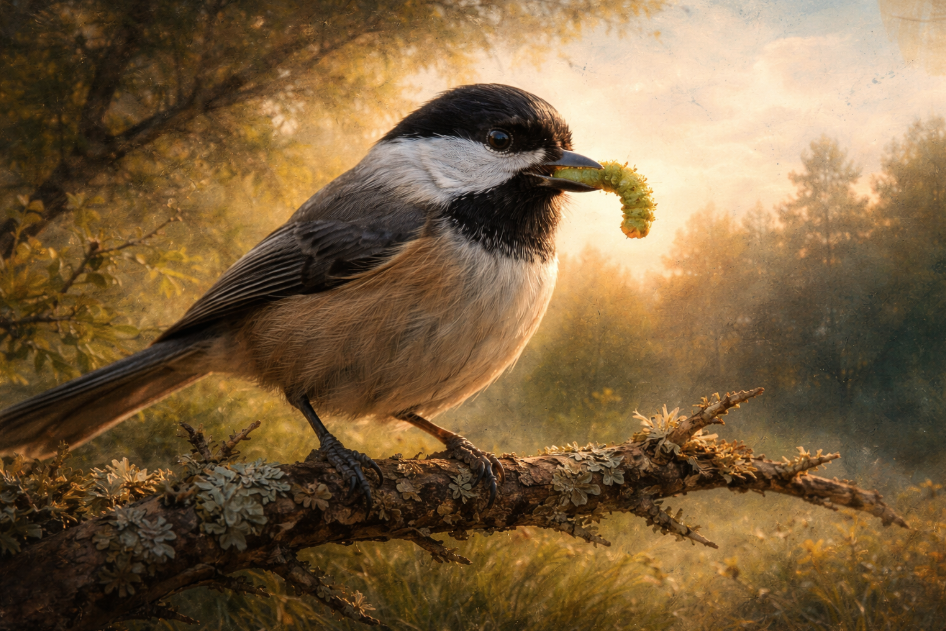
The chickadee is one of the most common birds in the garden, which is precisely why it is easy to miss. It is small, quiet, and familiar. It does not arrive announcing itself. It does not dominate space or demand attention. It simply lives its life in full view, day after day, season after season.
And that is exactly why it carries weight.
Most talk about gardening, especially in faith spaces, stays conceptual. Soil becomes metaphor. Seeds become ideas. Growth becomes outcomes. Gardening is used to explain spiritual truths while remaining insulated from risk, dependence, and restraint. Even Jesus’ words are often treated this way, admired as teaching rather than recognized as description.
But Jesus did not speak from abstraction.
When He talked about seeds, birds, fields, bread, lilies, and harvest, He was pointing to realities people could see and touch. The people listening lived inside an agrarian economy. If crops failed, people went hungry. If daily provision did not arrive, families suffered. Dependence was not symbolic. It was embodied.
So when Jesus said, “Consider the birds,” He was not offering comfort language. He was pointing to a survival pattern that could be observed, tested, and trusted. Birds did not hoard. They did not build storehouses. They did not panic about tomorrow. And they did not starve. That was not theology. It was evidence.
The chickadee makes this reality visible today.
During nesting season, a pair of chickadees feeds their young between 6,000 and 9,000 caterpillars before the chicks fledge. That nourishment does not arrive through one dramatic effort. It comes through hundreds of repeated trips. Back and forth. Again and again. Presence, not efficiency, sustains life.
There is no stockpiling. No hoarding. No attempt to solve the entire season in advance. Provision arrives as the day unfolds.
This is not metaphor. It is pattern.
Outside of nesting season, chickadees prepare for winter in a way that deepens the lesson. They do not build a single storehouse. Instead, they cache tiny amounts of food across hundreds or thousands of locations. Bark crevices. Fence posts. Soil cracks. Each cache is insignificant on its own.
And here is the detail that most people miss.
Some of those caches will spoil. Some will be stolen. Some will be forgotten. And it does not matter.
No single cache is essential. No loss threatens survival. The chickadee does not treat waste as failure. It does not interpret loss as danger. Its life is not dependent on any one provision. Security does not come from preservation. It comes from intimacy with place, memory of movement, and trust in return.
The chickadee survives because it knows where it lives.
This exposes one of the most misunderstood aspects of provision.
We are taught to believe that provision must be secured in advance. That resources must be guaranteed before movement. That faithfulness should wait until certainty arrives. Loss, in this mindset, is intolerable. Waste is immoral. Control is necessary.
But creation tells a different story.
Some loss is not failure. Some spoilage is not inefficiency. It is the cost of resilience. Life that depends on a single storehouse is fragile. Life that distributes nourishment across many places can endure disruption without panic.
This is not symbolic language for us. It is lived practice.
We do not hoard resources. We do not overthink provision. We do not attempt to solve entire seasons ahead of time. We live intimately within the human and physical landscape of the work God has entrusted to us. Care is distributed, not centralized. Nourishment is placed relationally. Small acts of faithfulness are scattered across time and people, trusting they will be available when needed.
And if some of that nourishment is never used, if some conversations do not lead anywhere, if some effort appears wasted, that is not failure. That is resilience. Nothing has to carry the whole weight. No single relationship has to perform. No moment has to justify itself.
Like the chickadee, we trust memory over management.
There is another layer that completes the picture, and it is the one most often overlooked.
The chickadee does not search broadly for provision. It does not scan the horizon looking for abundance somewhere else. It flies within its territory. And as it moves, resources appear. Caterpillars are not discovered through strategy. They are encountered through faithful motion. The bird’s flight itself brings it into contact with what sustains life.
Provision does not precede movement.
Provision is revealed through movement.
Resources do not appear first and then invite the chickadee to fly. The chickadee flies because flying is what it was created to do. And in doing so, it quite literally flies into nourishment.
This is not poetic language. It is biological reality.
And it is the same pattern for a human living inside a God-given assignment.
When life is lived abstractly, we wait for provision before obedience. We wait for funding before movement. We wait for certainty before faithfulness. We want resources to appear first so action feels justified. But when life is lived inside assignment, provision is encountered relationally. Conversations open doors. Presence reveals opportunity. Needs are met not because they were solved in advance, but because we were in the right place, moving at the right pace, with attention.
This way of life looks irresponsible to systems built on forecasting, accumulation, and control. But it is deeply responsible to reality. It requires presence. It demands restraint. It refuses fear.
Jesus lived this way.
He did not store bread. He trusted hospitality. He did not hoard followers. He sent them out. He did not build institutions for security. He stayed present to what the Father was doing that day.
“Give us this day our daily bread” was never meant to be poetic. It was meant to be observable.
This is why the garden is not a teaching prop. It is a training ground. The soil does not illustrate truth. It enforces it. You cannot fake dependence when your hands are in the dirt. You cannot spiritualize trust when weather turns or harvest is thin.
The chickadee matters because it lives this truth out loud.
It caches without hoarding.
It accepts loss without fear.
It moves before certainty.
It flies within its assignment.
And in motion, it encounters what it needs.
And like the chickadee, that is how life endures.
And it is enough.