When Faithfulness Is Enough
Joseph, Undivided Focus, and True Fatherhood
By Josh Singleton | Founder, serving as Lead Cultivator, The Neighborhood Garden Project
I keep returning to Joseph.
Not because Scripture gives us many words about him, but because it gives us so few. His quiet presence feels deliberate, almost instructional. Joseph stands at the center of one of the most important formation stories in human history, and yet he speaks nothing on the page. What we are shown instead is posture, rhythm, and faithfulness lived over time.
We often talk about Jesus as if His divinity erased the need for formation. As if being God meant He arrived complete, untouched by time, immune to the shaping power of ordinary human life. Scripture does not support that idea. It tells us plainly that Jesus grew in wisdom, in stature, and in favor with God and with people. Growth is formation language. It means time mattered. Relationship mattered. Environment mattered. Becoming mattered.
That makes Joseph essential.
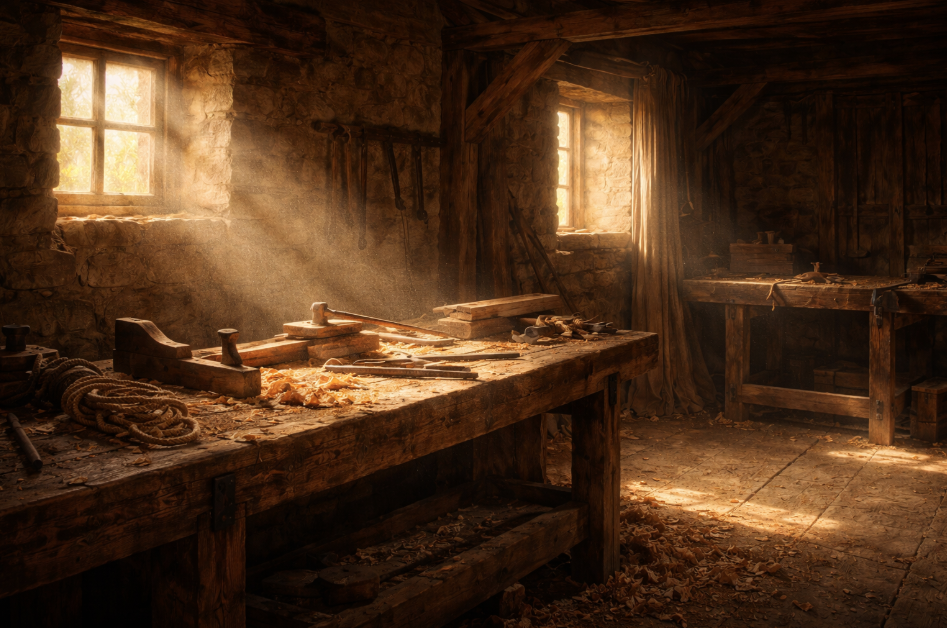
Joseph did not teach Jesus theology. He taught Him how to live. How to wake up and work. How to listen before acting. How to carry responsibility without controlling outcomes. How to obey God without needing explanation or recognition. Nazareth was not a delay in the story. It was a workshop. A place where humanity could mature without distortion.
Joseph’s fatherhood was not primarily about food, shelter, or clothing, though those were faithfully provided. Those things flowed naturally. The deeper work was the stewardship of the heart. He created safety without indulgence, structure without pressure, provision without anxiety, and presence without control. That kind of environment forms security. Security forms clarity. Clarity allows authority to emerge without striving.
What deepens this further is the way Joseph himself had clearly been formed long before Mary conceived.
Joseph does not appear as a man inventing righteousness in a crisis. His mercy toward Mary, his immediate obedience to God’s instruction, and his capacity to absorb misunderstanding without defending himself all point to a life already shaped. That kind of steadiness is not improvised. It is inherited through formation.
Scripture places Joseph in the lineage of David. We often read that as a legal necessity for Jesus. But biblical genealogies do more than establish right. They signal pattern. They tell us what kind of people God has been cultivating across generations.
David’s line is not marked by uninterrupted power or public success. It is marked by repentance, restraint, and return. Men who fail, are confronted, and choose humility over control. Over time, that kind of lineage produces people who understand authority as responsibility rather than entitlement.
Joseph carries that inheritance quietly. He belongs to a royal line reduced to obscurity, yet he shows no hunger for status. No resentment toward smallness. No attempt to reclaim lost glory. That tells us his formation included learning how to live faithfully without prominence. That lesson is rarely learned in one generation.
It also explains why carpentry mattered so much.
Trades like carpentry were often passed down within families. Joseph likely learned his craft from his father, just as Jesus learned it from him. Not just the skill, but the way of working. Patience with resistant material. Precision without spectacle. Submission to limits. Attention that cannot be divided without consequence.
Wood does not hurry. It reveals grain slowly and exposes force immediately. A carpenter cannot rush without damage. Day after day, Joseph worked with a material that trained cooperation rather than domination. Jesus learned that posture long before He spoke about seeds, vines, foundations, or yokes. When He later spoke about houses built on rock, He was speaking from His hands.
Carpentry also forms integrity. Most of its work disappears once the structure stands. Joints are hidden. Measurements must be exact. Either something holds weight or it does not. There is no room for performative goodness. Joseph’s righteousness looks exactly like that kind of work. Quiet, exact, trustworthy.
This work also demands undivided attention. You cannot cut straight while distracted. One moment of inattention ruins hours of effort. Presence is not optional. It is required. Joseph’s singular focus was not mystical. It was practiced surrender shaped by daily labor that demanded wholeness.
What stays with me is that Joseph modeled all of this without the indwelling Spirit as we understand it after Pentecost. He did not lead from inner empowerment. He led from alignment. His will was already settled. His loyalties were already clear. When instruction came, he moved. No bargaining. No delay. No self-protection. His obedience was not dramatic because it was habitual.
Joseph also understood something our culture resists. His role was seasonal. He knew when to protect and when to release. His disappearance from the Gospel narrative is not failure. It is completion. If the life entrusted to you can stand without you, the work is done. True fatherhood works itself out of visibility.
As I sit with all of this, I cannot miss how deeply it mirrors what we are walking out in The Neighborhood Garden Project.
Gardening, like carpentry, refuses hurry. Soil exposes control. Seeds cannot be coerced. Growth responds to conditions, not pressure. Gardening forms patience, restraint, timing, and trust. You prepare the ground, tend faithfully, and wait without guarantees. You steward life without owning it.
Just as carpentry shaped Joseph into a man capable of hosting the Messiah, gardening has been shaping me, and shaping this work, into something capable of hosting formation in others.
The garden has never been about speed or scale. It has always been about formation before visibility. Roots before fruit. Hidden faithfulness before public outcomes. Many pass through. Few remain. That is not loss. It is discernment.
Like Joseph, the garden operates from stewardship rather than ownership. The land is held, not possessed. People are accompanied, not used. Nothing is rushed. Nothing is extracted. Everything is entrusted for a season.
Formation happens here the same way it happened in Nazareth. Through proximity. Through rhythm. Through presence. People do not change because they are instructed well. They change because they are surrounded by something aligned long enough for it to re-form them. The soil teaches because the posture is already right.
Provision follows the same order. Joseph provided because his heart was ordered, not because he was anxious. The garden works the same way. We tend what has been given. We do not chase provision. Trust comes first. Overflow follows.
Leadership here is meant to be seasonal. Mentorship replaces dependence. If someone no longer needs us, the system worked. That runs against nearly every institutional instinct, but it feels deeply Kingdom-shaped.
Joseph never confronted the broken systems of his time. He simply lived rightly within them. The garden does the same. By being slow, relational, and grounded, it quietly exposes how hurried and extractive much of life has become. The contrast speaks without accusation.
Nazareth had wood and tools.
We have soil and seeds.
Different materials.
The same formation.
Joseph did not need to be known.
He needed to be faithful.
And in the same way, the garden does not need to be impressive.
It needs to be aligned.
If it is, the fruit will speak, long after the names fade.