Stop Standing at the Door
Relearning the Gospel Jesus Preached
By Josh Singleton | Founder, serving as Lead Cultivator, The Neighborhood Garden Project
For many, the Gospel has become a message about where you go when you die, how to manage guilt, or how to secure divine approval. It is often framed as a transaction, a belief system, or a safety net. Believe the right things, behave well enough, and trust that someday God will take you somewhere better. This version of the Gospel offers reassurance without transformation and comfort without confrontation. It promises safety but asks very little of how we actually live.
But that is not what Jesus preached. It is not what He taught, what He embodied, or what He reopened. Jesus did not arrive announcing an escape from the world. He arrived announcing the restoration of it. His opening proclamation was not about leaving earth behind, but about heaven returning to earth. When Jesus declared, “The Kingdom of God is at hand,” He was not speaking metaphorically or poetically. He was making a concrete claim about reality. He was saying that the distance humanity had learned to accept between itself and God was no longer necessary. God was not far away, not waiting for the right conditions, not hiding behind systems, sacrifices, or special access points. The Kingdom was present, reachable, accessible, and enterable.
Somewhere along the way, we began preaching a different gospel. Not an entirely false one, but a smaller one. A safer one. A gospel centered on belief rather than life, agreement rather than formation, and destination rather than participation. Jesus preached the Kingdom. We often preach about Jesus. That difference matters more than we are willing to admit, because it quietly reshapes what we expect faith to do and who we believe we are meant to become.
What Jesus Actually Preached
Jesus did not preach Himself. He preached the Kingdom. This distinction is essential, because much of modern Christianity reverses that order without realizing it. We treat Jesus primarily as the object of belief while neglecting the substance of what He actually proclaimed. Jesus did not travel from town to town asking people to admire Him, defend Him, or build institutions around His name. He announced access to a way of life.
He spoke of God as Father, not as a distant authority figure to be appeased. This was not sentimental language. It was a radical reorientation of relationship. A Father implies inheritance, belonging, provision, and shared life. Jesus was not softening God. He was revealing Him. He spoke of authority returning to ordinary people, not remaining concentrated among elites, priests, or scholars. Fishermen, tax collectors, women, and the overlooked were entrusted with authority over sickness, spirits, and systems. This authority was not symbolic. It was practiced.
Jesus spoke of healing as restoration, not as an occasional exception. Healing was not presented as a rare divine favor but as evidence that the Kingdom was breaking into what had been broken. It restored people to community, dignity, and participation in life. He spoke of forgiveness as release, not leverage. Forgiveness was not a bargaining chip used to manage behavior. It was the removal of debt that prevented people from living freely. He spoke of freedom as alignment with reality, not rebellion against rules. Freedom was not the absence of limits, but the ability to live in harmony with how life actually works.
The Good News Jesus preached was not, “Try harder and God might respond.” It was, “God has come near, and the way is open.” When Jesus said the Kingdom was near, He was not describing geography. He was describing availability. What had been mediated through temples, sacrifices, priests, and systems was now directly accessible. Relationship was no longer filtered. Authority was no longer outsourced. Participation was no longer restricted. This is what Jesus preached.
What Jesus Taught Us to See
Jesus taught almost exclusively in stories, not because truth was complicated, but because people had lost the ability to recognize what was already true. He did not replace people’s understanding of the world. He healed it. Seeds, soil, fields, bread, lamps, paths, gates, vines, storms, and seasons were not illustrations layered on top of theology. They were the theology. Jesus was not borrowing language from daily life to explain spiritual ideas. He was revealing that daily life had always been the classroom.
He was teaching people to see again. Growth depends on conditions, not effort alone. Compacted soil cannot receive seed no matter how valuable the seed is. Shallow soil may receive seed quickly, but it cannot sustain growth under heat. Crowded soil chokes life even when the plant itself is healthy. These are not moral failures. They are formation failures. Life grows quietly and invisibly before it becomes visible. Seeds break open in darkness. Roots spread unseen. Strength develops underground long before fruit appears. You cannot rush this process. You can only steward conditions and trust what is alive.
Jesus showed that fruit tells the truth about roots. What appears above the surface always reveals what is happening below. Managing appearances does not change reality. Depth determines durability. He showed that paths lead somewhere and that direction matters. Some paths feel easy because they resist nothing. Others feel narrow because they require alignment. Narrowness was never about restriction. It was about clarity. Jesus did not give people a doctrine to defend. He gave them a way to walk. This is what Jesus preached.
The Garden Was Always the Classroom
Jesus sounded like a gardener because creation was not a metaphor. It was the curriculum. Soil teaches receptivity before productivity. Healthy soil is open, structured, and alive. Compacted soil resists life not because it is bad, but because it has lost permeability. Exhausted soil cannot sustain growth because it has been overworked without restoration. Neglected soil becomes crowded and choked. These are not moral judgments. They are condition failures.
Roots teach patience. They grow in darkness, spread slowly, and respond to resistance, moisture, and nutrients. Strength develops unseen. A plant does not will itself into depth. It responds to its environment. Pruning teaches discernment. Cutting is not violence. It is care. Growth left unchecked weakens the whole plant. Fruitfulness requires subtraction. Fruit teaches timing. It comes in season or not at all. Forced fruit damages the plant and reveals a misunderstanding of how life works. Rest teaches trust. Soil must lie fallow or it depletes. Fields that never rest eventually fail, no matter how skilled the farmer. Rest is not a reward. It is design.
Nothing in a healthy garden is frantic. Nothing grows out of season. Nothing is wasted. Even decay feeds what comes next. The garden does not argue. It reveals. Jesus was restoring literacy in reality. He was teaching people how to read life again. This is what Jesus preached.
The Mistake We Keep Making With the Disciples
We shrink the Gospel by anchoring our expectations to the disciples before Pentecost. We quote their confusion as permission, frame their fear as humility, and normalize immaturity as honesty. Over time, the disciples’ transitional state becomes the ceiling instead of the threshold. But the disciples before Pentecost were not the model. They were the transition.
They lived in proximity, not indwelling. Jesus was with them, but not yet within them. Their confusion was not failure. It was limitation. Something essential had not yet been given. If proximity were enough, Jesus would have stayed. If imitation were enough, Pentecost would not have been necessary. When we preach the disciples’ confusion without preaching Pentecost, we quietly redefine the Gospel. We present a Jesus who forgives unbelief but never intends to heal it, a Jesus who stands near but never indwells, a Jesus who lowers expectations instead of fulfilling His promise. That is not the Gospel Jesus preached.
What makes this mistake especially damaging is that it subtly shifts responsibility away from transformation and onto reassurance. By treating pre-Pentecost faith as the norm, we excuse fragility instead of addressing its cause. We teach people to manage doubt rather than move through it, to expect collapse under pressure rather than formation through it. In doing so, we preach a Gospel that accommodates immaturity instead of completing the story Jesus actually told. The disciples’ early weakness was never meant to become our permanent theology. It was meant to highlight why indwelling life was necessary.
What Pentecost Actually Changed
Pentecost was not primarily emotional. It was structural. It did not mark a peak spiritual experience or a dramatic moment meant to be remembered nostalgically. It marked a fundamental shift in how God related to humanity and how humanity was now meant to live. The Kingdom did not move closer at Pentecost. It moved inside.
Up until that moment, access to God had always been mediated. Even when Jesus walked physically among the disciples, trust, clarity, and authority still depended on proximity. When fear rose, they looked outward. When confusion surfaced, they waited for correction. When pressure increased, their faith wavered because it still relied on Jesus standing nearby to carry what they could not yet hold. Pentecost ended that arrangement.
What had been external became internal. What had been near became indwelling. Authority was no longer borrowed from Jesus’ physical presence. Trust was no longer circumstantial or dependent on visible intervention. Faith no longer rose and fell with outcomes, reassurance, or proximity. The source of stability relocated from outside the person to within them.
The disciples did not become better people in the moral sense. They did not suddenly become braver, smarter, or more disciplined. They became inhabited people. Divine presence took up residence within ordinary lives, reshaping instincts, reflexes, and responses over time. Pentecost did not enhance human capacity. It relocated divine presence, and that relocation changed everything.
This shift also redefined responsibility. Once the Spirit dwelt within, faith could no longer be outsourced to personality, environment, or circumstance. The disciples could no longer rely on Jesus stepping in to stabilize fear or resolve confusion in the moment. That dependence was not removed as punishment, but as maturation. Indwelling presence meant that discernment, courage, and obedience were now expected to arise from within, formed through relationship rather than enforced through proximity.
This is why the language of the New Testament shifts so dramatically after Pentecost. Believers are no longer described primarily as followers standing behind Jesus, but as temples, carriers, ambassadors, and witnesses. The Gospel assumes internal capacity because divine presence has taken up residence. The Spirit was not given to inspire occasional bravery, but to form sustained trust.
Pentecost also explains why faith after that moment could no longer be sustained by spectacle. Signs and wonders still occurred, but they were no longer the foundation of belief. Faith was no longer built on what God might do next, but on who God already was within them. This is what made the early Church resilient rather than reactive. Their environment did not improve. In many cases, it became more dangerous. What changed was not the world around them, but the source of life within them.
From Pentecost forward, obedience no longer waited for certainty. Faith no longer required resolution before movement. Pressure did not signal retreat, and suffering did not imply abandonment. The Spirit within them made it possible to endure difficulty without collapse, disagreement without fragmentation, and opposition without losing direction. Pentecost did not eliminate hardship. It eliminated the need for hardship to resolve before faith could be lived.
This is what Pentecost actually changed. Faith was no longer meant to be borrowed, managed, or stabilized by proximity. It was meant to flow from union. The Kingdom Jesus preached could now be inhabited, not merely observed.
The Door, Not the Pedestal
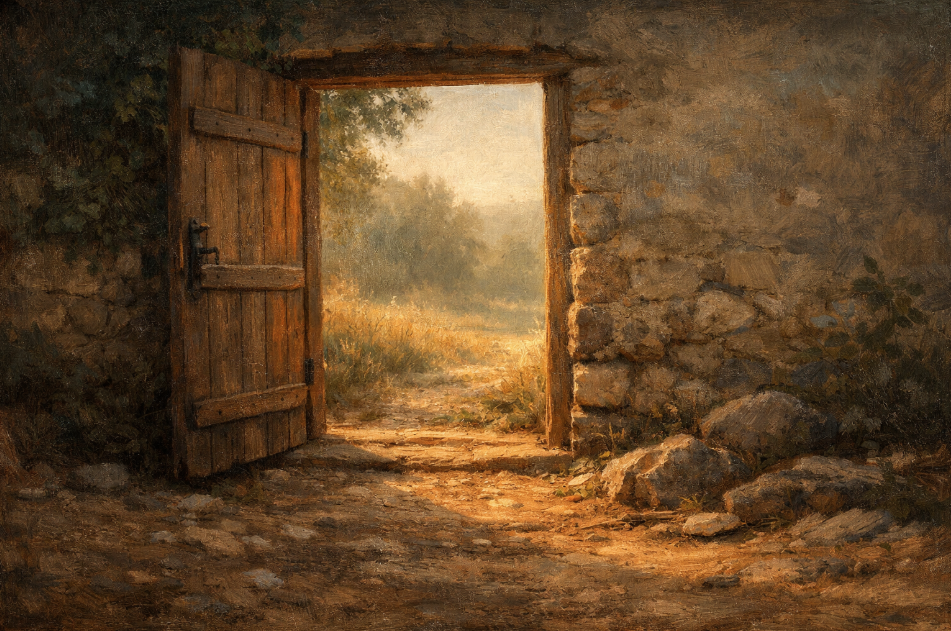
Jesus is the door. A door is not admired. It is entered. A pedestal allows reverence without participation, but a door requires movement. When Jesus is placed on a pedestal, faith becomes static, fixed in place by admiration and protected from disruption. When Jesus remains the door, faith becomes kinetic, requiring response, alignment, and change. A gospel that stops at admiration requires a pedestal. The gospel Jesus preached requires a door. Jesus did not tear the veil so people could stand back and feel grateful. He tore it so they could enter. The tragedy is not rejection. It is hesitation.
I have met countless people who know God and Jesus conceptually, who can speak fluently about theology, Scripture, and belief, yet have quietly pitched a tent at the door. They stand close enough to describe what lies on the other side, close enough to defend it, close enough to feel associated with it, but not close enough to be changed by entering it. What appears outwardly as patience or discernment is often misalignment. The longer someone remains at the threshold, the more movement begins to feel risky, disorienting, or even impossible.
I am also one of those people. For a long time, I believed that because Jesus died for me, I had already done what was required. I treated belief as arrival. I assumed the cross settled the question of participation. I trusted that gratitude, reverence, and right doctrine were sufficient responses, even as my life remained largely organized around safety, control, and self-preservation. I stood at the door sincerely thankful for what Jesus had done, while quietly resisting what walking through it would require of me.
Believing that Jesus died for me became a resting place rather than a passage. It allowed me to remain close to the Kingdom without letting it rearrange me. I could affirm the truth of the Gospel without submitting to its formation. Over time, I began to see that my faith was sincere but stalled. The door was open, but I had mistaken forgiveness for completion. What I had received was real, but it was not the whole invitation. The Gospel had never been asking only for my belief. It had been inviting my life.
Hesitation often disguises itself as reverence. We linger at the threshold, convincing ourselves that admiration is obedience and belief is participation. We speak highly of Jesus while remaining untouched by the way He opened. But doors do not exist to be honored. They exist to be passed through. To stop short of entry is to misunderstand their purpose entirely. When Jesus is reduced to an object of devotion rather than a passage into life, the Gospel loses its power to form. What remains is safety without surrender, belief without embodiment, and worship without movement.
Misalignment does not usually announce itself as rebellion. More often, it shows up as paralysis. People sense the invitation to step forward, but their internal systems are still organized around predictability and control. They want the Kingdom without relinquishing the structures that keep them stable outside of it. Over time, the tension between invitation and unwillingness produces immobility. The door remains open, but the cost of crossing it feels too high, not because the Kingdom is demanding, but because misalignment has trained us to equate surrender with loss rather than life.
Walking through the door means leaving one way of living and entering another. There is no neutral ground in a doorway. To enter is to accept that life on the other side will reorder priorities, loosen control, and reshape identity. This is why the door unsettles us. It does not merely invite agreement. It invites surrender. Jesus did not come to be admired from a distance, safely contained by theology and ritual. He came to reopen a way of being human that can only be known by walking it. The door stands open not to be contemplated, but to be crossed.
Conclusion: The Kingdom Is Still at Hand
Jesus began with the announcement that the Kingdom of God is at hand, and we must end there as well. Not because it is a slogan, but because it is the truest description of reality He ever spoke. The Kingdom is not a future destination waiting after death, nor a distant realm accessed through belief alone. It is a present reality meant to be lived. The Spirit is within. The way is open. The path is walkable.
What remains unresolved is not God’s availability, but our response. The Gospel no longer hinges on access being granted, forgiveness being secured, or presence being withheld. All of that has already been settled. What remains is whether we will continue to preach a Gospel that can be admired safely from a distance, or whether we will live the one Jesus actually announced. The Kingdom is at hand. The Spirit is within. The way is open. The path is walkable.
Jesus never allowed that reality to remain abstract. He pressed it directly into the ordering of everyday life with a simple, disruptive command: “Seek first the Kingdom of God.” Not eventually. Not once everything else is secured. Not as an addition to an already full life. Seek it first. That instruction assumes movement, reorientation, and trust. It assumes the door has been entered and life is now being organized from the inside out. If the Kingdom is truly at hand, then seeking it first is not a spiritual ambition or religious slogan. It is the practical work of alignment. And that is where the conversation must go next.