Through the Eyes of a Mockingbird
A Mockingbird’s Testimony to Faithful Stewardship
By Josh Singleton | Founder, serving as Lead Cultivator, The Neighborhood Garden Project
I do not know what the two-legged creatures call themselves.
I do not understand the sounds they make, the titles they give one another, or the reasons they return. I cannot read their plans or measure their intentions. To me, they are simply another force moving through the territory, like rain, wind, and the changing seasons.
What I understand is pattern.
I know where insects are abundant, where cover is dense enough to conceal a nest, where danger most often appears, and where my song carries across the morning air. My life depends on recognizing which places become more useful over time and which remain barren. I do not need explanations. I need evidence.
For many seasons, this ten-acre territory offered little more than open grass and scattered insects. I would perch briefly, sing from a fence post, and continue on. Then the two-legged creatures began returning with unusual consistency. They loosened the soil, carried water when the sky was dry, and planted stems that flowered and fruited. Their work stirred insects into the open and created cover where there had been very little before.
Each visit reinforced the same conclusion.
This territory was becoming more alive.
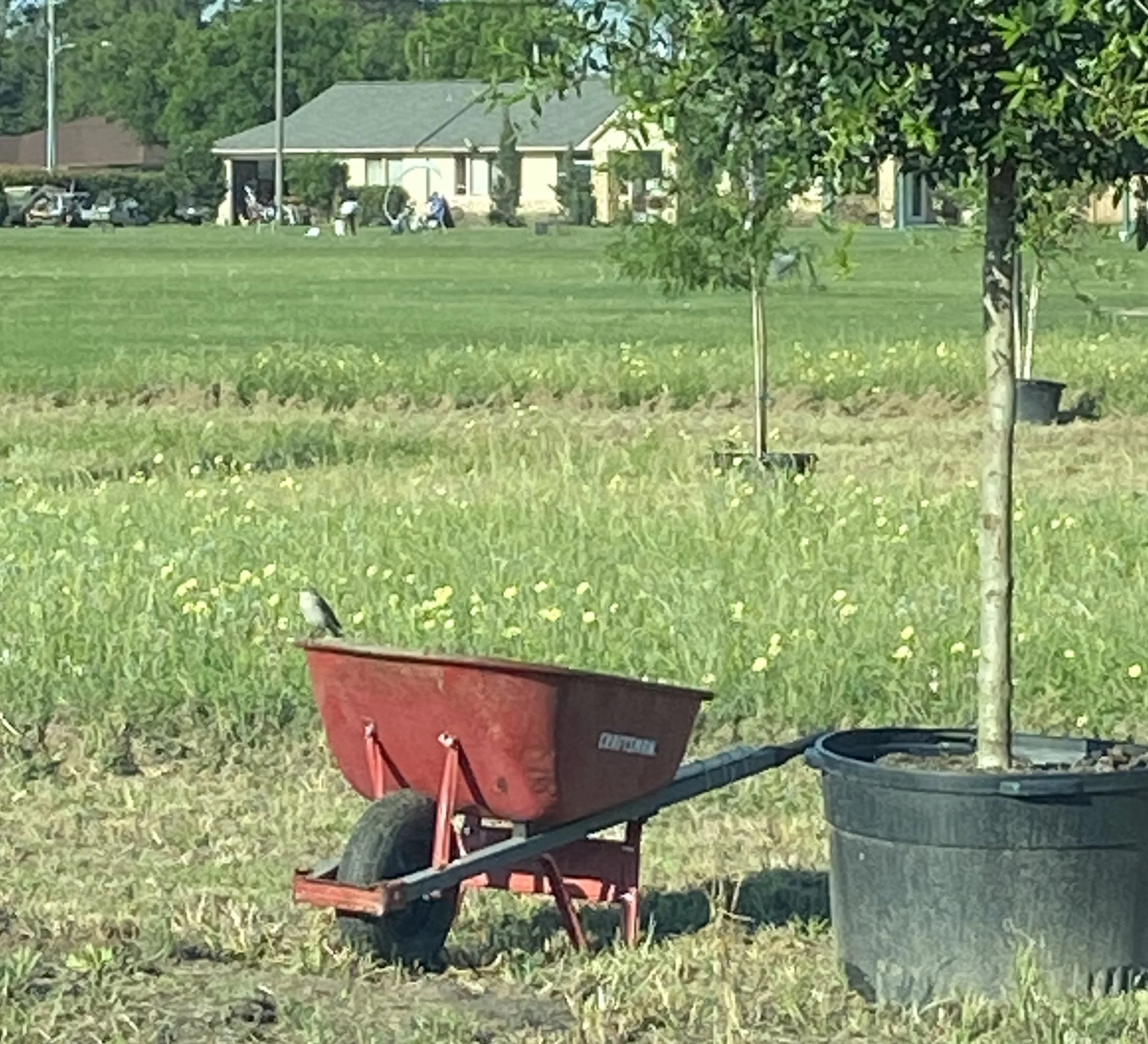
Then one morning, a two-legged creature arrived pushing a red wheelbarrow. Inside stood a six-foot Live Oak. Across this territory there were many large trees, but none with the dense, mid-level branching I seek when choosing a nest site. This tree was different. It offered concealment, structure, and a clear view of the surrounding landscape.
Before the tree was even planted, I landed on the wheelbarrow beside it.
I inspected what had been brought into my world.
My decision was immediate.
This would do.
The tree did not need to be rooted for me to recognize its value. I did not need to know why it was planted. Whether it was placed there with deep care or as part of a routine landscape job made no difference to me. Intentions are invisible. Consequences are not.
A suitable home had appeared.
I built my nest in the newly planted oak.
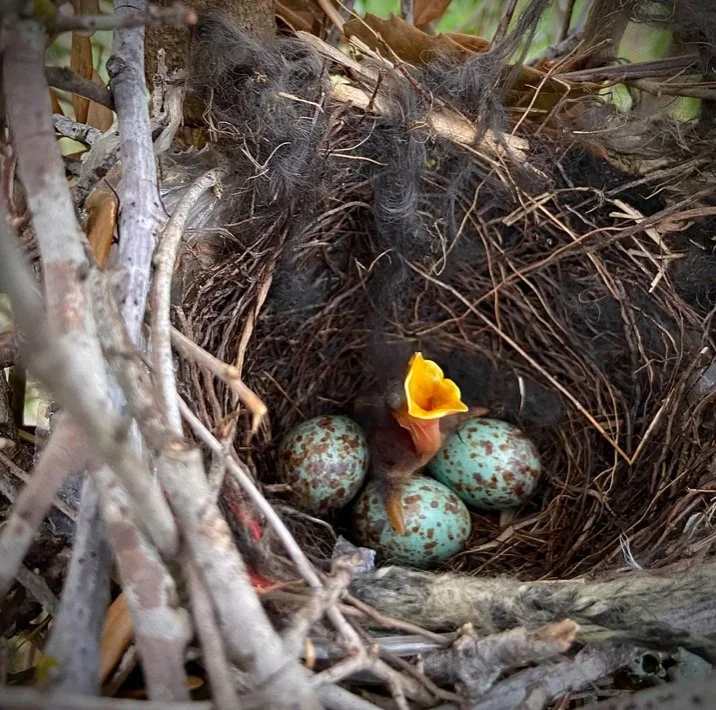
Twenty days later, the eggs were hatching.
Blue-green shells opening to reveal wide yellow mouths. Food was close. Caterpillars clung to leaves. Beetles moved through the mulch. Grasshoppers sprang from the paths. The territory provided what the next generation required.
Once the young arrived, my vigilance increased. I watched from exposed perches, sounded alarm calls, and defended the nest against anything that threatened what had been entrusted to me.
Each morning, I sang from the highest branch.
My song was not a theory or a strategy.
It was a declaration.
This place supports life.
Among birds, no one asks what purpose a mockingbird serves. We do not debate our worth. We sing, hunt, scatter seeds, defend territory, and raise our young. Our purpose is expressed by living fully according to what we were made to do.
From my perch, I sometimes wonder, in the instinctive way a bird wonders, what purpose these two-legged creatures serve.
If I were to judge them as they often judge one another, I would not ask what they call themselves. I would not ask about their titles, their plans, or their stated intentions.
I would ask only one question.
Does life increase where they are present?
At this place, the answer is unmistakable.
Yes.
The soil has deepened. The insects have multiplied. The plants have flourished. Suitable homes have appeared. Eggs have hatched. Young have survived. Song has increased.
I do not know the One who taught me to sing, to build, and to trust the returning spring. But I live within a world that consistently provides what I need. And when these two-legged creatures fulfill their part, the territory becomes even more generous. If a bird can sense anything of its Maker, perhaps it is through the abundance that appears when another creature lives according to its design.
And so I return, season after season.
I remember this territory.
I recognize its patterns.
I trust what repeatedly proves true.
Each dawn, I take my place in the highest branch and sing what my instincts already know.
Whatever these two-legged creatures are doing, they are fulfilling their part.