The Threshold Is Real
On hesitation, invitation, and crossing into what already exists
By Josh Singleton | Founder, serving as Lead Cultivator, The Neighborhood Garden Project
On a piece of church property in a growing suburban area, we steward a garden—intentionally cultivated and carefully tended—used regularly by members of the surrounding community. People come, work the soil, spend time, and share in the quiet, ordinary rhythms of growing things. Over time, it becomes clear that what is being cultivated is not only the land.
Just a short distance away, the church building stands. The congregation gathers there regularly. The two spaces coexist—physically connected, yet functionally separate.
Across both gardens, a similar pattern emerges. The spaces are active, but parishioners rarely enter them—not to garden, not to sit, not even to linger. Within the church, other forms of engagement have come and gone. For a time, food was brought into both churches, creating moments of contact and a limited relationship formed around provision.
When that practice stopped, the same response followed: silence.
The absence reveals how much of the connection depended on that structure. Without it, there is no clear point of contact. The gardens continue. They do not require participation from the church to function. They are sustained by those who choose to be there. They are already alive.
What emerges is not conflict, but parallel life. The gardens do not lack users. The church does not lack people. But there is little overlap. Even when individuals are familiar with one another, the boundary remains—not enforced, but present as a quiet understanding: this is where we gather; that is where they gather.
The result is a form of proximity without presence.
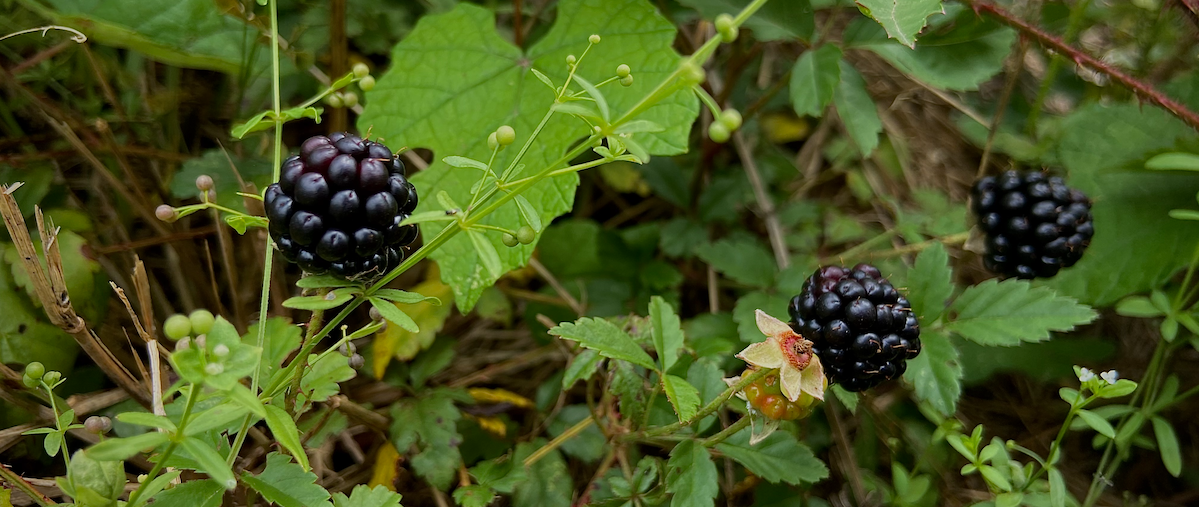
At the second garden, on one occasion, that pattern shifted. A group—about a dozen people—came out together to pick dewberries. They gathered first in the parking lot, where a quiet hesitation was visible on their faces. The question was not whether to go, but how far.
The distance could be measured: .126 miles—approximately 665 feet. Not far. And yet, it felt far.
The garden itself lies just 55 feet from the parking lot. It is visible, near, and familiar. And yet, it is rarely entered. On that day, it was passed through. The group moved beyond it, following a path into a three-acre prairie—an intentionally unmanicured space—toward what could not be immediately seen. The walk required effort. It was not incidental. Their presence was chosen.
Lizzie, a curate within the church and part of The Neighborhood Garden Project, moved between both spaces with familiarity. With feet in each, she did not explain the garden so much as walk people into it.
At the threshold—between the familiar and the unknown—we were present, and it was there that the movement shifted. What began as invitation became reception. The path did not change, but the way it was held did.
The handoff was not formal, but it was real. The way forward was no longer explained, but held—by someone who knew the land. The garden steward knew where the dewberries were, when they were ready, and how to move through the space to reach them. In that familiarity, there was certainty, and in that certainty, the threshold became crossable.
Nothing needed to be created. The life of the place was already established. What unfolded was not provision, but connection—an invitation, a presence, and a handoff. Between them, a crossing.
There are no gates. No permissions required. The space is open, visible, and in use. And yet, the threshold is real—not in the ground, but in the mind. It is there that people pause, uncertain, reading the space and feeling the distance in a way that cannot be measured. Nothing requires them to continue. And it is there that they are met.
For those who came that day, it was a first crossing. The path remained. The distance did not change. And yet, the movement did not continue in the same way. It has yet to be determined who will return.
At times, the question arises about participation. And yet, the space is already prepared—tended, open, and in use. Nothing is withheld. What remains is not a lack of readiness, but a hesitation at the threshold. The crossing must be made again, often in the same way it began: through invitation. Over time, something may take root, but this is not assumed.
In this instance, the movement began with one person—someone who could recognize what was already present in both spaces. The garden did not extend outward. It remained prepared, tended, and alive. When invitation occurred, it arose from relationship—from a familiarity already formed, and from a moment when the time was right. It was not summoned. It was offered.
And so the connection, when it happened, did not come from trying to create something new, but from someone who could see both spaces and, for a moment, make the distance between them visible—and crossable.
If the land were not held by the church, there would be no expectation that those within it would participate. The space would simply be observed as it is—used by some, passed by by others.
At the second garden, the land extends far beyond the building—nearly ten acres within the fence line. This scale is present, but not always perceived. For some, the church is understood primarily as the building and what happens within it. Beyond that, the space feels less defined—less contained, more uncertain.
The church gathers. The garden grows. Each continues in its own way, without requiring participation from the other. There is no shared structure that binds them together. No expectation that one will animate the other. No assumption of overlap.
They remain distinct.
And still, the garden is alive.
It is used. It is tended. It continues—without reliance on institutional participation, without tension over ownership, and without the need for alignment.
The absence of engagement does not diminish it. It simply reveals what sustains it.
What is present. And what is not required.
The building gathers. The land opens. Both are held within the same ground. And still, they are rarely experienced as one.