The Slow Drift Away from the Source
What a wilted leaf reveals about human disconnection and delayed consequences
By Josh Singleton | Founder, serving as Lead Cultivator, The Neighborhood Garden Project
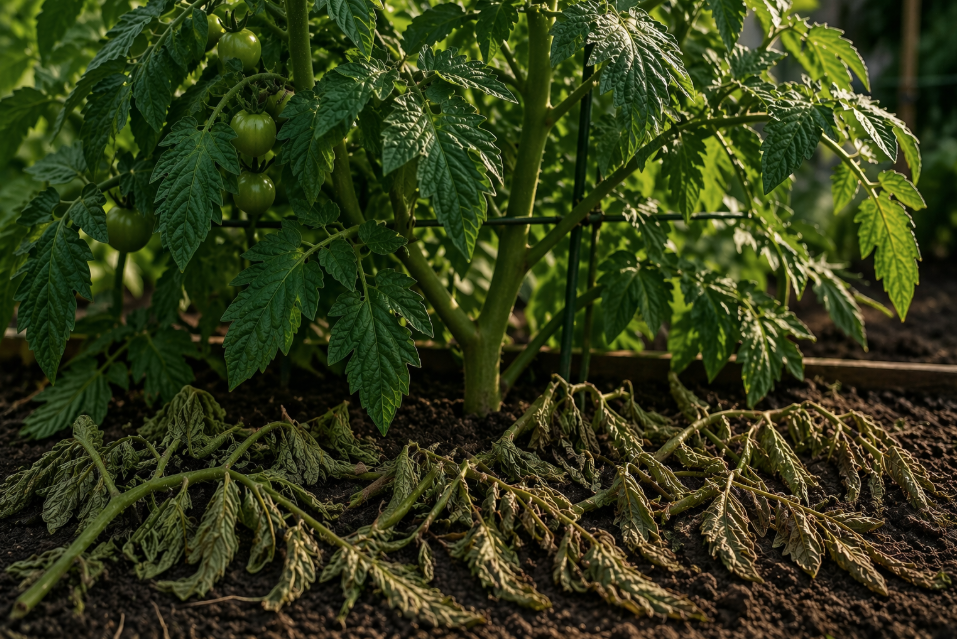
I wasn’t thinking about anything deep at the time—I was just pruning tomato plants. Cutting away extra leaves, clearing space for better growth. But after removing a few leaves and setting them aside, I noticed something I had seen many times before but never really paid attention to. They didn’t stay the same for long. Within a short time, they began to soften, then droop, then visibly wilt. Nothing dramatic—just a quiet, steady decline. And the reason was obvious: they were no longer connected.
At first, it seems like the leaf is simply separated from the plant. But that’s not the full picture. The real flow of life is from the soil, through the roots, up the stem, and into the leaf. Water and dissolved nutrients move upward through specialized vascular tissue called xylem, driven by transpiration—the pull created as water evaporates from the leaf surface. That continuous flow maintains what’s known as turgor pressure, the internal water pressure that keeps plant cells firm and upright.
When the leaf is removed, that flow stops instantly. Water is no longer supplied, but evaporation continues. As the cells lose water, turgor pressure drops, and the leaf softens and wilts. What I was seeing wasn’t just a leaf dying—it was the visible breakdown of a life-sustaining connection.
That’s what stayed with me. A leaf, once disconnected from its source, begins to wilt quickly. There’s no delay, no illusion, no pretending that everything is fine. But humans are different. We can be disconnected and still function. We keep going—working, talking, producing, showing up—and because nothing collapses immediately, it’s easy to assume nothing is wrong.
Biologically, this difference is real. The human body is built with layers of buffering and regulation that plants don’t have in the same way. We maintain internal balance through processes known as homeostasis—systems that regulate temperature, energy, hydration, and stress responses. We store energy, adapt to shortages, and compensate for imbalance over time. Even psychologically, the brain can mask or delay awareness of deeper issues through habit, distraction, and coping mechanisms.
But those systems don’t remove consequences—they delay them.
A life that’s visibly disconnected from the source is often the result of a life-giving system that has been quietly breaking down for years.
Plants fail fast. Humans fail slow. A leaf shows the truth almost immediately, but a person can live disconnected for years and not recognize it. Not because the disconnection isn’t real, but because the consequences are buffered. We have ways of sustaining appearance—physically, mentally, and socially—even when something deeper is off.
So the question isn’t just whether anything is obviously wrong.
It’s more subtle than that:
Where is the flow of life actually coming from?
And is it still flowing?
Every living thing has a condition it was made for. A plant draws life from the soil. A fish lives in water. A bird is made for the air. These aren’t just environments—they are what sustain life. A fish can survive briefly outside of water, and a bird can stand on the ground, but neither can live long apart from what it was made for.
Watching those leaves made something simple and hard to ignore. Just as the soil is the source for the plant, God is the source for us. And just like the leaf, we don’t lose our form right away when that connection is weakened. We can still look the same, still carry on, still appear alive in every outward sense. But what matters isn’t just form—it’s whether the flow is still there.
This is also where a common assumption begins to break down. Much of what we’re taught—especially in self-improvement—centers on becoming stronger, more disciplined, more in control, as if we can generate and sustain life from within ourselves. And to a point, those things matter. They can shape habits, build structure, and improve outcomes.
But they cannot replace the source.
A leaf cannot will itself to stay alive once it’s been cut off. It cannot compensate through effort or discipline. In the same way, there’s a limit to what self-sufficiency can actually sustain. You can maintain appearance for a while. You can function. You can even succeed by external measures. But if the underlying connection is missing, effort alone cannot restore what only the source provides.
But here’s where the comparison breaks—and where it becomes hopeful. A leaf, once cut off, cannot be reattached. Its vascular system cannot be restored in a way that brings it back to life. Humans are not like that. We can be disconnected—and still be restored. We can return. What would be irreversible in a plant is still open to change in us.
Looking back, I can see that the last eight years haven’t just been change—they’ve been a realignment. A slow reconnection to the source. Not sudden or dramatic, but steady. Learning what it means to remain, to abide, and to let certain things be pruned away—not out of pressure, but with a kind of quiet joy. Letting go of what competes with that connection, even when it’s familiar.
What’s harder to admit is how normal the opposite once felt. For most of my life before that, I was trained—subtly and consistently—on how to live disconnected in spirit while still appearing fully alive. Everything looked right from the outside. The structure was there. The discipline was there. Even a kind of outward correctness. But underneath it, something was missing.
It’s possible to build a life that looks whole while being disconnected at the root. To become very practiced at maintaining appearance, while losing touch with the source that gives it life. And because humans don’t “wilt” right away, that kind of life can go on for a long time without being questioned.
That’s why the shift over these past years has mattered so much. Not just changing what I do, but reconnecting to where life actually comes from. Learning the difference between maintaining an image and actually being rooted. And realizing that pruning isn’t loss when it brings you back to the source—it’s part of how life is restored.
Not from a place of doubt, but from honest reflection, the question becomes more specific:
Where in my life have I slowly drifted out of connection without realizing it?
Where have I replaced depth with routine?
Where have I stayed busy instead of present?
Where have I relied on momentum instead of staying rooted?
These aren’t things that usually reveal themselves in noise or activity. They tend to surface when things slow down—when there’s enough stillness to notice what’s actually there.
So maybe the deeper question is this:
What would it look like—not to perform connection—but to return to it?
Because if the leaf taught anything, it’s this—life doesn’t come from appearance. It comes from connection. And unlike the leaf, that connection is something we can return to.