The Garden Was Never the Point
How a Lifetime of Gardening Revealed Something Much Deeper
By Josh Singleton | Founder, serving as Lead Cultivator, The Neighborhood Garden Project
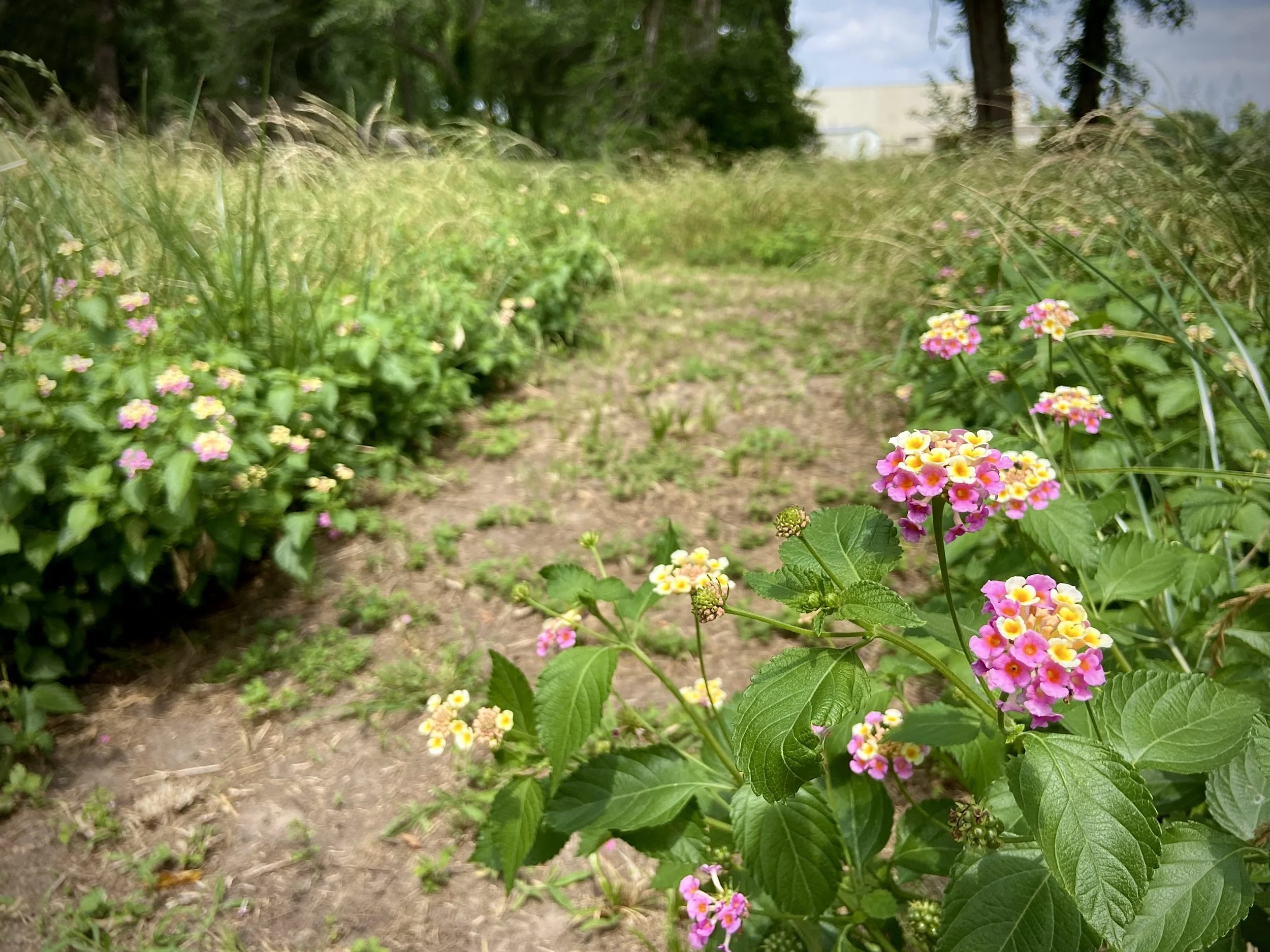
As I continue returning to the photograph that accompanies this reflection, I find myself noticing different things each time I look at it.
My eyes are initially drawn to the flowers and the path winding through them. Yet the longer I sit with the image, the more I become aware of how much is happening beyond what first captures my attention. Layers of life are interacting throughout the landscape. Some are visible. Others remain hidden. Some draw the eye immediately. Others reveal themselves only with time.
There are structures in the distance that helped make the landscape possible.
Yet they are not what captures my attention.
The life does.
The image has become meaningful to me because it feels less like a photograph of a prairie and more like a reflection of the journey itself.
As I reflect on the past four years—and perhaps the past twenty-five—I find myself arriving at a place that feels less like discovery and more like recognition.
Much of what has become clear during this season is not entirely new. In many ways, it feels as though I have finally found language for things I have been observing, practicing, and wrestling with for a very long time.
For years, I believed I was learning about gardens. Then I thought I was learning about community. Later, I became convinced I was learning about stewardship. More recently, I found myself wrestling with participation, assumptions, and the conditions that allow life to flourish.
Yet beneath all of those experiences, there seems to have been a deeper thread running through the entire journey.
I keep returning to the idea of inheritance.
Not inheritance as a future reward.
Inheritance as a present reality.
A seed receives an extraordinary inheritance before it ever germinates. It receives genetic potential, sunlight, water, soil, minerals, microbial relationships, and an entire ecosystem that existed before it arrived. The seed does not spend its early life attempting to earn access to these gifts. It does not strive to justify its existence. It simply participates in a reality that has already been prepared for it.
The more I sit with this reality, the more I realize how different it is from the framework many of us have inherited.
Most of us have been taught that margin comes after earning. We work, prove, achieve, accumulate, and perhaps someday we will possess enough margin to slow down, pay attention, and enjoy what we have built. Belonging becomes something we secure through achievement. Significance becomes something we prove. Rest becomes something we deserve only after we have accomplished enough.
Yet creation appears to reveal something different.
The pattern revealed in Genesis begins not with earning but with gift. Adam awakens into abundance. The garden already exists. Provision already exists. Relationship already exists. Purpose already exists. The inheritance comes first. Only then does the assignment emerge.
Adam is not working to create belonging. He is working from belonging. He is not working to secure provision. He is working within provision. He is not working to establish identity. He is working from identity.
When viewed through this lens, Genesis 3 reveals more than a single act of disobedience. It reveals a shift in humanity's relationship to reality itself. The gifts remain, yet humanity's relationship to them changes. Scarcity becomes believable. Self-protection becomes necessary. Control becomes attractive. Proving becomes important.
The question subtly shifts from "What have I been given?" to "What must I secure?"
The more I observe modern life, the more I wonder how many of our systems have been shaped by this shift. We learn to earn belonging. We learn to prove value. We learn to secure significance. We learn to justify our existence. We learn to accumulate enough margin to someday enjoy the life that has been available all along.
What fascinates me is that I rarely observe this pattern in living systems.
When I walk through a prairie, I do not see grasses striving to justify their existence. I do not see pollinators competing for significance. I do not see an oak tree attempting to prove its value. Each participates according to its nature while contributing to something larger than itself. Life emerges not because every participant is performing for recognition, but because each is participating within conditions that support life.
This is not an argument against work, responsibility, accountability, or contribution. Work existed before Genesis 3. Stewardship existed before Genesis 3. The assignment existed before Genesis 3.
What changed was the relationship.
Work became entangled with proving. Stewardship became entangled with control. Contribution became entangled with identity. Receiving gave way to securing.
Perhaps this is why so many people feel exhausted.
We have inherited extraordinary abundance and yet often experience profound scarcity because our attention remains fixed on what has not yet been earned rather than what has already been given.
As I have reflected on this season, another realization has slowly emerged.
I never actually loved gardening in the way I once assumed.
That statement would have confused me for most of my life.
I enjoy plants. I enjoy soil. I enjoy ecology. I enjoy observing living systems. I enjoy watching life emerge from healthy conditions. I enjoy helping people recognize patterns that often remain hidden beneath the surface.
What captivated me was never the garden itself.
It was what the garden revealed.
The garden gave me a place to observe stewardship, participation, trust, inheritance, and the countless interactions taking place beyond what was immediately visible. The garden was valuable because it made invisible realities visible.
The prairie accelerated this realization.
Unlike a vegetable garden, a prairie does not invite questions about productivity. It simply responds to conditions. Diversity emerges. Relationships emerge. Life emerges.
The prairie revealed something that had been quietly present all along.
The garden was never the destination.
The garden was the classroom.
Perhaps one of the most important realizations of this season is that the garden was never the reality itself. The garden was evidence of the reality.
The flourishing plants, healthy soil, abundant harvests, relationships, and moments of transformation were all visible expressions of something deeper taking place beneath the surface. Inheritance. Stewardship. Participation. Belonging. Trust. Healthy conditions.
The garden was not creating these realities as much as revealing them.
In the same way that fruit reveals the health of a tree and a flourishing ecosystem reveals the conditions supporting it, the garden became evidence of an unseen reality already at work.
Perhaps this is why the garden eventually had to move into the background.
The lesson was never about the garden.
The garden simply helped reveal what had been there all along.
Looking back, I am increasingly convinced that this may also be true of many of the structures we build. Every structure creates boundaries. Every container creates constraints. This is not a flaw. It is simply the nature of structure itself.
The healthiest supporting systems understand their role.
Healthy soil does not compete with the flower. Roots do not compete with the fruit. The path does not compete with the prairie. Their purpose is not to become the center of attention. Their purpose is to support life.
Perhaps stewardship functions in much the same way.
At its best, stewardship gradually recedes into the background while the life it supports becomes increasingly visible.
As this season has unfolded, many of the tools and structures that shaped the past four years have fallen away. Some ended naturally. Others ended unexpectedly. Some I fought to preserve. Others I eventually released.
What surprises me most is not what disappeared.
It is what remained.
The curiosity remained.
The stewardship remained.
The lessons remained.
The relationships remained.
The inheritance remained.
The life remained.
For a long time, I assumed the life was attached to the tools. The gardens. The programs. The partnerships. The structures. The containers.
What I am beginning to see is that the life was never contained by those things. They simply gave it form for a season.
Perhaps one of the greatest gifts of this transition is that many of the tools and structures I had grown accustomed to relying upon were removed.
What remained was life.
And in many ways, life is what I had been paying attention to all along.
As I look again at the photograph of that prairie path, I find myself wondering what assumptions I still carry that prevent me from seeing what has already been given.
Perhaps that is the invitation.
Not simply for me, but for all of us.
To slow down long enough to notice the inheritance that already surrounds us. To question the assumptions that keep us striving. To reconsider the belief that belonging must be earned, significance must be proven, and life must be secured.
And perhaps most importantly, to remember what creation has been revealing from the beginning.
The gift comes first.
The assignment follows.
Life begins with inheritance.
And stewardship begins when we learn to receive it.