A Hunter Among the Flowers
The life cycle of a prairie wasp and the balance it brings
By Josh Singleton | Founder, serving as Lead Cultivator, The Neighborhood Garden Project
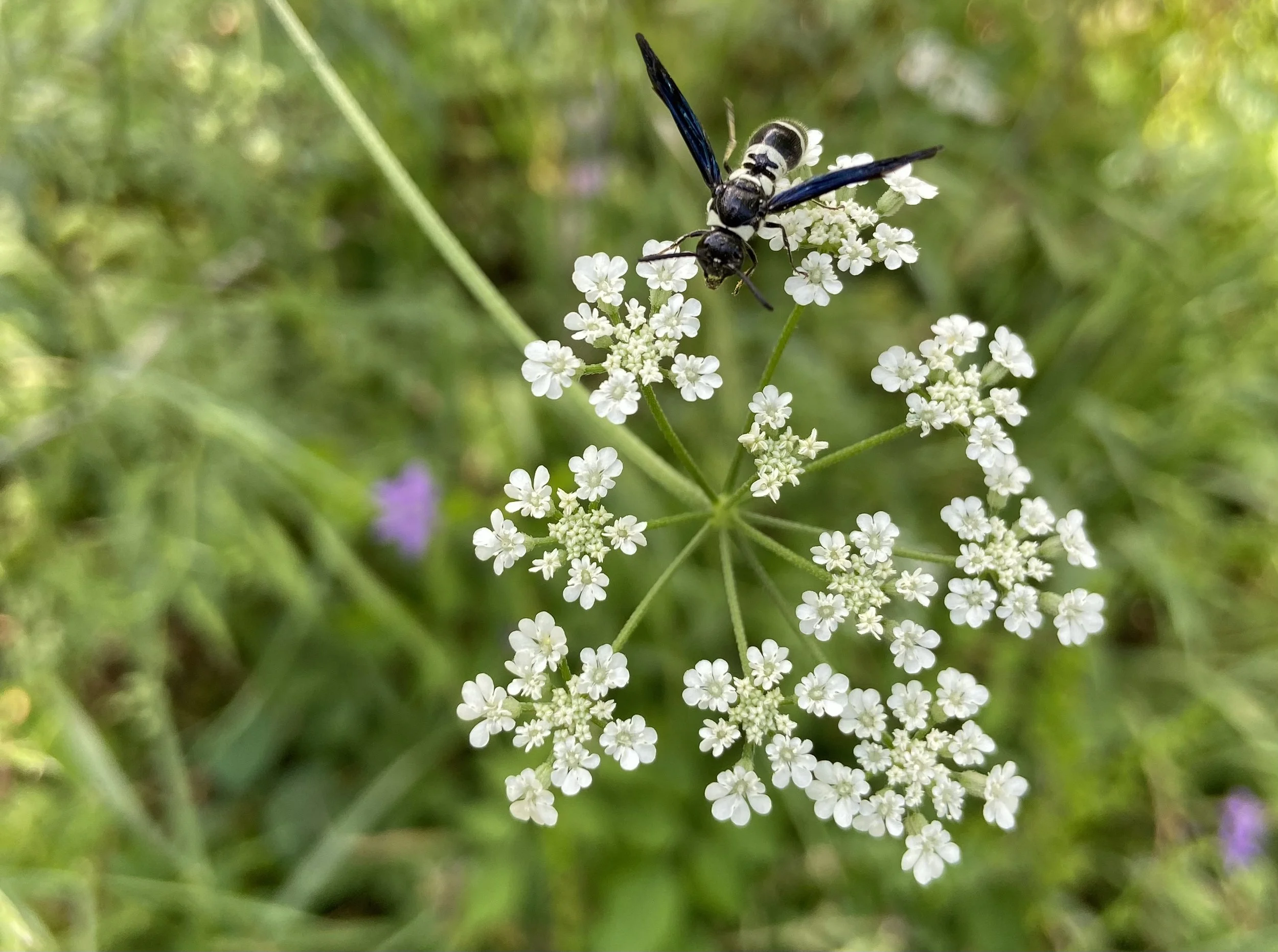
A small wasp lands quietly on wild hedge parsley in the prairie. It pauses, moves slowly across the tiny white flowers, and then lifts off again. It is easy to overlook, just another small interaction happening among thousands.
But this moment reveals something deeper about how the prairie functions.
This is likely a Four-toothed mason wasp, and its visit is not accidental. Plants in the carrot family, including wild hedge parsley, produce small, open clusters of flowers with shallow nectar. This design allows insects with short mouthparts, like many beneficial wasps, to feed easily. The nectar provides carbohydrates, the fuel that powers movement, hunting, and reproduction.
After feeding, the wasp begins searching. It flies low, scanning stems and leaves for caterpillars or other soft-bodied insects. When it finds one, it stings and paralyzes the insect without killing it. This is a precise biological strategy. By keeping the prey alive but immobilized, the wasp preserves it as fresh food.
The wasp then carries the paralyzed insect to a small cavity, often inside hollow stems, cracks in wood, or other protected spaces in the prairie. There, it lays a single egg on or near the immobilized prey and seals the chamber.
Within two to four days, the egg hatches into a larva. The larva begins feeding slowly, instinctively consuming non-vital tissues first, keeping the host alive as long as possible. This reduces decay and prevents bacterial growth. Over the next several days, the larva continues feeding until it reaches full size.
Once feeding is complete, the larva forms a cocoon and enters the pupal stage. Inside this protective casing, it undergoes metamorphosis, reorganizing into an adult wasp. Depending on temperature and conditions, this transformation can take two to four weeks, sometimes longer. When the adult emerges, it begins feeding on nectar, and the cycle continues.
This is not a one-time event. A female mason wasp repeats this process again and again. She may hunt multiple times in a single day, building chamber after chamber, laying one egg in each. Over her lifetime, she may lay twenty to forty eggs, removing dozens of caterpillars from the system while simultaneously pollinating flowers.
All of this begins with a small plant most people would call a weed.
Wild hedge parsley feeds the hunter.
The hunter reduces herbivore pressure.
The system stabilizes.
No one directs this. No one organizes it. Yet everything works together through relationship.
The prairie does not rely on control. It relies on connection. Small plants feed small hunters. Small hunters influence larger outcomes. Quiet interactions accumulate into stability.
What appears insignificant becomes essential.
What appears random becomes purposeful.
And the prairie continues working, quietly and faithfully, one small interaction at a time.