June 2026
The Fruit Was Easy to Love
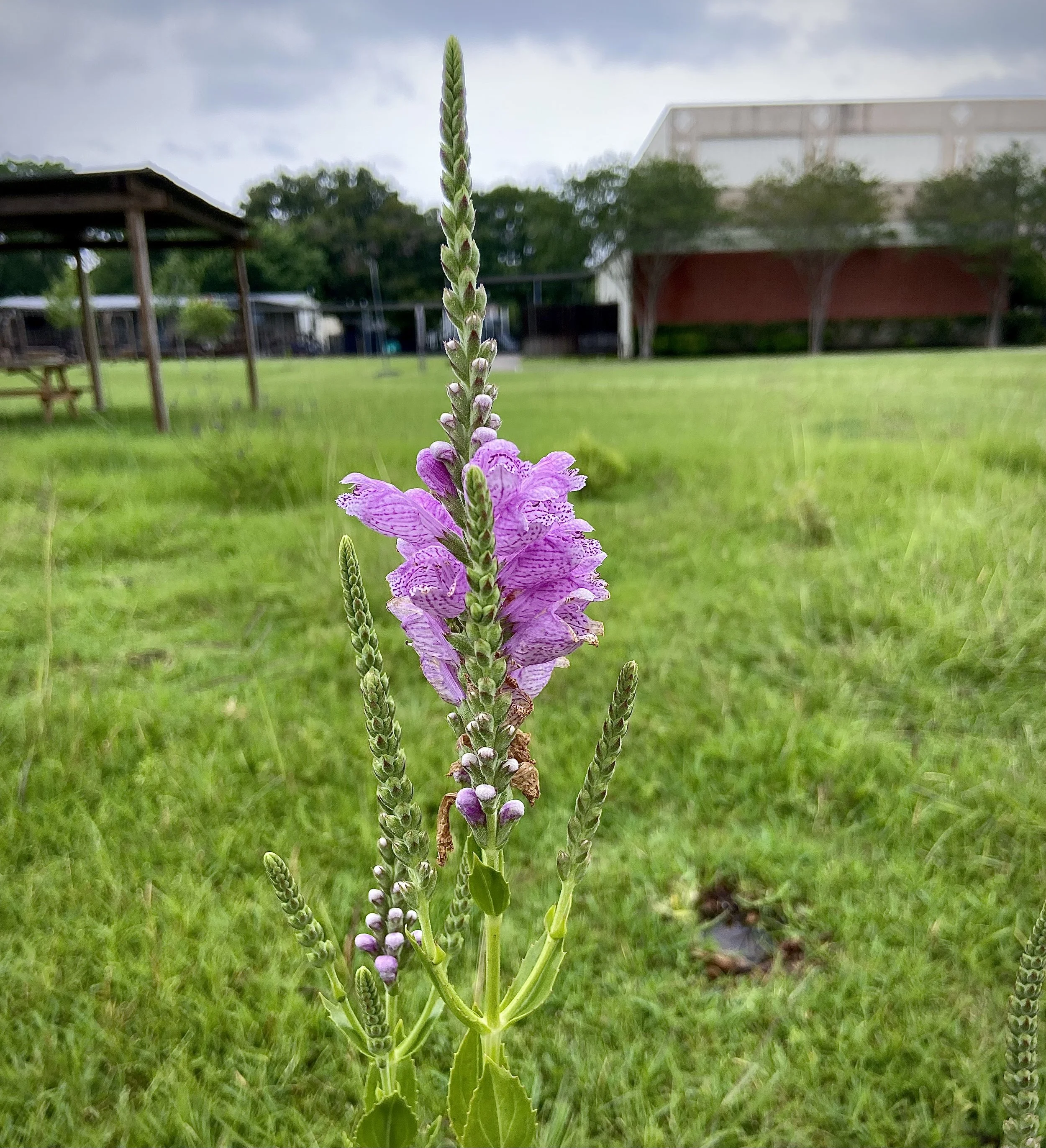
The image included with this reflection was taken nearly two weeks after both church partners made the decision to end the existing garden partnerships at both locations.
In many ways, the image quietly captures much of what this season has revealed. Life continues emerging at ground level even while larger structures, agreements, and transitions shift around it. The flower still blooms. The pollinators still move. The soil still responds.
And perhaps that is part of what living systems teach us over time: they continue responding to the conditions surrounding them.
Over the last several months, a great deal has become clearer. Not just about gardens, partnerships, or organizations, but about people, systems, and the way we often relate to living things.
Recently, both church properties where The Neighborhood Garden Project’s primary garden spaces existed made the decision to discontinue the partnership moving forward. At the same time, something else has quietly been unfolding for quite a while now. The life cultivated through these gardens has already been moving beyond the boundaries of the original sites and deeper into the community itself. Not through expansion campaigns or strategic scaling plans, but naturally, relationally, and slowly.
That movement has happened through families, conversations, backyard gardens, restored rhythms, and individuals beginning to reconnect with responsibility, stewardship, creation, and one another in more personal and sustainable ways. In many ways, this transition has only clarified something that was already becoming true: the deepest work was never confined to the physical garden spaces themselves.
And honestly, this season has revealed something important. Many people appreciated the fruit of the garden, but far fewer fully understood the daily stewardship, relational trust, and restraint required to sustain something alive without controlling it.
Because appreciation and participation are not the same thing.
Living systems do not sustain themselves through admiration alone. They are sustained through attentiveness, consistency, relationship, participation, and the willingness to remain present long enough for trust and stewardship to take root.
Most people encounter living systems at the surface level. They experience the bloom, not the root system. The harvest, not the cultivation. The atmosphere, not the unseen rhythms that made the atmosphere possible.
But living things rarely look efficient.
Healthy soil does not look efficient. A prairie does not look efficient. Even healthy relationships often do not look efficient from the outside.
Living systems carry tension, unpredictability, and interdependence. They require participation more than control.
Modern culture has trained many of us to expect immediate clarity, visible outcomes, and manageable systems. But creation itself does not move that way. The soil does not panic when seeds disappear underground. Trees do not apologize for growing slowly. Healthy ecosystems are not obsessed with proving their value every moment. They simply continue responding to the conditions surrounding them.
And perhaps that is part of what this season revealed most clearly: often, when we cannot fully control, predict, categorize, or measure something, we slowly create distance from it. Not always maliciously. Sometimes simply because living systems ask more of us than observation alone.
They ask for participation.
And strangely enough, resistance itself often becomes part of the work.
Not to destroy, but to clarify.
Living systems reveal what is truly willing to participate, remain rooted, and continue growing over time. Gardens do not grow through force. They grow through alignment.
Over time, resistance exposes the difference between admiration and stewardship, proximity and participation.
Some people genuinely desire to enter the work of cultivation. Others may only desire the comfort, beauty, or fruit produced by it. Neither reality needs condemnation. But living systems eventually make the distinction visible.
Because participation always asks something of us: patience, responsibility, presence, humility, and consistency. And those things cannot be outsourced indefinitely.
In many ways, resistance becomes part of how living systems mature and clarify themselves. Not by punishing what is unwilling, but by revealing what is truly prepared to remain in relationship with the work over time.
The same is true for people, organizations, churches, and gardens alike.
Perhaps the deeper tragedy underneath much of modern life is that many institutions unintentionally train people away from their humanity while claiming to help humans flourish. Not through malice, but often through efficiency, control, over-structuring, and the gradual removal of responsibility and participation.
We become observers instead of participants. Consumers instead of cultivators. Audiences instead of neighbors. And over time, many people forget what it even feels like to belong to something living.
That is part of why gardens can feel so disruptive. Not because they are merely growing food, but because they quietly reintroduce people to realities modern systems often suppress: slowness, patience, dependence, relationship, embodiment, responsibility, and participation in life beyond performance.
The current team of The Neighborhood Garden Project collectively carries decades of gardening experience. And honestly, our value was never primarily in growing enough tomatoes to feed one person’s stomach. Anyone can eventually learn to grow tomatoes.
The deeper value has always been the relational ability, through dedication over long periods of time, to walk alongside people as they slowly move toward greater wholeness and less fragmentation. That is what the gardens were actually cultivating. Not simply produce, but conditions where people could begin reconnecting with stewardship, patience, creation, responsibility, and their own capacity to participate in life again.
Because soil tells the truth slowly.
Healthy growth cannot be rushed. And living systems cannot be sustained through control alone.
The same is true for people.
Over the last four years, this became one of the clearest distinctions between institutional models and living systems. Institutions often unintentionally centralize dependency. Living systems cultivate participation. Institutions often gather people around services. Living systems help people slowly recover stewardship. Institutions often measure success through visibility and outputs. Living systems measure health through depth, consistency, relationship, and the growing ability for life to sustain and reproduce itself naturally.
And perhaps the deepest irony of all is this: the very thing that created discomfort, uncertainty, or resistance is now theirs to step into for themselves.
Not just the physical gardens, but the middle ground itself. The slow stewardship. The attentiveness. The relational trust. The patience required to hold something alive without overcontrolling it or abandoning it altogether.
Because the physical gardens themselves were never the hardest thing to sustain. Raised beds can be rebuilt. Irrigation can be repaired. Seeds can be replanted. The harder thing to sustain was the relational and spiritual posture required to remain in participation with a living system over time.
And now, with the partnerships coming to a close, the responsibility of stewardship now rests with the churches themselves. The responsibility is no longer theoretical. They now have the opportunity to experience firsthand what it actually requires to sustain not just the appearance of a garden, but the living system beneath it.
And in many ways, that may be one of the clearest testimonies underneath this entire season:
Life itself keeps telling the truth.
Not through arguments. Not through blame. But through visible response.
The land reveals what is being participated in. The gardens reveal where attentiveness remains present. And whether flourishing or slowly fading, creation eventually makes visible what words often cannot.
None of it is punishment. It is simply the honest response of creation itself.
Because living systems cannot be sustained merely through appreciation or inherited structure. They respond to relationship, stewardship, participation, and presence.
And honestly, we do not say any of this cynically. We say it hopefully.
Because perhaps this season was never simply about preserving gardens exactly as they were. Perhaps it was revealing what the gardens were asking of all of us the entire time: not merely to admire life, inherit it, or manage it from a distance, but to participate in it.
The deeper hope for institutions, churches, organizations, and individuals is not that they become better at controlling living systems. The hope is that we slowly remember how to enter them again. To move from observation to presence. From management to relationship. From admiration to stewardship.
Because living systems still welcome participation.
The soil still receives seeds. The prairie still responds to care. Gardens still teach anyone willing to slow down long enough to listen.
We also carry deep gratitude for the temporary containers that held this work over the last four years.
Those spaces created room for something deeply human to emerge without the constant pressure to prove, measure, justify, or validate itself at every step.
In many ways, the gardens gave people permission to slow down long enough to remember what participation in living systems actually feels like.
And regardless of where the work continues moving from here, that remains deeply meaningful to us.
And even now, we carry tremendous peace about what lies ahead. Because what is truly alive does not depend on one container to survive.
In many ways, the work is becoming more embedded than ever before. Not centralized around a few visible locations, but quietly woven throughout homes, relationships, neighborhoods, and everyday life.
The work was never ultimately about preserving gardens.
It was about helping cultivate people capable of remaining in relationship with life itself.
The goal has never been for people to become dependent on The Neighborhood Garden Project. The goal has always been to help people slowly rediscover their own capacity to participate in life, stewardship, cultivation, and relationship themselves.
Healthy gardens do not exist to create permanent dependence on the gardener. They exist to help cultivate more stewards.
Life continues moving. Seeds continue spreading. And slowly, quietly, the understanding grows:
Living things do not merely exist to be appreciated.
They invite participation.