January 2026
Meet a Family of the Garden…
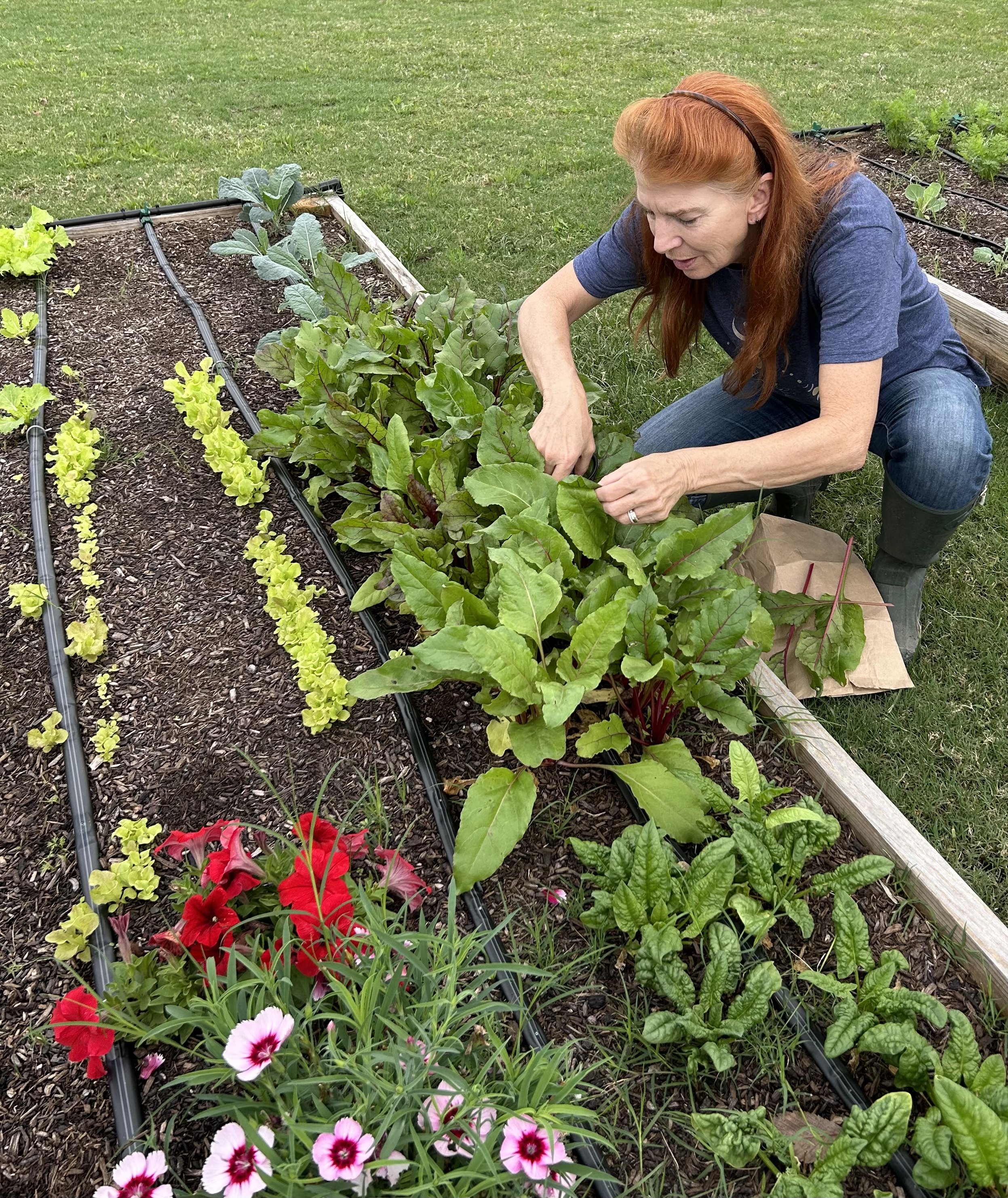
As 2025 came to a close and 2026 approached, Kay reflected on a year of growth that began when she encountered the bees and later deepened through her involvement with The Neighborhood Garden Project. For years, she had tried to grow gardens at home, but heavy tree cover in her yard made consistent production difficult. “It was so frustrating,” she said. Despite her effort, her gardens never truly produced.
Kay lives behind the Barker Cypress garden and has a small waterfall in her backyard. One afternoon, while sweeping leaves from the rocks, a small swarm of bees emerged and began swirling around her broom with each movement. “They were dancing along with every stroke,” she recalled. “I was in such awe. I wasn’t scared at all, just amazed and so happy.” From that day on, she noticed them daily, and caring for them became a source of joy. In return, she watched something shift in her own garden at home. “The bees worked magic on my flowerbeds,” she said. “I’ve never had so many blooming flowers.”
Through that connection, Kay met Chris, the beekeeper, who introduced her to The Neighborhood Garden Project. Though she had to wait several months before beginning her volunteer hours, her anticipation never faded. “I thought the first day would never come,” she said. “But it did, and I am loving it.”
In the garden, Kay found both practical learning and a new rhythm of patience. She learned how to prepare a bed well, how to wait through the seed stage, and how to harvest carefully so the fruit could be enjoyed fully. “Now I get to enjoy the fruit of my labors,” she shared. “My dinner salads have never tasted better, and neither have my fresh green smoothies.”
As she prepares to retire in the coming weeks, Kay sees the season ahead as one of continued growth. She expressed gratitude for the bees, the garden, and the steady teaching that has shaped her along the way. Looking ahead, she carries a simple hope for the year to come and a confidence in all that is still growing.
Formed Underground
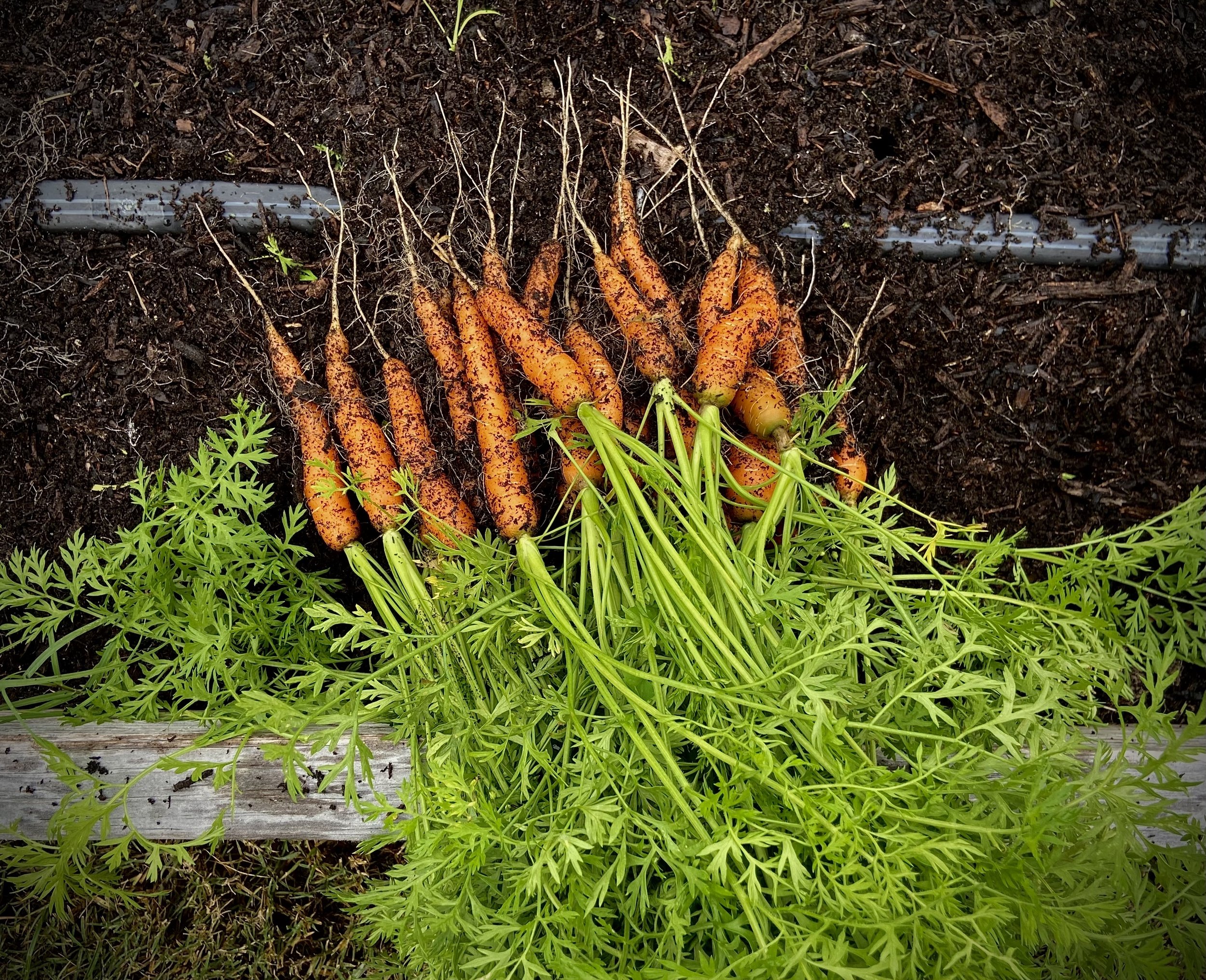
Carrots do most of their work where no one is looking.
While the greens grow upward, the root forms slowly in the soil. Carrots push down through resistance, adjusting to clay, stones, moisture, and space. They are shaped by what they encounter. What shows up at harvest is not a perfected plan, but a record of real conditions. Crooked roots, splits, and bends are not failures. They are evidence of formation.
Carrots are in season now because cool weather completes their growth. As temperatures drop, the plant converts stored starches into sugars. This is not added sweetness. It is revealed sweetness. Cold signals the root to protect itself, and that protection becomes flavor. Frost does not damage carrots. It finishes them.
This response is ancient and intentional.
From a health standpoint, carrots provide steady, stabilizing nourishment. They are rich in beta-carotene, which the body converts into vitamin A as needed. Vitamin A supports vision, immune function, skin health, and cellular repair. It helps the body see clearly and respond appropriately rather than react.
Carrots also support the nervous system. Their natural sugars are bound to fiber, which slows absorption and prevents sharp blood sugar spikes. This steadiness reduces stress on the adrenal system and helps regulate energy over time. Carrots nourish without stimulating. They restore rhythm rather than demand urgency.
The fiber in carrots feeds beneficial gut bacteria, strengthening the gut lining and reducing inflammation. A healthier gut improves nutrient absorption, immune resilience, and even mood regulation. In this way, carrots do not just feed the body. They feed the systems that allow the body to feed itself.
Carrots contain antioxidant compounds that support long-term cellular health and help lower chronic inflammation. These compounds work gradually. They protect rather than excite. Over time, they support joint health, cardiovascular function, and metabolic balance.
Cool weather deepens all of this. Slower growth allows minerals to accumulate. Dense contact with soil increases both flavor and nutritional concentration. What tastes sweeter is also more sustaining. The carrot becomes heavier, not just in weight, but in value.
Carrots never signal readiness from above ground. You only know what has formed by pulling them from the soil. Some are straight. Some are twisted. All are shaped by patience, pressure, and time.
Like everything healthy in the garden, carrots remind us that nourishment does not come from speed or control. It comes from staying rooted long enough to be changed by the season.
Burrows Beneath the Plan
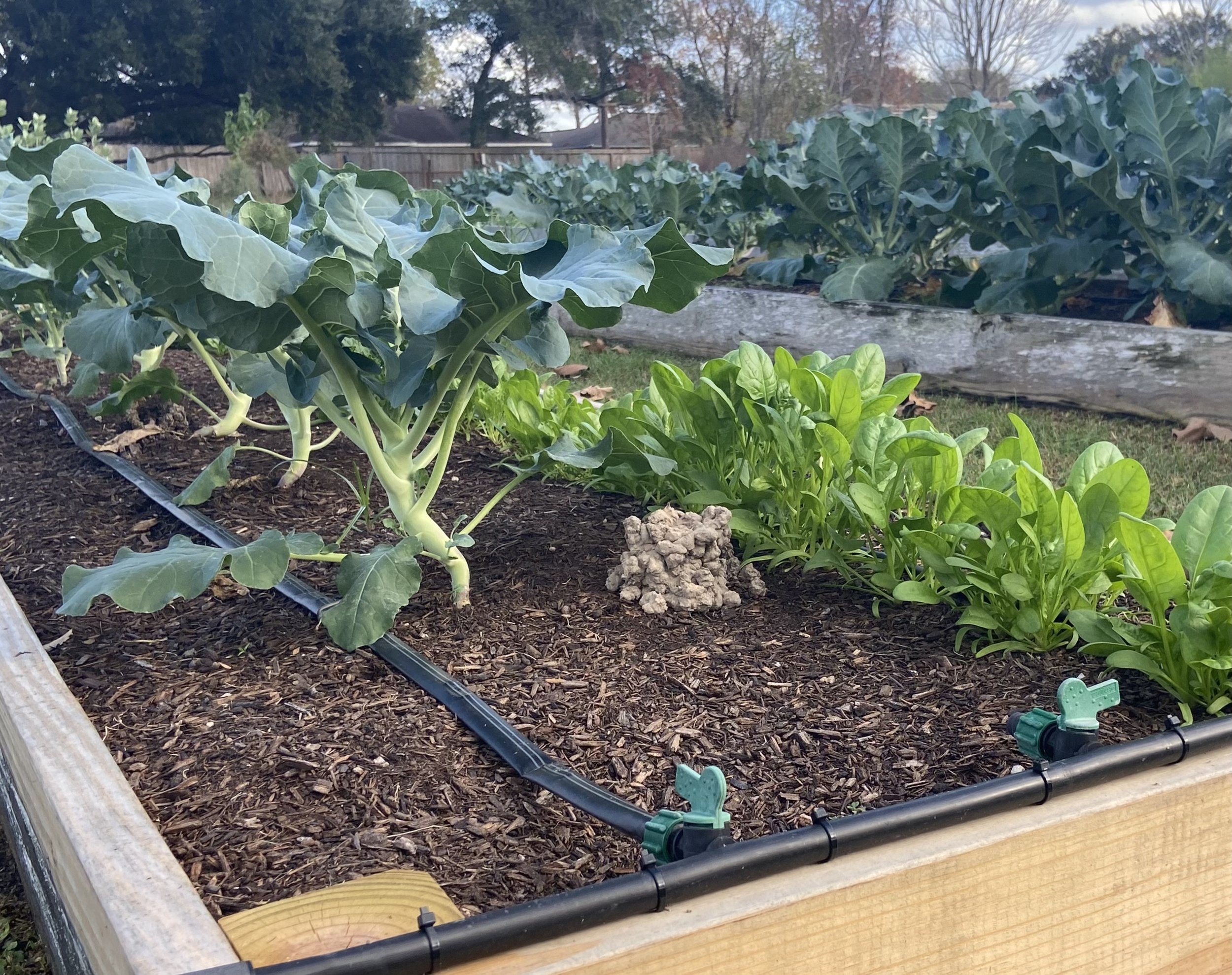
Before the raised beds, before there was drip tape, before broccoli and spinach were carefully spaced, this land already knew how to live. Long before the garden, it was Katy rice fields. Long before that, it was wet ground shaped by slow water and burrowing life. Crawfish were here then. They were not introduced, invited, or managed. They simply belonged.
That small mound in the middle of the bed is proof.
It is easy to see it as disruption, something out of place in an orderly system. But it is actually evidence of ancient work continuing alongside something new. Crawfish are soil engineers. They burrow deep, breaking up heavy clay, creating channels that let water drain and roots breathe. As they dig, they pull minerals and organic matter from below and place them back on the surface. What looks like a mess is nutrient cycling. What looks like interference is formation.
They help regulate water in a landscape shaped by flooding and saturation. They oxygenate soil layers that would otherwise compact and suffocate life. They feed microbes, birds, and predators, quietly supporting an entire web most people never notice. Their presence means the land still remembers how to function beyond human systems.
And there is room for them here.
Because there is margin, the crawfish can surface without destroying the garden. Because there is restraint, the garden can grow without needing dominance. The old does not need to be erased for the new to take root. The new does not need to overpower what came before to be fruitful.
Modern systems struggle with this. We prefer clean starts. We like control. We assume progress requires replacement. But healthy land does not work that way. Life stacks. History remains active. The soil carries memory, and when given space, it integrates rather than resists.
This bed holds both intention and inheritance. Drip lines and burrows. Spinach and clay pulled from depth. Human planning and ancient instinct sharing the same ground.
That is the quiet wisdom here. When margin exists, nothing has to disappear for something else to grow.
What the Garden Taught Us in 2025…
In 2025, The Neighborhood Garden Project continued to be shaped by what the garden itself was revealing. When we set out in 2022, we did not know who the garden would be for. We knew how to cultivate food, and we knew people were tired. Over time, the garden began to show us who was arriving and who was staying. It consistently drew those in the middle and working class, people quietly holding culture together. The garden revealed them as a hinge, helping the resourced reach the vulnerable while carrying the weight of their own families, often without anywhere truly restful to go.
Rather than asking us to expand or define ourselves, the garden taught us to slow and pay attention. It became a place where life could be observed rather than managed, where people could arrive without pressure and remain only if something deeper was stirring. The garden did not require explanation. It taught through experience. For many, it became the first place in a long time where nothing was being asked of them, and that absence of demand did the formative work.
Throughout the year, the garden continued to teach the same lesson through land and people alike. When disturbance decreased and rhythms stabilized, life responded. Soil health improved. Diversity increased. Individuals who stayed began to take responsibility, not because they were instructed to, but because health invites stewardship. The garden showed us that formation is not something imposed. It emerges when conditions are right.
As this rhythm held, the garden also instructed us in contrast. It stood as a quiet alternative to urgency, performance, and extraction. There was no incentive to stay and no consequence for leaving. The garden taught us that freedom reveals readiness more clearly than structure ever could. Many passed through. A few returned. Those who remained did so because something within them recognized the pace as true.
By the end of the year, what was most evident was not what had been built, but what had been rooted. The garden taught us that rest and responsibility are not opposites, but companions. It revealed that alignment deepens when pressure is removed, and that trust grows where presence is practiced. Internally and externally, the work became steadier, quieter, and more grounded.
Looking ahead, the garden continues to lead. It has taught us that clarity follows faithfulness, not the other way around. What has been revealed is enough for now, a people, a posture, and a place where life can reorganize itself without force. As the strain of modern life continues to press on those holding the middle together, the garden will remain what it has become, steady, receptive, and ready to receive whoever arrives carrying more than they were meant to hold alone.