Victory Gardens and the Fragility of Responsibility
What History Reveals When Systems Fail, Recover, and Leave Us in the Margin
By Josh Singleton | Founder, serving as Lead Cultivator, The Neighborhood Garden Project
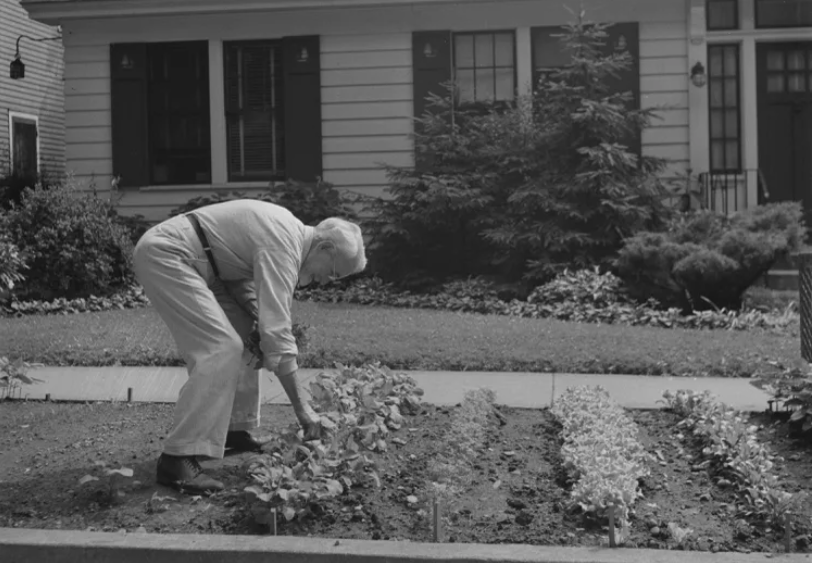
Victory Gardens are remembered as one of the great moral successes of World War II. Lawns became food. Front yards and backyards were converted from ornament to provision. Children learned to weed. Neighbors shared seed, labor, and surplus. By the height of the war, tens of millions of gardens were planted, producing a remarkable share of the nation’s fresh vegetables.
The image above captures that moment with quiet clarity. A man bends over a narrow garden bed, hands in the soil, focused on what is directly in front of him. There is no spectacle here. No banners or slogans. Just attention, patience, and responsibility localized to a few square feet of earth. This is what participation looked like when systems tightened and provision moved back into the household.
They worked. They mattered. They fed both bodies and morale.
But what we rarely name is what followed.
When the war ended, the gardens disappeared. Not slowly. Not ceremonially. They collapsed. That collapse was not a failure of effort or discipline. It was a revelation. As larger systems recovered and convenience returned, responsibility shifted away again. What had been carried by households under pressure was absorbed back into institutions that promised relief.
The garden did not stop working. It was simply no longer required.
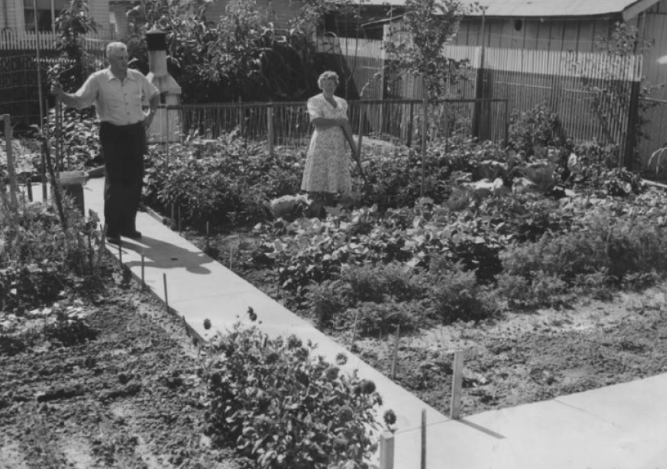
A photograph from August of 1942 shows a couple standing in their backyard garden. Twenty-six varieties of vegetables grow in deliberate rows. The caption notes that, for a small sum, they produced enough fresh food to feed their household and half of their neighbors.
There is no spectacle here. No visible emergency. No urgency captured mid-motion.
Just responsibility quietly being carried.
This image is often remembered as proof of American resilience. And it is that. But it is also evidence of something more fragile. This garden existed because responsibility had moved home. Food provision was no longer abstract or guaranteed. It lived in the soil behind the house.
The garden was not the result of a new hobby discovered in leisure. It was the result of systems tightening and households being asked to participate again. National pressure translated into daily practice.
What the photograph does not show is how long this garden lasted.
History tells us the answer.
When pressure eased, when systems expanded again, when food became abundant and effortless, most gardens like this one disappeared. Not because the gardeners failed, but because the responsibility they carried was absorbed back into systems that promised relief.
The image captures a moment when responsibility was visible, local, and shared. It does not capture how easily responsibility moves once it is no longer required.
The Garden Was Never the Point
Victory Gardens were not hobbies or lifestyle choices. They were acts of national obedience shaped by necessity. Food was rationed. Supply chains were strained. The country needed households to shoulder responsibility that had long been carried by distant systems.
Citizens were asked to step in, and they did.
Families learned how to grow food quickly, often without prior experience. Children learned that contribution mattered, that their hands had a role to play. People felt useful in a way that was concrete and immediate. The work of provision became visible again. Participation replaced consumption, if only for a season.
But the garden itself was never the point.
These gardens were formed by pressure, not by long-term formation. They were framed as temporary duty in a time of emergency, not as a lasting expression of identity or calling. Responsibility returned to households because it had to, not because households had chosen to reclaim it.
That distinction matters.
When responsibility is carried under compulsion, it can be sustained for a time. When it is carried by choice, it reshapes how people see themselves and their place in the world. Victory Gardens largely belonged to the first category. They were effective, but they were provisional.
Pressure held the gardens together. Pressure always does.
And when the pressure eased, the structures built to carry it quietly gave way as well.
Courage Under Constraint
It matters to say this clearly. Victory Gardens were courageous. They required discipline, patience, and cooperation at a time when nearly every aspect of life was already under strain. People showed up day after day, tending soil alongside factory shifts, ration lines, and the emotional weight of a nation at war.
This was not easy work. It required learning, failure, and persistence. It demanded attention when attention was scarce. And it asked households to carry responsibility without knowing how long the burden would last.
That courage deserves to be honored.
But courage sustained by crisis has an expiration date.
When action is driven primarily by external pressure, it remains tethered to that pressure. As long as the constraint holds, the behavior holds. When the constraint lifts, the behavior is free to recede.
The deeper question, then, was never whether people could grow food. History shows they could. The question was whether they would continue once responsibility was no longer required, once survival no longer depended on participation.
History answered that question quickly.
When the crisis passed, most people did not abandon gardening out of failure or fatigue. They simply returned responsibility to systems willing to carry it again. The courage of the moment did not disappear. It was just no longer needed.
When the War Ended, So Did the Gardens
When servicemen returned home, something else returned with them. Convenience.
The war economy gave way to a consumer economy. Factories that had produced supplies for the front shifted toward household goods. Industrial agriculture expanded rapidly. Supermarkets multiplied and spread into neighborhoods. Food became abundant again, standardized, and easy to access.
Provision moved farther away from the household.
The system stepped back in quietly, without announcement or debate, and said, we’ve got this now. And for many people, that promise felt like relief. After years of rationing, uncertainty, and shared sacrifice, ease was welcomed. Responsibility could be set down.
Victory Gardens did not fade because they stopped working. They faded because they were no longer required. They were outcompeted not by better food, but by easier food. Not by more nourishing systems, but by faster and more efficient ones.
What had been carried locally under pressure was absorbed back into centralized systems the moment survival no longer depended on participation. Responsibility did not disappear. It simply moved again.
And once it moved, the gardens quietly gave way.
We Repeated the Pattern During COVID
Decades later, we repeated this pattern almost exactly.
When the COVID-19 pandemic gripped the country in early 2020, millions of people were suddenly quarantined at home for days, weeks, and months. Daily routines collapsed. Work moved indoors. Time, once tightly managed by schedules and commutes, opened up.
Purchasing habits shifted. Not only how much people bought, but what they bought and how they bought it.
While many industries struggled, the green industry surged. The share of adults working from home jumped from roughly one in five before the pandemic to more than two-thirds at the height of lockdowns. During that same period, revenues for plant and landscape-related items increased by an estimated eight percent compared to the year before.
Responsibility had shifted again.
The increase was driven by longtime gardeners purchasing more and by a large influx of new households entering gardening for the first time. Raised beds appeared in backyards. Seed racks emptied. Gardening became a response to disruption.
I watched this happen in real time while working as a farm educator at Harvest Green in Richmond, Texas.
Before the pandemic, our Farm Club consisted of eight members. Eight residents willing to show up consistently, learn the rhythms of the farm, and stay connected through the seasons. It was slow, relational work.
When lockdowns began, membership jumped from eight to forty in a matter of months.
Then it plateaued.
No further increase. And eventually, withdrawals.
As restrictions eased, work returned to offices, and schedules filled back up, participation quietly receded. The farm did not change. The invitation did not change. The meaning of the work did not change.
The conditions did.
The Data Confirms the Pattern
National research conducted in early 2021 confirms what was observed on the ground.
Using a large, nationally representative survey of more than four thousand households, researchers examined who entered gardening during the pandemic and who expected to continue as life returned to normal.
Younger adults were the least likely to have been consistent gardeners before the pandemic. They were also the most likely to begin gardening during lockdowns. At the same time, they were the most likely to say they did not expect to continue once normal routines resumed.
The group that surged in fastest was also the group most likely to step back out.
Gardening participation correlated strongly with time spent at home, income disruption, household composition, and the overall impact of the pandemic on daily life. Nearly two-thirds of respondents expected their gardening purchases and activity levels to return to pre-pandemic levels.
This was not about lack of interest or ability. It was about responsibility shifting again.
Gardening functioned as a response to disruption, not a reorientation of life.
Responsibility Does Not Disappear. It Moves.
When systems fail, responsibility does not vanish. It falls. Food, care, time, and provision return suddenly to the household, often without warning. What had been managed invisibly by distant systems becomes immediate and personal again. The weight is felt all at once.
Most responses in that moment are reactive. People scramble to compensate for what has been lost. They rush to secure alternatives, to restore a sense of stability as quickly as possible. The goal is not transformation, but replacement. Something must step in where the system stepped out.
When systems recover, responsibility shifts back out just as quickly. It is absorbed again into institutions, markets, schedules, and services designed to carry it at scale. With that shift comes relief. Time is reclaimed. Effort is reduced. The burden is no longer felt as directly.
This is not a moral judgment. It is a pattern that repeats with remarkable consistency.
Victory Gardens rose when systems strained and fell when systems stabilized. Gardening surged during COVID when households were forced back into daily provision and receded as normal routines returned. Farm clubs swelled under pressure and thinned when convenience reasserted itself. Across generations, the same mechanism is at work.
Action driven by crisis can mobilize people quickly. But action sustained only by crisis rarely becomes formation.
How the Garden Responds When Systems Fail
When systems fail, most responses aim to restore speed and certainty as quickly as possible. Replacement becomes the goal. Something must step in to do what the system was doing before, preferably faster, bigger, or more efficiently.
The garden responds differently.
It does not attempt to replace what was lost. It refuses the illusion of immediacy. Seeds still take time. Roots still grow unseen. Growth still follows seasons rather than headlines. No amount of urgency, anxiety, or collective effort can compress that timeline.
This slowness is not weakness. It is corrective.
When panic accelerates thought and action, the garden slows the body back into reality. It interrupts the instinct to rush past the present moment in search of control. It insists that provision begins where you are, not where you wish you could be.
The garden gives fear somewhere to go.
Instead of carrying anxiety abstractly, people are given tasks that are concrete and embodied. You plant. You water. You observe. You return. Worry is translated into movement. Responsibility becomes something that can be practiced rather than something that overwhelms.
In this way, the garden reshapes the experience of responsibility itself.
When responsibility returns suddenly, it often feels total and crushing, as if everything must be fixed at once. The garden teaches a different shape. Responsibility is incremental. You tend what is in front of you. You do not manage the whole system. You care for a plot. You learn limits. You leave the rest for tomorrow.
This is how responsibility becomes survivable.
The garden also redistributes responsibility without centralizing it again. There is no single authority that absorbs the burden on behalf of everyone else. Each person carries what is within reach. Each plot becomes a place of participation rather than delegation. The load is shared, but not outsourced.
And the garden does all of this without commentary.
It does not shame people for showing up late. It does not reward people for staying. It does not coerce participation. It simply reveals posture over time. Some people arrive looking for relief and leave when relief does not come quickly. Others stay long enough to learn rhythm, patience, and return.
The garden does not judge who stays and who leaves. It exposes the difference between reacting to crisis and being willing to be formed by it.
In moments of system failure, the garden does not offer rescue. It offers reorientation. It teaches people how to carry responsibility again, not all at once, not forever, but faithfully, in small places, over time.
That is how it prepares people not just to survive disruption, but to become different because of it.
Learning to Garden in the Margin
This is where we are now.
Learning to garden in the margin.
Not in crisis. Not in collapse. But not in abundance either. Systems still function well enough to be trusted most days. Food is accessible. Schedules hold. Responsibility can still be deferred without immediate consequence. And yet, something has shifted. Confidence has thinned. Certainty no longer feels permanent.
Margins are these in-between spaces. They are not defined by emergency, but by quiet unease. They exist where systems still work, but no longer feel invincible. Where time exists, but only if it is chosen. Where responsibility can be reclaimed, but only voluntarily.
This is the hardest place to learn anything meaningful.
When systems fail, people react. When systems thrive, people outsource. But in the margin, there is no pressure and no excuse. Nothing forces engagement. Nothing justifies withdrawal.
The garden belongs to this space, but not as a task alone.
In the margin, gardening is not just about food. It becomes a place to walk with people at an unhurried pace. To work side by side without agenda. To share stories that surface naturally while hands are busy. To laugh, to rest, to notice what is growing and what is not. Presence matters more than productivity.
This kind of work cannot be rushed. It does not scale through urgency. It unfolds through return.
The garden does not shout for attention. It does not promise efficiency or quick results. It simply remains available, offering a place where responsibility is practiced gently and relationally rather than demanded all at once.
Most people will not learn here. History makes that clear. Without necessity, responsibility feels optional, and optional responsibility is rarely chosen for long. Many will wait for crisis to force the lesson back into view.
But those who learn in the margin are formed differently.
They do not panic when systems strain again. They already know how to stay. They have practiced showing up when the cost was small, when the weight was light, when time allowed for conversation, laughter, and rest alongside the work.
Learning to garden in the margin is not preparation for disaster. It is preparation for maturity.
It is the slow work of becoming people who can carry responsibility without being compelled, who walk with others without rushing outcomes, and who know that formation often happens not in urgency, but in shared presence over time.
Why This Work Often Goes Unnoticed
The model we offer through The Neighborhood Garden Project does not immediately strike a chord because America is not on fire right now.
There is no rationing. No shared emergency. No collective urgency forcing responsibility back into the household. Systems still absorb most of the weight. Food is available. Time is scheduled. Convenience remains persuasive. In a season like this, slow, relational work can feel unnecessary, even indulgent.
That quietness is not accidental.
This work does not rely on alarm to justify itself. It is not positioned as a solution to an immediate crisis, nor does it compete for attention by promising scale, efficiency, or impact metrics. We are not trying to prove our relevance or urgency. There is nothing here to sell, accelerate, or defend.
That posture often makes the work hard to see.
What we are seeing on the ground reflects this reality with clarity.
In Katy, 20 of our 30 family and individual plots are currently stewarded, leaving 10 intentionally unclaimed. In West Houston, we began by building only 10 plots, with plans to build 20 more as readiness is revealed over time. Of those first 10 plots, only 3 are currently being stewarded.
These numbers are not setbacks. They are information.
They tell us that capacity alone does not create stewardship. Even where land is prepared, access is offered, and legitimate needs exist, responsibility still must be chosen. As long as systems continue to function well enough to carry the load, most people will defer responsibility back to them.
The pattern becomes even clearer when we look beyond neighborhoods of relative abundance.
At two church-hosted garden sites, where there are legitimate, articulated needs around food access and stability, participation has been minimal. At the first church, there are currently no participants. At the second, only two individuals have stepped into stewardship.
On the surface, that can feel counterintuitive. If need alone drove participation, these gardens should be full. But history and experience suggest otherwise.
Need does not automatically produce willingness. In fact, when systems designed to address need are already present, responsibility is often expected to arrive through provision, not participation. Help is anticipated as service delivered, not stewardship shared.
This is not failure on the part of the people. It is formation at work.
Many communities experiencing real need have also experienced long exposure to systems that step in on their behalf. Food banks, programs, aid structures, and relief efforts are necessary and often life-giving. But over time, they can also condition people to relate to provision as something received rather than something co-created.
In those contexts, the invitation to steward land can feel foreign, even burdensome. Not because people are unwilling to work, but because responsibility has long been mediated through systems that promise relief without requiring sustained presence.
The garden reveals this gently.
It exposes the difference between having needs met and being invited into responsibility. One does not automatically lead to the other. When systems are built primarily around delivery, participation can feel confusing, unnecessary, or even risky.
This is why we resist framing the garden as a solution to need alone. The garden is not primarily a service to consume. It is a place of formation. And formation requires willingness, not just necessity.
Across affluent neighborhoods, mixed-income communities, and church-based sites alike, the pattern holds. When responsibility is still being carried by systems, participation remains sparse. When responsibility is forced back onto people by crisis, participation surges.
The numbers are not condemning. They are instructive.
They show us how deeply dependency on systems runs across socioeconomic lines. They remind us that true stewardship cannot be assumed, even where need is real. And they affirm why this work must move slowly, relationally, and without coercion.
This is also why we are not looking to advertise or increase visibility.
Not because the work lacks confidence, but because visibility often distorts formation. Attention can fill beds quickly, but it rarely forms stewards. Urgency can gather people, but it seldom teaches them how to stay. We are not trying to manufacture engagement by borrowing the language of crisis.
We are holding space.
We are building only as readiness is revealed through return, not as demand is imagined. The remaining plots are not vacancies waiting to be filled. They are capacity held in reserve, allowing willingness to surface honestly rather than be produced by pressure.
History, however, repeats itself with uncomfortable consistency. Systems strain. Convenience falters. Responsibility returns. It always has.
This work is not designed to scale quickly in calm seasons, because speed formed under calm conditions rarely lasts under pressure. What grows fast when everything is easy often collapses when weight is applied. It has learned how to perform, not how to carry.
Instead, this work is designed to endure.
It exists to quietly form people before pressure arrives, not in reaction to it. To build capacity while responsibility is still light enough to be carried without breaking. To practice return, presence, and care when the cost is small and the consequences are gentle.
Victory Gardens remind us of what people can do when they are forced to respond under threat. They show mobilization, compliance, and shared effort under constraint. Gardens in the margin reveal something subtler and more enduring. They show who is willing to become responsible before threat arrives, when no crisis demands it and no recognition rewards it.
They form people who can withstand system collapse rather than reveal absolute dependency on the next system to step in.
That kind of formation rarely draws attention in stable times. It does not photograph well. It does not scale quickly. But it is precisely the kind that remains when stability gives way again.
Right now, the quiet and the empty spaces are not problems to solve. They are truth-telling space.
They show us how deeply responsibility has been outsourced. They affirm why this work must move slowly, relationally, and without coercion. And they remind us that when responsibility inevitably returns, the question will not be who reacted fastest, but who had already learned how to stay.