The Sweetness of Understanding
How Honey Reveals the Kingdom Way
By Josh Singleton | Founder and Lead Cultivator, The Neighborhood Garden Project
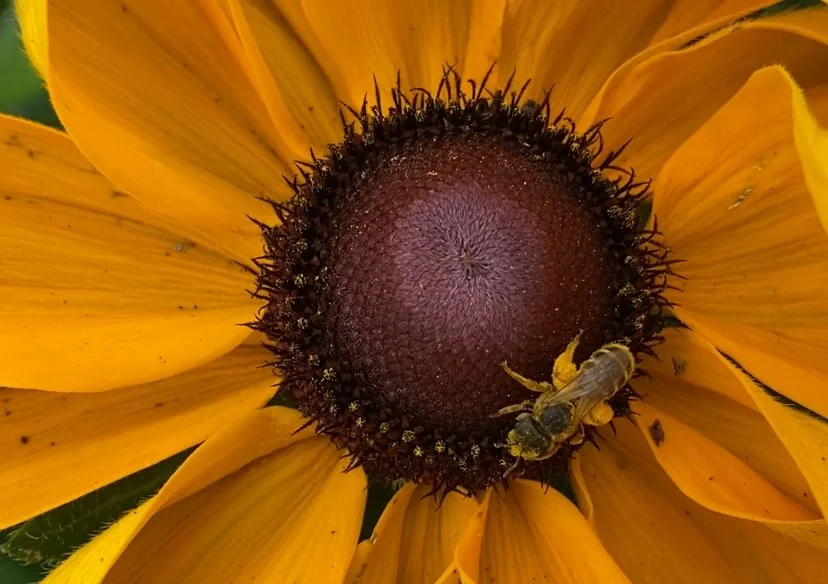
We live in a world that consumes the final product and rarely asks what it took to become what it is. Honey is one of the clearest examples of this. We hold a sixteen ounce jar in our hands and taste the sweetness, but we are blind to the formation behind it. We see the extracted fruit, but we do not honor the process that created it. We enjoy honey void of formation, and in doing so we miss the deeper truth that the Kingdom is never revealed in the outcome alone. It is revealed in everything required to get there.
People often walk into the garden and ask the same question. Do y’all harvest the honey. Do y’all sell it. But the truth is, The Neighborhood Garden Project does not own the bees. At our first site there are six hives and at our second there are three, each one funded, placed and stewarded by beekeepers who walk with us in relationship. The bees were not brought here for production. They were brought here for partnership. The hives live in harmony with the land and strengthen everything God is already doing. Any honey that has ever come from these colonies has flowed only through relationship, never transaction. It has been shared freely by the beekeepers into the community. Nothing is extracted for profit because the honey is not the point. The formation is.
And formation is staggering when you truly see it. A single pound of honey comes from nearly sixty ounces of nectar, gathered one drop at a time from roughly two hundred thousand flowers. To gather that nectar, bees fly fifty thousand miles or more. A single sixteen ounce jar represents the lifetime work of almost a thousand bees. And honey is so perfectly formed that it can be preserved for centuries. Archaeologists have opened ancient tombs and found honey still intact, still edible, still carrying the labor and alignment of the colony that produced it. A jar of honey is the distilled essence of a community that spent its entire existence living in alignment with design. The sweetness in your hand is simply the smallest, most visible part of something much larger, deeper and hidden. When you understand what it took, the sweetness reaches the soul.
And this is where the deeper problem sits. The systems we live in have conditioned us to stop being curious. They have trained us to accept things as they are, to take the final product at face value, to not ask questions anymore. Curiosity is the first step of formation, and yet most of us have been shaped to live without it. We see honey in a jar and never wonder what it took. We see fruit but never consider the becoming. We settle for sweetness without understanding and call that normal, but it is not the way of the Kingdom. The Kingdom invites us to look deeper, to ask, to notice, to seek, to trace the story behind the sweetness. Curiosity reopens the door to formation, and honey becomes one of the clearest invitations to recover the wonder we lost.
To understand honey, you also have to understand the life of the bee itself. A honeybee lives only four to six weeks in the warm months, yet in that short span she experiences more than most creatures ever will. Her life begins in darkness inside the comb, surrounded by the hum and warmth of a colony moving as one. Before she ever sees the world, she learns the scent of home, memorizes the vibration of the hive and grows inside perfect order.
When she emerges, her first experience is light filtering through thousands of wings. She is greeted by the warmth generated by her sisters’ bodies and the queen’s pheromone moving softly through the hive. She begins her life as a cleaner, preparing empty honeycomb cells for the next generation. She experiences responsibility before freedom. She feels purpose before she ever flies.
Soon she becomes a nurse bee, and this is where she first tastes the miracle of nurturing life. She produces royal jelly from glands in her head and feeds larvae that will one day become workers like herself or even the next queen. She experiences the hive’s heartbeat as she tends the brood. She senses subtle temperature changes and works with thousands of others to keep the nursery at a perfect ninety five degrees. She smells the unique blend of wax, nectar, pollen and pheromones that make up the living fragrance of the hive.
Next she becomes a house bee, and here she encounters the first taste of sweetness she will ever handle. She receives nectar from returning foragers and begins the slow process of transforming it into honey. She adds enzymes, spreads it across the comb and fans her wings for hours to evaporate the water from it. She may never taste the finished honey, but she experiences every stage of its formation. She learns the weight of filled comb, the soft click of bees sealing cells with wax and the gentle thrum of thousands fanning in perfect unity. She is surrounded by order, by rhythm, by the oneness of many.
And then comes the most important truth of all. A worker bee is not born a forager. She becomes one. Her entire life is a movement outward. She begins in the hidden places of the hive doing internal work, and she ends her life outside the hive doing external work. This slow outward expansion is her formation. It is the unfolding of her identity. It is the natural progression of assignment that increases only as she matures.
She does not start where she will finish. She is not immediately trusted with flight, distance, risk or the weight of the colony’s survival. She is trained first in the unseen, slow, inside work. She learns the rhythms of the hive. She learns what life requires. She learns what sweetness costs. Before she ever gathers a drop of nectar, she spends her earliest days tending new life, cleaning comb, preparing cells and caring for brood. These early roles cultivate humility, awareness and instinct. They root her in the truth that the hive does not revolve around her but around unity, order and shared responsibility.
Only after she has been shaped by the inner work does she graduate to the roles that carry more weight. She learns to handle nectar. She learns to build wax. She learns to fan the hive, guard the entrance and tend to honey in its early stages. She learns to move with thousands of others as if one mind guides them. Her formation is not about skill alone. It is about learning how to live surrendered to the rhythm of the whole.
This is why she cannot skip steps. A bee who has not cared for brood will not understand what the hive is protecting. A bee who has not processed honey cannot grasp the importance of gathering nectar. A bee who has not fanned the hive cannot understand the urgency of temperature or season. Her early roles shape her instincts, deepen her understanding and prepare her for the assignment that will define her final weeks.
Only then, after she has been formed by these hidden responsibilities, is she ready to become a forager. Only then is she given the sky. Only then does she carry the weight of the colony’s future on her small wings. Her previous formation becomes the foundation that steadies her when she faces wind, predators, storms, exhaustion and the long distances required to bring sweetness home. She becomes a forager not because she is strong enough but because she is formed enough.
Then everything changes. She becomes a forager, and the hive opens the world to her. She sees sunlight for the first time. She feels wind lift her body. She memorizes landmarks and learns the landscape through ultraviolet vision humans will never have. She sees patterns on flowers that are invisible to us, guides built into creation just for bees. She experiences the thrill of flight and the precision required to return home with accuracy that defies logic.
She drinks nectar from clover, vetch, horsemint, wildflower, goldenrod and every bloom God scatters across her flight path. She tastes the land itself. She collects pollen in baskets on her legs, carrying the dust of life back to her sisters. She reads the sky for storms, dodges predators, survives gusts of wind and pushes her small body farther than it should ever be able to go.
She dances. Inside the hive, she performs the waggle dance to show her sisters exactly where the nectar is located. She communicates distance, direction and quality through movement. She experiences communication so refined it becomes worship. Her work becomes part of a larger symphony of alignment.
But her life is not without cost. Her wings slowly fray with every mile. The edges tatter like worn cloth. Her flight becomes harder. Her return trips become slower. Eventually her body gives out on the path she has flown hundreds or even thousands of times. She dies in the rhythm she was created to live. She does not retire. She does not resist. She gives her entire life to her assignment.
She lives with purpose. She lives aligned. She lives whole.
And honey is the condensation of all she experienced, all she gave, all she became. It carries her miles, her flowers, her labor, her unity with the hive and her hidden obedience. Every drop is a record of her becoming. Every jar is the testimony of countless lives poured out for something sweet.
This is the Kingdom. The sweetness is real, but the sweetness is not the point. The process is the point. The bees do not strive. They do not compare themselves. They do not chase position. They do not run from their assignment. They simply live what they were made to be, and honey becomes inevitable. The final jar only exists because the formation was embraced, not bypassed. Every bee knows its place in the story. Every role matters. The nectar forager cannot replace the nurse bee. The wax builder cannot replace the queen. The guard cannot replace the house bee. The strength of the hive is not in one heroic worker but in the harmony of many small obediences. Honey is the byproduct of a community living in alignment. It is the natural result of design, not the reward for performance.
This is why understanding the process makes the honey sweeter. When you taste honey without knowing what it took, the sweetness stays on the tongue. When you taste honey with understanding, the sweetness settles deeper. God hid a Kingdom pattern inside a colony of insects. Formation is slow. Multiplication takes time. Fruit is born through unity. Sweetness flows from alignment, not striving. People want the sweetness of the Kingdom without the formation that produces it. They want the jar without the miles. They want the harvest without the hidden obedience. They want the honey without the hive. But the Kingdom does not work that way. Sweetness does not come from extracting the visible. Sweetness comes from becoming who you were designed to be, faithfully, quietly and consistently.
When you understand what it takes for one jar of honey to exist, you begin to understand what it takes for one life to bear Kingdom fruit. Formation is not glamorous. It is steady. It is repetitive. It is deeply relational. It is unseen by the world but witnessed by God. The bees show us that God is not impressed with production. He is moved by alignment. They show us that the visible harvest is always the smallest expression of the unseen work. They show us that when a community lives from identity and assignment, the honey will flow.
In that way, the bees are not simply part of the garden. They are some of its clearest teachers. Their honey is not the harvest. Their formation is.