Returning to Participation
Garden Culture, Reassurance, and the Alignment We Forgot
By Josh Singleton | Founder, serving as Lead Cultivator, The Neighborhood Garden Project
For a long time, garden culture taught me that responsibility meant outsourcing. We outsource fertility, biology, timing, and judgment. We import finished compost. We apply products that promise balance. We flip beds to reset the clock. None of this is malicious. Much of it works. Plants grow. Beds perform. But somewhere along the way, participation quietly disappears.
I didn’t step away from the garden. I stepped away from the process that makes a garden alive.
Outsourcing creates efficiency, but it also creates distance. When fertility arrives in bags and biology is delivered on demand, the system no longer needs attention. It only needs compliance. Follow the schedule. Apply the input. Clear the residue. Start again. Over time, the garden becomes predictable, and predictability dulls curiosity. What we often call stewardship becomes management, and management flattens readiness into dates and outcomes.
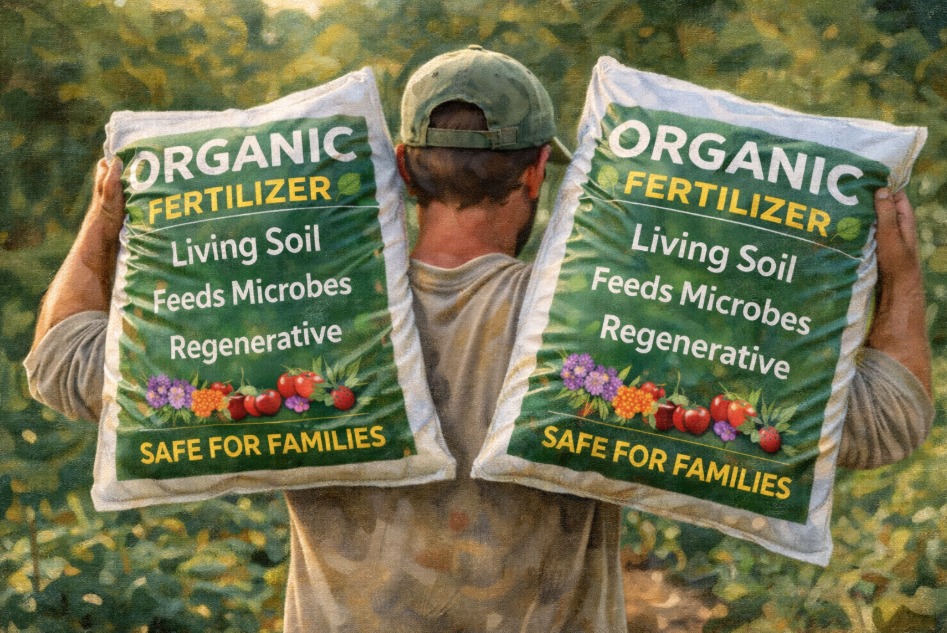
Modern garden culture reinforces this flattening through reassurance. Walk into any garden center and you are surrounded by calming promises. Natural. Living soil. Feeds microbes. Works with nature. Safe for families. These words are not false, but they are carefully chosen. They are meant to settle unease and offer peace of mind. The promise being sold is not just healthier plants, but certainty. You are doing the right thing. You can relax now.
Companies like Microlife speak fluently in this language. Their emphasis on soil life and organic inputs resonates with gardeners who genuinely want to care for the land. Much of what they say is true. Organic nutrients behave differently than salts. Microbial life matters. Slow release is gentler than force. These distinctions are real.
But reassurance itself has become a product.
A profit-driven system cannot sell patience, attentiveness, or soil maturity. It can only sell inputs. So buying becomes synonymous with stewardship. Application replaces observation. Readiness is standardized into instructions on a bag. The garden stays externally supported, productive, and young. It performs well, but it does not deepen.
The shift for me did not come from learning a better method. It came from stopping. I stopped flipping beds. I stopped mixing things in. I stopped reaching for solutions when uncertainty showed up. What replaced those habits was not neglect. It was presence. Leaves stayed where they fell. Roots stayed in the ground. Beds were allowed to differentiate inch by inch instead of being kept uniform for convenience.
Almost immediately, the garden became interesting again.
I found myself watching broccoli leaves wither in place. Not to see how fast they would break down, but to see what they would tell me. How long they held their shape. How moisture lingered beneath them. When the soil cooled. When it smelled sweet instead of sharp. I began adjusting planting schedules not based on dates or charts, but on readiness. I learned when I could gently move residue aside and plant, and when waiting another week would cost nothing and give more.
This kind of attention feels foreign because culture has trained us out of it. We remove residue because it looks messy. We rush timing because delay feels inefficient. We intervene because we do not trust systems to organize themselves. But life does not respond to demand. It responds to conditions. The garden will always reveal this if we let it.
As this posture took root, I began seeing the pattern everywhere. Trust is missing in the culture, and when trust disappears, readiness gets flattened. We replace discernment with schedules. We replace patience with pressure. We replace participation with outsourcing. The result is not just shallow soil. It is shallow formation.
That realization sharpened when I faced a simple, unavoidable question. I had bought more MicroLife than I care to admit. Enough that I began wondering how I would grow vegetables outside their service region. They are not a wholesale company with locations nationwide. And this project is meant to expand.
That question wasn’t about supply.
It was about structure.
If a garden depends on a product, then its future depends on trucks, regions, pricing, and availability. That works at one site. It works at a few. But it quietly collapses the moment the work grows beyond where reassurance can be delivered. Living systems do not scale by replicating inputs. They scale by reproducing processes.
Compost that must be purchased does not scale.
Biology that must be applied does not scale.
Fertility that arrives in bags does not scale.
What scales is what closes the loop. What grows here feeds here. What finishes here stays here. Leaves are returned. Roots are left to decay and build structure. Timing is learned through observation rather than imposed through instruction. The system no longer asks what to apply next. It asks what is already present.
Then there was a moment that settled everything in my body. The joy that filled me when I shredded what had been planted and returned it to the bed was undeniable. Not because something new was going in, but because something was being completed. The plant had grown. It had fed us. And now it was feeding the place that held it. The roots stayed. The channels stayed. The memory stayed.
Leaving roots in the ground changed my understanding of stewardship. I was no longer cleaning the bed for the next crop. I was honoring the one that had finished. That act did not feel efficient. It felt aligned. I was no longer interrupting the system to keep it moving. I was moving with it.
This is not about finding a better way to garden. It is about alignment. Alignment with how living systems actually work. Alignment with timing that cannot be rushed. Alignment with trust that formation happens when conditions are honored rather than overridden. Tools can support a system, but they cannot replace relationship. Reassurance can open a door, but it cannot carry you all the way through.
I am done now. Not burned out. Not disillusioned. Complete in a way I had not been before. I have entered full participation. The garden no longer asks me to manage it. It asks me to stay. To watch. To return what has been planted. To trust readiness.
That joy I felt was not sentimental.
It was a signal.
Alignment had been restored.
And once you feel it, you know you are home.